
Switzerland Delays Crypto Tax Sharing Rule to 2027 — What It Means for Investors


Switzerland delays implementation of cross-border crypto information exchange until 2027


Switzerland has announced a delay in the activation of its crypto account data sharing framework with international tax authorities, extending the timeline to 2027. Although the crypto-asset reporting framework (CARF) remains enshrined into law on January 1, 2026, the Swiss government will not begin exchanging crypto account information with partner nations until at least a year later. The delay stems from ongoing deliberations regarding which countries will be included in the data-sharing agreements.


The Organisation for Economic Co-operation and Development (OECD) approved CARF in 2022 as part of a global effort to combat tax evasion through increased transparency in crypto holdings. While 75 countries have signed up to implement CARF over the next two to four years—covering jurisdictions such as Switzerland—some nations like Argentina, El Salvador, Vietnam, and India have yet to commit. Switzerland had previously indicated that their first data exchange was scheduled for 2027, but recent statements suggest uncertainty surrounding the immediate timeline for data transfers.


The Swiss Federal Council and the State Secretariat for International Finance explained that their tax committee has paused discussions on partner states for the arrangement, resulting in the postponement. The government also cited amendments to local crypto tax laws and transitional provisions aimed at easing compliance for domestic crypto firms as part of recent regulatory updates. In June, Switzerland moved forward with a bill to adopt CARF rules in January 2026, with intentions for the initial data exchange to begin the following year.
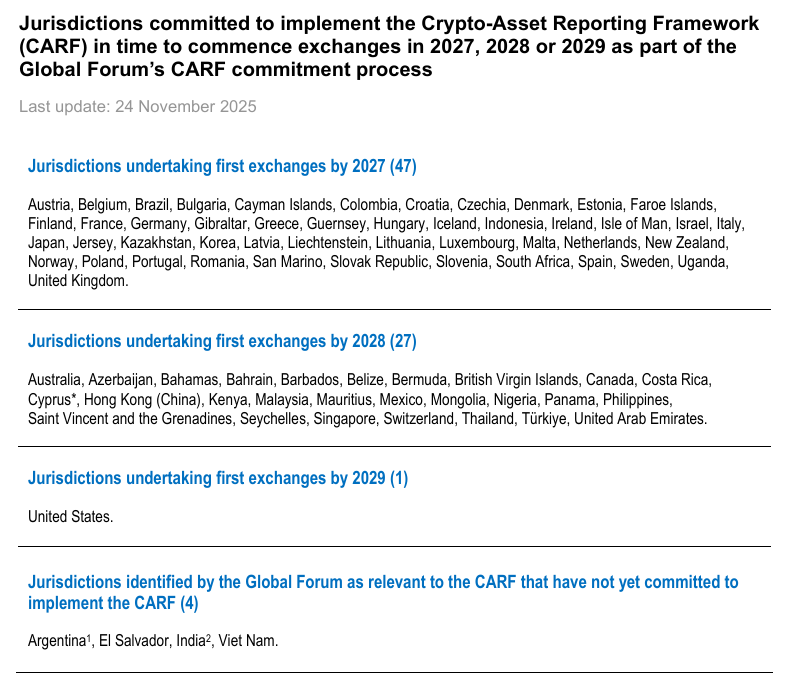


List of jurisdictions implementing CARF
List of jurisdictions implementing CARF. Source: OECD


In the broader context, the adoption of CARF reflects an increasing push worldwide to enhance transparency in cryptocurrency holdings and enforce tax compliance. Countries such as Brazil are contemplating similar measures; recent reports indicate Brazil is evaluating a tax on international crypto transfers to align with OECD standards. Meanwhile, the U.S. government’s White House is revisiting proposals for the IRS to join CARF, aiming to establish more rigorous capital gains tax reporting for Americans utilizing foreign exchanges.


As regulatory frameworks evolve, the crypto industry continues to face heightened scrutiny from authorities worldwide, emphasizing the importance of compliance amid ongoing efforts to combat tax evasion and promote transparency in the digital asset space.


https://www.cryptobreaking.com/switzerland-delays-crypto-tax-sharing/?utm_source=blogger%20&utm_medium=social_auto&utm_campaign=Switzerland%20Delays%20Crypto%20Tax%20Sharing%20Rule%20to%202027%20—%20What%20It%20Means%20for%20Investors%20

Comments

Popular posts from this blog

Coinbase's x402 launches AI agents app store for payments

Coinbase-backed x402 has unveiled Agentic.market, a dedicated marketplace aimed at increasing the usefulness of AI agents by aggregating thousands of apps and services that agents can access without any API keys. The rollout positions the platform as a central hub for agents to discover, evaluate, and deploy capabilities across a standardized payments layer. Coinbase product lead Nick Prince described Agentic.market in a video posted on X as a storefront for discovering, comparing, and using x402 services. The marketplace is designed to give both humans and their AI agents access to a wide range of tools—from data feeds to consumer apps—without the friction of managing API credentials. A storefront for discovering, comparing, and using x402 services. Thousands of services. Zero API keys. Powered by x402. Prince added that the market offers a web interface for humans to browse and assess services, alongside a programming layer that lets AI agents autonomously search, filter, and integra...

Top Cryptocurrencies to Watch: BTC, ETH, BNB, XRP, Solana, Dogecoin & More

Market Analysis and Price Predictions for Key Cryptocurrencies Recent market dynamics reveal a cautious sentiment across the cryptocurrency landscape, with Bitcoin struggling to maintain levels above $90,000 and many major altcoins facing downward pressure. Indicators point toward reduced participation from both institutional and retail investors, raising concerns about a potential consolidation phase after notable gains earlier in the year. Bitcoin has fallen below $87,000, reflecting waning demand at higher price points. Institutional fund flows into BTC and ETH ETFs have turned negative, indicating a period of subdued market activity. Active addresses and Binance deposit/withdrawal activities are at annual lows, suggesting market indecision. Most leading altcoins are approaching support levels, with some poised for potential breakdowns. Tickers mentioned: Bitcoin, Ethereum, Binance Coin, XRP, Solana, Dogecoin, Cardano, Bitcoin Cash, Chainlink, Hyperliquid Sentiment: Neutral to Sli...

Analyst: Bitcoin can reclaim $100K without a new narrative

Bitcoin has stalled below the $100,000 threshold, marking a run of almost five months without a breakout above that level. As of the latest market close, BTC hovered around $78,250 after a February nadir of about $60,000, underscoring a slow, grinding recovery amid broader market dynamics. In parallel, tech markets—especially AI-focused equities—have captured the spotlight, with investors rotating capital away from crypto in search of different risk-reward profiles. Nvidia (NVDA), the leading AI stock by market cap, has gained about 5.08% since the start of the year, while Bitcoin has faced a roughly 10% dip over the same period, illustrating a diverging performance within risk assets. MN Trading Capital founder Michael van de Poppe suggested that Bitcoin may not require a fresh narrative to push back above $100,000. In a post on X, he asked what narrative would drive BTC to the milestone and concluded that “price moves upwards, and the narrative will create itself.” He continued that ...