
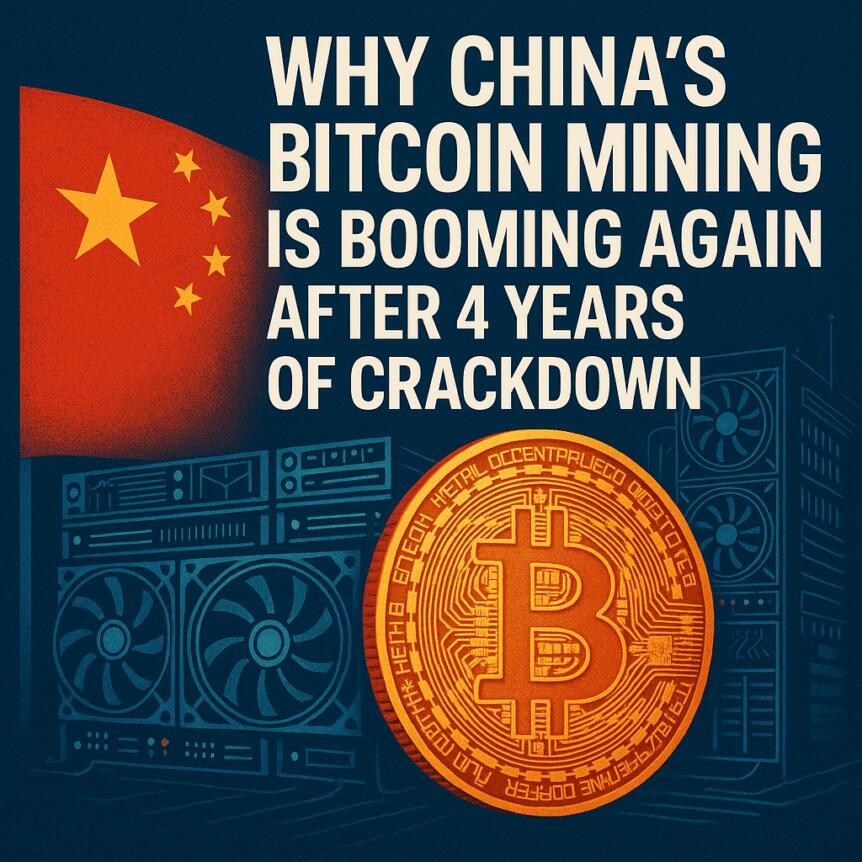
From dominance to ban: The 2021 crackdown
China played a pivotal role in global Bitcoin (BTC) mining, accounting for approximately 65% of the world's hashing power in 2020, according to the Cambridge Bitcoin Electricity Consumption Index. However, in 2021, the Chinese government took decisive action to curb mining activities, citing concerns over financial risks, capital flight, and high electricity consumption. In September of that year, the People’s Bank of China officially declared all cryptocurrency transactions illegal, reinforcing a nationwide ban on mining operations.
The immediate fallout was a significant drop in the global Bitcoin hash rate, as many Chinese miners shuttered operations or relocated their hardware to countries like the United States, Kazakhstan, and Russia. Despite China's ban, overall electricity consumption by Bitcoin miners continued to climb, driven by a surge in mining activity elsewhere. Global electricity usage for Bitcoin mining increased from 89 terawatt-hours (TWh) in 2021 to roughly 121.13 TWh in 2023, reflecting a resilient and expanding industry.

The 2024-2025 recovery of mining operations
Recent developments indicate a resurgence of Bitcoin mining activities in China, albeit on a smaller scale compared to the early days of large-scale farms. Data from Hashrate Index reports that as of October 2025, China now accounts for about 14% of global Bitcoin mining capacity, making it the third-largest mining country after the United States and Kazakhstan. Further estimates by CryptoQuant suggest that the actual share could be between 15% and 20%.
Industry indicators support this resurgence, including increased sales from Canaan, one of China's leading manufacturers of Bitcoin mining hardware. The company's revenue share from China grew from a mere 2.8% in 2022 to over 30% in 2023, with industry sources estimating it surpassed 50% in the second quarter of 2025.
Bitcoin’s network is secured by miners solving complex cryptographic puzzles, and no single entity has maintained long-term control. The geographic shifts spanning China, the US, and Central Asia underscore its resilience in the face of political and economic disruptions.
Underlying reasons for China's mining resurgence
According to a Reuters report, mining operations have restarted in regions like Xinjiang and Sichuan, which are rich in energy resources. Xinjiang benefits from abundant coal and wind power, often producing more electricity than it can transmit to coastal cities, making surplus energy readily available for mining. Similarly, Sichuan's low-cost hydropower during the rainy season provides an attractive environment for mining companies.
Local governments have also developed large-scale data centers, which, during periods of low demand, can rent out space and power to miners. The combination of rising Bitcoin prices since 2024 and surplus energy availability has further fueled this activity. Key contributing factors include:
- Availability of inexpensive or underutilized power: Regions like Xinjiang and Sichuan offer surplus energy suitable for mining.
- Excess capacity in data centers: Overbuilt infrastructure seeks operational clients, including miners.
- Favorable Bitcoin price environment: Rising prices, supported by policy shifts in the US, enhance mining profitability.
Geographically, the mining resurgence is concentrated in power-rich areas such as Xinjiang, known for its coal and wind resources, and Sichuan, famed for its hydroelectric capacity. As the cycle of Bitcoin halving—occurring every four years—approaches, affecting miner rewards and supply, the industry remains adaptable and resilient, navigating political and market shifts.
Did you know? Bitcoin undergoes halving every four years, reducing miner rewards by 50%. This built-in scarcity mechanism is a key driver of long-term market cycles and supply dynamics.
https://www.cryptobreaking.com/why-chinas-bitcoin-mining-is/?utm_source=blogger%20&utm_medium=social_auto&utm_campaign=Why%20China's%20Bitcoin%20Mining%20Is%20Booming%20Again%20After%204%20Years%20of%20Crackdown%20
Comments
Post a Comment