

Bitcoin's Year-End Course Diverges from Stocks Amid Volatile Market Trends
The second half of 2025 has been characterized by a notable divergence between Bitcoin and traditional equity markets. While US stocks have experienced robust gains, Bitcoin has faced significant volatility, including a nearly 18% decline over six months, contrasting sharply with the Nasdaq’s 21%, S&P 500's 14.35%, and Dow Jones’ 12.11% increases. Despite this, Bitcoin continues to reach key milestones, including setting new all-time highs and avoiding the customary "red September" for three consecutive years.
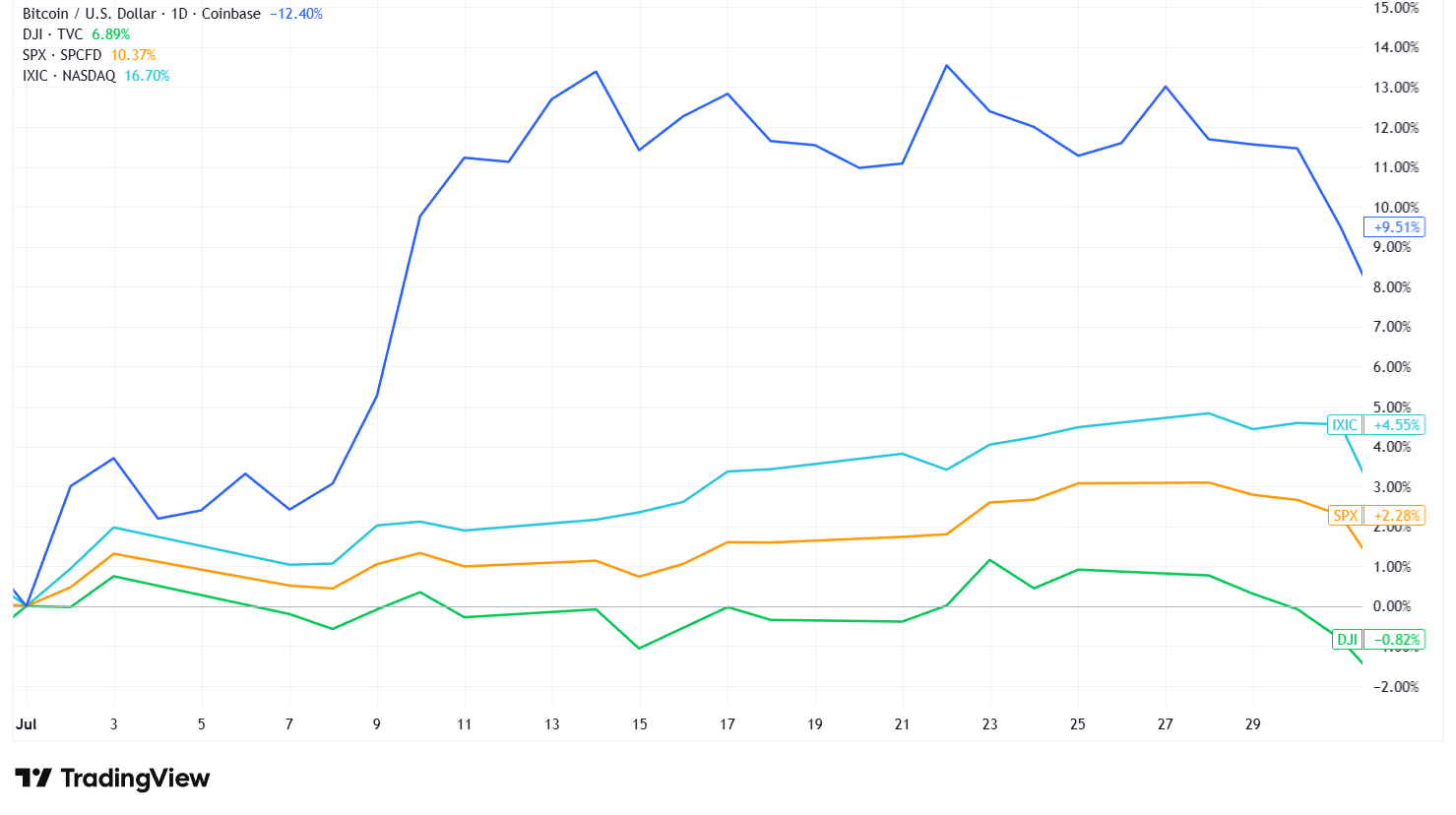
Market dynamics in July highlighted resilient risk appetite, with equities maintaining their upward trajectory despite tariff threats. Notably, Nvidia's milestone of becoming the first company to reach a $4 trillion valuation was a standout event. On the same day, US equities hit new records, an impressive feat considering 50% tariffs on copper. Bitcoin responded to macroeconomic optimism with an 8.13% monthly gain—the strongest since late 2024—after the US Congress passed the GENIUS Act into law, boosting confidence in stablecoins and broader crypto adoption. Corporations continued to diversify their treasury holdings by adding Bitcoin, with increasing interest also observed in Ethereum and Solana.
August transactions saw Bitcoin reach a new record high of approximately $124,000 amid weakening US dollar strength and escalating trade tensions. The Jackson Hole Economic Symposium prompted Federal Reserve Chair Jerome Powell to deliver dovish signals about potential rate cuts. This optimism propelled Ether to new highs, though Bitcoin’s momentum was short-lived, with the asset retreating to end the month down 6.49%, diverging from equities that maintained a rally on expectations of continued monetary easing.
September defied historical trends, posting a 5.16% increase even as the Fed delivered its first rate cut of 2025—a move traditionally associated with August and later months. However, internal divisions within the Bitcoin community emerged over a proposed network upgrade that would lift data limits—support from Bitcoin Core contrasted with pushback from advocates of alternative implementations like Bitcoin Knots.
October was marked by the largest liquidation event in Bitcoin’s history, with approximately $19 billion wiped out, exacerbated by a sharp drop below $110,000 following a social media post by President Trump threatening heavy tariffs on China. Despite the month’s reputation as "Uptober" for bullish sentiment, Bitcoin posted a 3.69% decline, ending its five-year streak of positive October returns.
November emerged as a period of concern as Bitcoin fell 17.67%, its worst performance of the year, amid extended market cautions following the end of the government shutdown. Still, broader markets recovered, helped by record earnings reports like Nvidia’s, and investors watched for stabilization signals. As December progresses, Bitcoin has modestly gained around 2%, but many analysts have scaled back their year-end forecasts. Standard Chartered, for instance, revised its target from $200,000 to $100,000, citing increased market uncertainty amid macroeconomic headwinds.
https://www.cryptobreaking.com/bitcoin-breaks-free-from-stocks/?utm_source=blogger%20&utm_medium=social_auto&utm_campaign=Bitcoin%20Breaks%20Free%20from%20Stocks%20in%20Second%20Half%20of%202025:%20What%20Investors%20Need%20to%20Know%20
Comments
Post a Comment