
Crypto Retention Insights: Why Platforms Fail to Keep Users Engaged


Crypto Platforms Seek to Improve User Engagement Through Prediction Markets


Maintaining consistent user activity on cryptocurrency platforms remains a significant challenge, despite initial interest in onboarding new users. Recently, analytics and prediction market trends have shed light on this ongoing issue, highlighting the difficulty crypto projects face in fostering sustained engagement beyond the early stages.


Data compiled by analytics firm Dune and market maker Keyrock analyzed monthly cohorts of new active users across 275 crypto projects, including networks, decentralized finance (DeFi) platforms, wallets, and trading applications. The findings revealed that Polymarket’s retention rate exceeded over 85% of other protocols sampled, indicating relatively strong user retention. However, overall, the study emphasizes how rare long-term engagement remains within the crypto sector. Low retention rates are especially critical in markets that rely on frequent participation and liquidity, as weak user retention can signal superficial growth or declining activity.
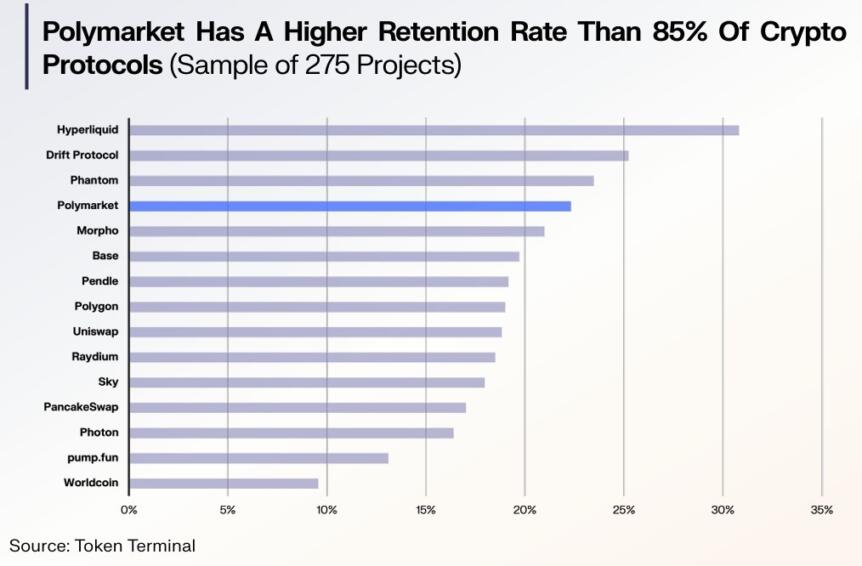


Polymarket retention rate versus crypto entities. Source: Token Terminal


Why Prediction Markets Are Attractive for Crypto Platforms


Prediction markets introduce a different kind of engagement compared to traditional crypto apps. By anchoring activities to real-world events such as elections, sports competitions, or macroeconomic data releases, these markets create recurring reasons for users to come back. This event-driven approach fosters more frequent participation, moving beyond the typical short-term speculation that often characterizes crypto trading. Consequently, prediction markets can help reduce dependency on incentives to sustain activity, encouraging habitual usage rather than one-off trades.


This strategic shift may explain why leading crypto platforms are increasingly experimenting with integrating prediction markets into their offerings. Platforms recognizing the challenge of maintaining continuous activity amid periods of low volatility may see value in features that promote regular engagement, establishing a more stable user base.


Crypto Entities Entering the Prediction Market Arena


Several notable crypto organizations are making strides into prediction markets. Coinbase, Gemini, Phantom, and Bitnomial Clearinghouse are among the firms signaling their entry into this sector. Recently, Bloomberg reported that Coinbase plans to launch tokenized equities and prediction markets, following leaks from researcher Jane Manchun Wong indicating upcoming features on the platform.


Meanwhile, Phantom announced a partnership with Kalshi, allowing users to trade tokenized event-based positions within their wallet app, enhancing user interaction with prediction markets. Additionally, Bitnomial received approval from the U.S. Commodity Futures Trading Commission (CFTC) to operate prediction markets and provide clearing services, marking a significant step for the industry. In the United States, Gemini launched an in-house prediction market available across all 50 states, aiming to integrate crypto trading and event-based betting into a single app experience.


https://www.cryptobreaking.com/crypto-retention-insights-why-platforms/?utm_source=blogger%20&utm_medium=social_auto&utm_campaign=Crypto%20Retention%20Insights:%20Why%20Platforms%20Fail%20to%20Keep%20Users%20Engaged%20

Comments

Popular posts from this blog

Mastercard Launches AI Agent Pay System With Ripple and Solana Help

Mastercard has launched Agent Pay for Machines, a payments system built for autonomous software agents. The service allows AI agents to send and receive payments without direct human action. It brings Ripple, Coinbase, and Solana Foundation into Mastercard’s push for automated digital commerce. Ripple Brings XRPL and RLUSD to Mastercard’s Agent Pay System Mastercard introduced Agent Pay for Machines on June 10 as a tool for machine-led payments. The system targets high-volume and low-value transactions across business and consumer use cases. It also supports automated settlement between software agents and connected machines. Ripple will support the system through the XRP Ledger and its RLUSD stablecoin. The company said that settlement will become more important as automated commerce grows. It also sees blockchain rails as useful for fast and rule-based payments. RippleX senior vice president Markus Infanger said XRPL and RLUSD support enterprise-grade agent payments. He said the tool...

Coinbase's x402 launches AI agents app store for payments

Coinbase-backed x402 has unveiled Agentic.market, a dedicated marketplace aimed at increasing the usefulness of AI agents by aggregating thousands of apps and services that agents can access without any API keys. The rollout positions the platform as a central hub for agents to discover, evaluate, and deploy capabilities across a standardized payments layer. Coinbase product lead Nick Prince described Agentic.market in a video posted on X as a storefront for discovering, comparing, and using x402 services. The marketplace is designed to give both humans and their AI agents access to a wide range of tools—from data feeds to consumer apps—without the friction of managing API credentials. A storefront for discovering, comparing, and using x402 services. Thousands of services. Zero API keys. Powered by x402. Prince added that the market offers a web interface for humans to browse and assess services, alongside a programming layer that lets AI agents autonomously search, filter, and integra...

Top Cryptocurrencies to Watch: BTC, ETH, BNB, XRP, Solana, Dogecoin & More

Market Analysis and Price Predictions for Key Cryptocurrencies Recent market dynamics reveal a cautious sentiment across the cryptocurrency landscape, with Bitcoin struggling to maintain levels above $90,000 and many major altcoins facing downward pressure. Indicators point toward reduced participation from both institutional and retail investors, raising concerns about a potential consolidation phase after notable gains earlier in the year. Bitcoin has fallen below $87,000, reflecting waning demand at higher price points. Institutional fund flows into BTC and ETH ETFs have turned negative, indicating a period of subdued market activity. Active addresses and Binance deposit/withdrawal activities are at annual lows, suggesting market indecision. Most leading altcoins are approaching support levels, with some poised for potential breakdowns. Tickers mentioned: Bitcoin, Ethereum, Binance Coin, XRP, Solana, Dogecoin, Cardano, Bitcoin Cash, Chainlink, Hyperliquid Sentiment: Neutral to Sli...