
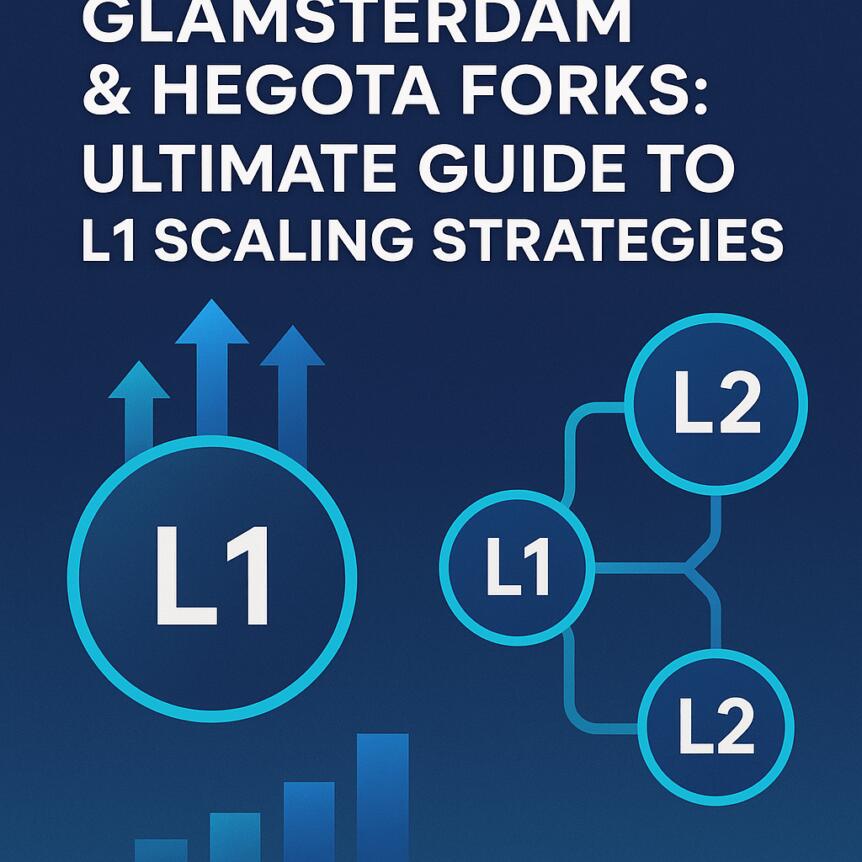
Ethereum Set for Major Scaling Advancements in 2026
The upcoming year promises transformative upgrades for Ethereum, targeted at significantly boosting its scalability and efficiency. Central to these developments is the Glamsterdam fork, scheduled for mid-2026, which aims to introduce perfect parallel processing capabilities and increase the network’s gas limit to 200 million from the current 60 million. Alongside, new consensus protocols and interoperability enhancements are expected to herald a new era of high-speed, low-cost transactions.
Key innovations include a transition of validators from executing transactions to verifying zero-knowledge (ZK) proofs. This shift is anticipated to propel Ethereum’s transaction processing capacity to around 10,000 transactions per second (TPS) and potentially higher, although reaching that milestone immediately remains uncertain. Additionally, data blobs per block could rise to 72 or more, allowing layer 2 solutions to even further scale transactions—potentially to hundreds of thousands per second.
The Glamsterdam Fork: Enhancing Parallel Processing
Developers are finalizing proposals for the Glamsterdam hard fork, expected to activate in 2026, which will incorporate several key Ethereum Improvement Proposals (EIPs). Notable among these are Block Access Lists and Enshrined Proposer Builder Separation. While these technical improvements may sound mundane, their impact could be substantial—enabling "perfect" parallel processing across the network.
Block Access Lists (EIP-7928) will allow transaction processing to occur on multiple CPU cores simultaneously by mapping dependencies within each block. This means transactions affecting different accounts or storage can be executed concurrently, dramatically increasing throughput without raising gas limits. "With Block Access List, we are getting all the state that changes from transaction to transaction, and you are putting that information in the block,” explained Gabriel Trintinalia of Consensys.
Meanwhile, the Enshrined Proposer Builder Separation (ePBS) separates the roles of block proposers and builders, addressing issues related to MEV and centralization. This separation not only improves decentralization but also enhances network security by affording validators more time to validate ZK-proofs, a critical step in scaling Ethereum’s throughput in conjunction with rollups and layer 2 solutions.
Future Gas Limit Increases and Scalability
The current gas limit of 60 million is expected to surge in 2026, with estimates ranging from 100 million to possibly 200 million after implementation of certain upgrades. Ethereum co-creator Vitalik Buterin anticipates targeted, incremental increases rather than uniform jumps, factoring in storage costs and smart contract complexities. Such expansions are key to accommodating increasing transaction demand without sacrificing decentralization or security.
In addition, the Heze-Bogota fork is expected to focus on censorship resistance through mechanisms like Fork-Choice Inclusion Lists, ensuring transaction inclusion even amid contentious scenarios. These innovations collectively highlight Ethereum's ongoing efforts to enhance scalability, privacy, and resilience as it approaches its network upgrade milestones in 2026.
https://www.cryptobreaking.com/glamsterdam-hegota-forks-ultimate-guide/?utm_source=blogger%20&utm_medium=social_auto&utm_campaign=Glamsterdam%20&%20Hegota%20Forks:%20Ultimate%20Guide%20to%20L1%20Scaling%20Strategies%20
Comments
Post a Comment