Ledger Chips Flaw Security Breach Lets Hackers Fully Control Phones


Critical Vulnerability in Smartphone Chips Poses Security Risks for Crypto Holders


A widely used smartphone component, the MediaTek Dimensity 7300 system on chip (SoC), has been identified by security firm Ledger as harboring an unfixable vulnerability that could threaten private key security for mobile crypto wallets. The flaw, uncovered through targeted electromagnetic fault injection techniques, allows attackers to gain complete control over affected devices, potentially enabling them to steal sensitive cryptographic data.


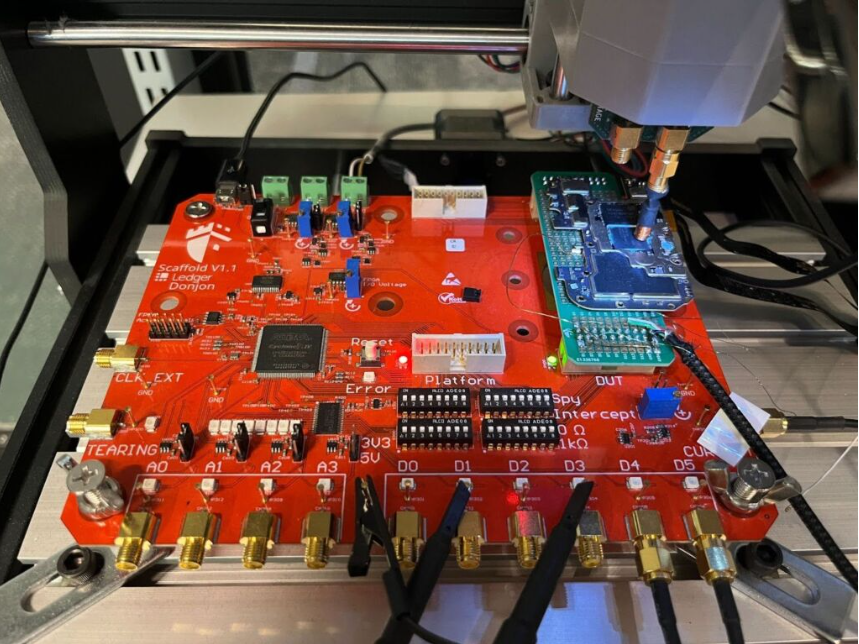
Ledger's security researchers Charles Christen and Léo Benito demonstrated that by using electromagnetic pulses during the initial boot process, they could bypass security measures embedded in the chip. This exploit exposes a significant risk for users storing private keys directly on their smartphones, as it could allow malicious actors to extract private keys and compromise digital assets.


“There is simply no way to safely store and use one’s private keys on these devices,” Christen and Benito emphasized. Their findings reveal that the fault injection vulnerability is embedded within the silicon, meaning it cannot be mitigated through software updates or patches. As a result, affected devices remain vulnerable indefinitely, even after disclosure of the flaw.


Wallet, Cybersecurity, Smartphone, Hacks
Ledger security engineers Charles Christen and Léo Benito exposed the vulnerability in MediaTek’s Dimensity 7300 chip via electromagnetic pulses. Source: Ledger


The chance of an attacker successfully executing this exploit is currently low, estimated between 0.1% and 1%. Nonetheless, its high speed—allowing repeated attempts every second—means an attacker could eventually succeed within minutes. Christen and Benito noted, “Given that we can try to inject a fault every 1 second or so, we repeatedly boot up the device, try to inject the fault, and if it does not succeed, we simply restart and try again.”


MediaTek States the Chip Isn’t Designed for High-Security Applications


MediaTek responded to the disclosures by clarifying that electromagnetic fault injection attacks are outside the scope of the MT6878 chip’s intended use. They emphasized that the chip is designed for consumer products and not for high-security applications such as financial transactions or hardware security modules (HSMs).


“It is not specifically hardened against EMFI hardware physical attacks. For products with higher hardware security requirements, such as hardware crypto wallets, we believe that they should be designed with appropriate countermeasures against EMFI attacks,” a MediaTek representative explained.


The security researchers began their investigation in February and successfully exploited the vulnerability in early May. Following their findings, they disclosed the issue to MediaTek’s security team, prompting updates to affected vendors. While the flaw’s low success rate limits immediate risks, the potential for rapid repeated attempts underscores the importance of hardware security considerations in mobile device manufacturing.


https://www.cryptobreaking.com/ledger-chips-flaw-security-breach/?utm_source=blogger%20&utm_medium=social_auto&utm_campaign=Ledger%20Chips%20Flaw%20Security%20Breach%20Lets%20Hackers%20Fully%20Control%20Phones%20

Comments

Popular posts from this blog

Mastercard Launches AI Agent Pay System With Ripple and Solana Help

Mastercard has launched Agent Pay for Machines, a payments system built for autonomous software agents. The service allows AI agents to send and receive payments without direct human action. It brings Ripple, Coinbase, and Solana Foundation into Mastercard’s push for automated digital commerce. Ripple Brings XRPL and RLUSD to Mastercard’s Agent Pay System Mastercard introduced Agent Pay for Machines on June 10 as a tool for machine-led payments. The system targets high-volume and low-value transactions across business and consumer use cases. It also supports automated settlement between software agents and connected machines. Ripple will support the system through the XRP Ledger and its RLUSD stablecoin. The company said that settlement will become more important as automated commerce grows. It also sees blockchain rails as useful for fast and rule-based payments. RippleX senior vice president Markus Infanger said XRPL and RLUSD support enterprise-grade agent payments. He said the tool...

Coinbase's x402 launches AI agents app store for payments

Coinbase-backed x402 has unveiled Agentic.market, a dedicated marketplace aimed at increasing the usefulness of AI agents by aggregating thousands of apps and services that agents can access without any API keys. The rollout positions the platform as a central hub for agents to discover, evaluate, and deploy capabilities across a standardized payments layer. Coinbase product lead Nick Prince described Agentic.market in a video posted on X as a storefront for discovering, comparing, and using x402 services. The marketplace is designed to give both humans and their AI agents access to a wide range of tools—from data feeds to consumer apps—without the friction of managing API credentials. A storefront for discovering, comparing, and using x402 services. Thousands of services. Zero API keys. Powered by x402. Prince added that the market offers a web interface for humans to browse and assess services, alongside a programming layer that lets AI agents autonomously search, filter, and integra...

Top Cryptocurrencies to Watch: BTC, ETH, BNB, XRP, Solana, Dogecoin & More

Market Analysis and Price Predictions for Key Cryptocurrencies Recent market dynamics reveal a cautious sentiment across the cryptocurrency landscape, with Bitcoin struggling to maintain levels above $90,000 and many major altcoins facing downward pressure. Indicators point toward reduced participation from both institutional and retail investors, raising concerns about a potential consolidation phase after notable gains earlier in the year. Bitcoin has fallen below $87,000, reflecting waning demand at higher price points. Institutional fund flows into BTC and ETH ETFs have turned negative, indicating a period of subdued market activity. Active addresses and Binance deposit/withdrawal activities are at annual lows, suggesting market indecision. Most leading altcoins are approaching support levels, with some poised for potential breakdowns. Tickers mentioned: Bitcoin, Ethereum, Binance Coin, XRP, Solana, Dogecoin, Cardano, Bitcoin Cash, Chainlink, Hyperliquid Sentiment: Neutral to Sli...