
From Encrypted Chats to Decentralized Messaging: The Next Evolution in Privacy
Encrypted messaging apps have long prioritized user privacy, but recent developments aim to push the boundaries further by decentralizing their architectures. These innovations focus on eliminating reliance on phone numbers, centralized servers, and metadata collection, addressing longstanding privacy concerns amid growing digital surveillance.
Key Takeaways
- Vitalik Buterin advocates for permissionless account creation with enhanced metadata privacy, supporting projects like Session and SimpleX.
- Session employs decentralized onion routing and public key identities, enabling private, peer-to-peer messaging without phone numbers or email.
- Trade-offs between user experience and privacy appear in notification modes; push notifications may expose device IPs, whereas slower polling offers increased privacy.
- Governance transitions to Swiss stewardship and transparency efforts aim to ensure accountability, but decentralization does not fully prevent government or adversarial access.
Tickers mentioned:
Tickers mentioned: $ETH
Sentiment:
Sentiment: Positive toward advancing privacy and decentralization solutions
Price impact:
Price impact: Neutral, as these developments reflect ongoing innovation rather than immediate market movements
Market context:
Market context: Growing user demand for privacy-aware messaging amidst increasing regulatory scrutiny fuels innovation in decentralized communication
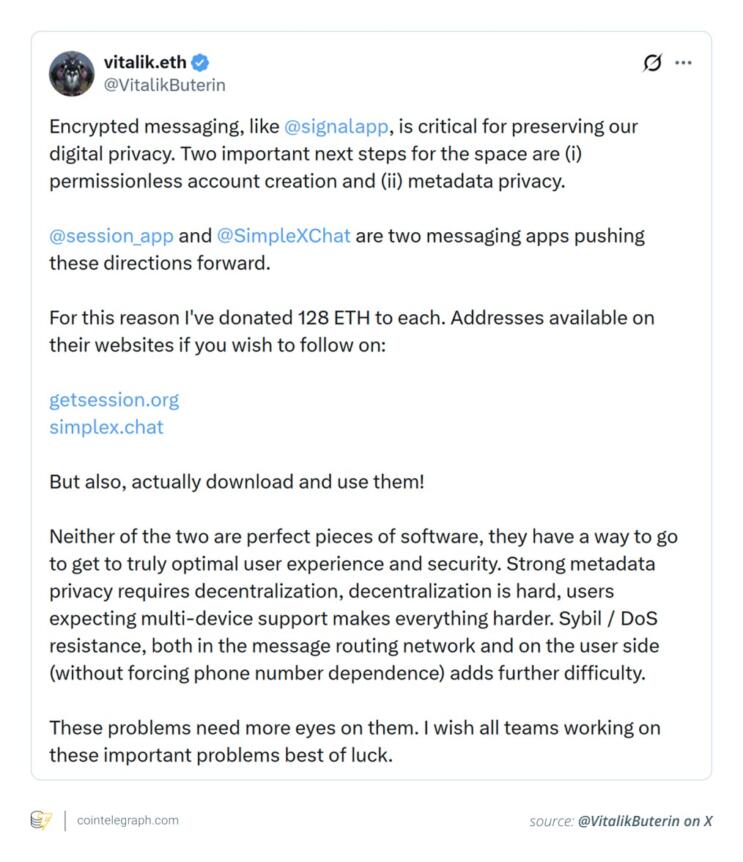
Recent efforts in the encrypted messaging landscape signal a significant shift toward decentralization, aiming to reduce metadata exposure while maintaining security. Vitalik Buterin, co-founder of Ethereum, has highlighted the importance of permissionless account setup and robust metadata privacy. Supporting projects like Session demonstrate how decentralized, onion-routed networks can deliver end-to-end encrypted messaging without relying on traditional phone number identifiers.
Session employs a unique architecture centered around public key identities. When registering, users generate a local key pair, avoiding the need for phone numbers or emails. Messages are routed through a network of nodes using onion routing, ensuring no single node can access both sender and recipient details. To facilitate offline messaging, Session stores messages encrypted in small groups of nodes called "swarms," which are linked to each user’s Session ID. This approach balances ephemeral network storage with persistent local storage, allowing users to scroll through chat history locally while minimizing on-network data retention.
Nonetheless, privacy choices involve trade-offs, especially regarding notifications. Session offers two modes: Slow Mode, which polls periodically for messages, and Fast Mode, which leverages push notifications. While the latter offers prompt alerts, it exposes device IP addresses and Session account IDs to infrastructure servers, raising privacy concerns. The team emphasizes that message contents remain end-to-end encrypted even in Fast Mode, though metadata may still be partially exposed.
Governance has shifted from the Australian Oxen Privacy Tech Foundation to a Swiss entity, Session Technology Foundation, which maintains transparency reports on law enforcement requests. Despite decentralization's benefits, authorities can request auxiliary data from infrastructure nodes, but cannot access encrypted message contents, provided protocols are adhered to.
Addressing future threats, Session's Protocol v2 aims to introduce post-quantum cryptography and perfect forward secrecy, though these features are still in development. Voice and video calling remains experimental and cautious users are advised to avoid enabling call features until privacy guarantees improve further.
Ultimately, these advancements illustrate both the promise and current limits of decentralized messaging. While offering stronger privacy protections, local device security and metadata leaks remain potential risks. As governments scrutinize digital communications and quantum computing advances threaten encryption, the evolution of secure messaging must incorporate decentralization, minimal metadata, and post-quantum readiness to truly safeguard user privacy in the long run.
https://www.cryptobreaking.com/the-future-of-secure-messaging/?utm_source=blogger%20&utm_medium=social_auto&utm_campaign=The%20Future%20of%20Secure%20Messaging:%20Why%20Decentralization%20Is%20a%20Game-Changer%20
Comments
Post a Comment