US Opposes DeFi Education Fund Brief Ahead of Possible MEV Case Retrial


US Court Rejects DeFi Education Fund's Amicus Brief in High-Profile Ethereum Exploit Case


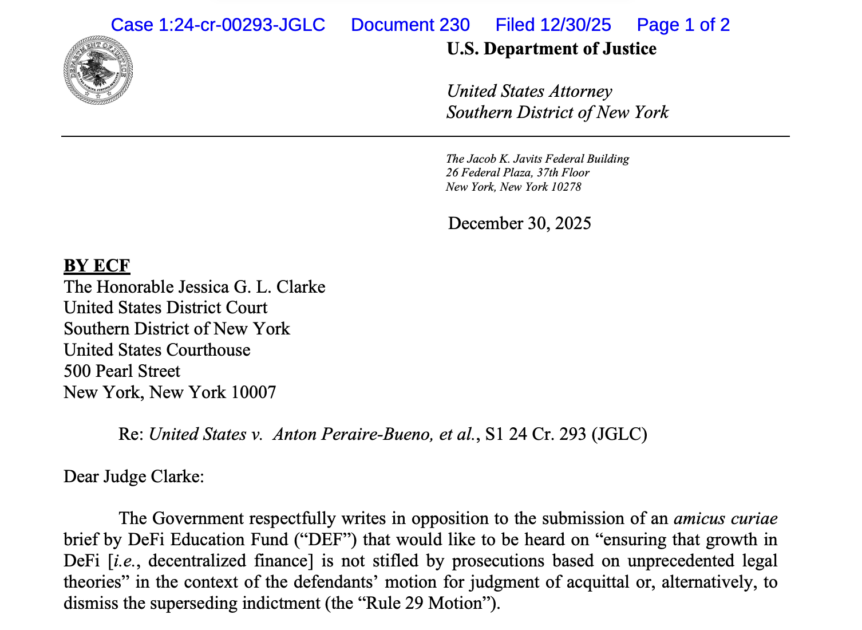
The US government has officially opposed efforts by the DeFi Education Fund (DEF) to submit an amicus brief in a controversial case involving allegations against two hackers accused of exploiting the Ethereum blockchain, resulting in a $25 million theft. The case has gained significant attention within the crypto community, raising questions about the legal boundaries of DeFi activities and automated trading bots.


Key Takeaways


  • The US government filed a letter in court opposing DEF’s amicus brief, claiming it offers no new insights.

  • The defendant brothers, Anton and James Peraire-Bueno, faced a mistrial in November after jurors failed to reach a verdict.

  • The government has requested a retrial, scheduled for late February or early March 2026.

  • Defense and advocacy groups argue the case could set a dangerous precedent impacting DeFi innovation.


Tickers mentioned: None


Sentiment: Neutral


Price impact: Neutral. The legal proceedings remain ongoing, with no immediate effect on market prices.


Trading idea (Not Financial Advice): Hold. The case's outcome is uncertain and likely to influence regulatory climate more than short-term price movements.


Market context: The case exemplifies the ongoing legal challenges faced by the DeFi and crypto industries amid increased regulatory scrutiny.


Legal Proceedings and Industry Impact


The case centers on allegations that the Peraire-Bueno brothers used automated maximal extractable value (MEV) bots to orchestrate the exploit. In November, Judge Jessica Clarke declared a mistrial after jurors could not reach a verdict on whether to convict or acquit the defendants, who face charges including conspiracy to commit wire fraud, money laundering, and conspiracy to receive stolen property. If convicted upon retrial, they could face a combined sentence of up to 60 years in prison.


Law, Ethereum, Court, Crimes, DeFi
Source: PACER


Advocacy groups like Coin Center had previously filed amicus briefs supporting the defendants’ right to a fair trial, though prosecutors opposed such submissions. The DEF’s draft brief argues that the case could have broader implications for DeFi development, citing fears that aggressive prosecution may chill participation and innovation within the ecosystem. DEF warns that overreach in such legal actions could sow confusion and hinder growth by creating uncertainty around regulatory expectations.


While the legal process unfolds, industry commentators continue to debate how this case may influence future regulatory approaches to automated trading strategies and blockchain exploits. As the trial progresses, it highlights the delicate balance regulators must strike between enforcement and fostering innovation in decentralized finance.


https://www.cryptobreaking.com/us-opposes-defi-education-fund/?utm_source=blogger%20&utm_medium=social_auto&utm_campaign=US%20Opposes%20DeFi%20Education%20Fund%20Brief%20Ahead%20of%20Possible%20MEV%20Case%20Retrial%20

Comments

Popular posts from this blog

Coinbase's x402 launches AI agents app store for payments

Coinbase-backed x402 has unveiled Agentic.market, a dedicated marketplace aimed at increasing the usefulness of AI agents by aggregating thousands of apps and services that agents can access without any API keys. The rollout positions the platform as a central hub for agents to discover, evaluate, and deploy capabilities across a standardized payments layer. Coinbase product lead Nick Prince described Agentic.market in a video posted on X as a storefront for discovering, comparing, and using x402 services. The marketplace is designed to give both humans and their AI agents access to a wide range of tools—from data feeds to consumer apps—without the friction of managing API credentials. A storefront for discovering, comparing, and using x402 services. Thousands of services. Zero API keys. Powered by x402. Prince added that the market offers a web interface for humans to browse and assess services, alongside a programming layer that lets AI agents autonomously search, filter, and integra...

Scaramucci Family Invests $100M in Trump-Backed Bitcoin Mining Firm

The recent investment in American Bitcoin highlights the growing interest and participation of prominent figures and families in the cryptocurrency mining sector, particularly in the United States. With over $100 million from the Scaramucci family’s Solari Capital and backing from notable entrepreneurs and investors, American Bitcoin is solidifying its position as a significant player in the evolving blockchain and crypto markets. This move underscores the increasing institutional and individual involvement in Bitcoin and related assets, shaping the future of the crypto industry amidst regulatory and market dynamics. The Scaramucci family’s private investment firm, Solari Capital, has committed over $100 million to American Bitcoin, a major U.S.-based mining company. American Bitcoin raised $220 million in a funding round before going public via reverse merger, with notable backers including Tony Robbins, Charles Hoskinson, Grant Cardone, and Peter Diamandis. The company ...

AML Fines Surpass SEC Cases, Elevating Crypto Regulatory Risk

Anti-money-laundering enforcement has overtaken securities violations as the principal regulatory threat facing crypto firms, according to CertiK’s State of Digital Asset Regulations report. The U.S. Department of Justice and the Financial Crimes Enforcement Network together imposed more than $1 billion in AML-related fines during the first half of 2025. The development signals a sharp regulatory pivot away from the Securities and Exchange Commission-led enforcement cycle that once dominated crypto compliance discourse. CertiK notes that SEC crypto-specific penalties collapsed in value, falling from $4.9 billion in 2024 to about $142 million in 2025, a trend the firm attributes to shifts in policy priorities and jurisdictional focus. According to CertiK’s findings, transaction-monitoring and licensing lapses are now generating penalties that rival or exceed many prior securities cases. High-profile settlements illustrate the trend: the Department of Justice’s February 2025 resolution w...