
Introduction
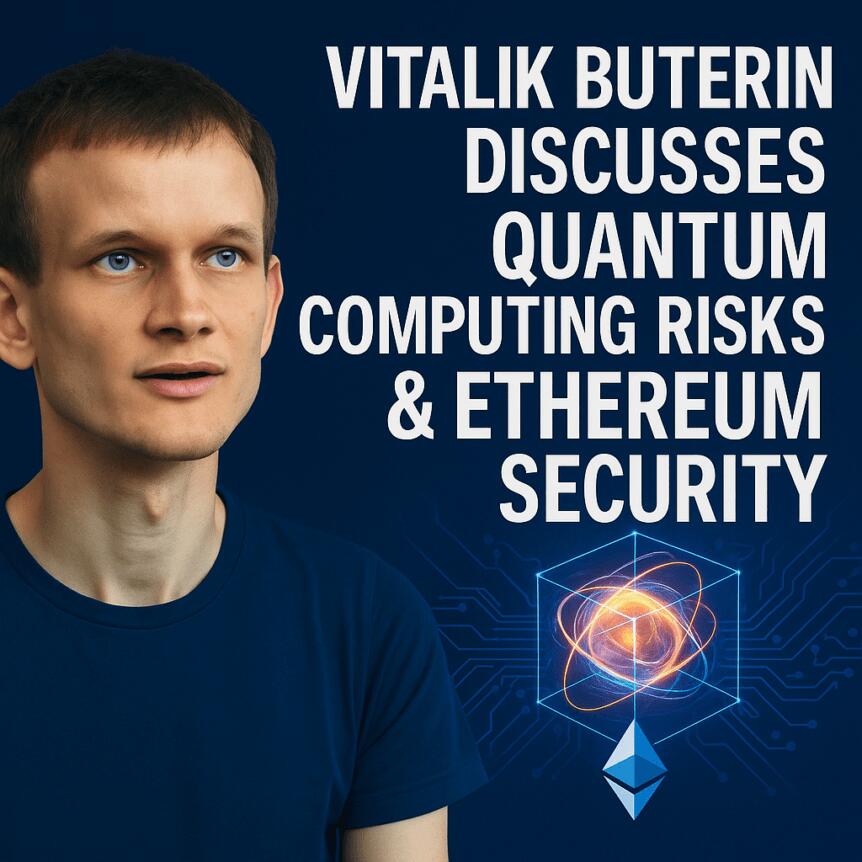
Ethereum co-founder Vitalik Buterin has highlighted the emerging risk quantum computers pose to current cryptographic security. With an estimated 20% probability of capable quantum machines arriving before 2030, the Ethereum ecosystem is urged to proactively implement quantum-resistant solutions to safeguard assets and maintain network integrity.
Key Takeaways
- Buterin assesses a substantial 20% likelihood that quantum computers could compromise existing cryptography before 2030, prompting the need for preparation.
- The primary vulnerability involves elliptic curve cryptography (ECDSA), where public keys exposed on-chain could enable future quantum attacks to recover private keys.
- The proposed emergency measures include rolling back affected blocks, freezing externally owned accounts (EOAs), and transitioning funds into smart contract wallets built with quantum-resistance.
- Mitigation strategies emphasize deploying post-quantum signature schemes, crypto-agile infrastructure, and smart contract wallets capable of scheme swaps without disrupting the network.
Tickers Mentioned
Tickers mentioned: Ethereum
Sentiment
Sentiment: Cautiously optimistic with an emphasis on proactive risk mitigation
Price Impact
Price impact: Neutral — The article emphasizes preparedness without indicating imminent market movements.
Market Context
Market context: As quantum computing advances, the industry faces long-term cryptographic challenges that may affect blockchain security and require early adaptation.
Ethereum’s Quantum Threat and Preparedness Strategy
In late 2025, Vitalik Buterin emphasized a growing concern within the Ethereum community regarding the impact of quantum computing on blockchain security. Citing forecasts from the platform Metaculus, Buterin estimated a roughly 20% chance that a quantum computer capable of breaking current cryptographic standards could emerge before 2030, with the median expectation around 2040. This potential threat, primarily targeting elliptic curve cryptography, is considered a significant risk, especially given that once a transaction is executed, the associated public key becomes visible on-chain.
Ethereum relies heavily on ECDSA, which secures transactions with the secp256k1 elliptic curve. The process involves generating a private key (a large random number), deriving a public key (a point on the curve), and then hashing that public key to obtain the address. Under classical computing, deriving the public key from a private key is considered infeasible, but a sufficiently powerful quantum computer could leverage Shor’s algorithm to solve the discrete log problem efficiently, rendering the cryptography vulnerable.
Buterin advocates for a comprehensive plan to mitigate potential risks. This includes deploying a hard fork in 2024 capable of reversing transactions if a quantum attack occurs, freezing legacy EOAs, and transitioning control to quantum-resistant smart contract wallets using zero-knowledge proofs like STARKs. Such a migration would enable users to demonstrate control through cryptographic proofs, shifting assets into post-quantum secure schemes seamlessly.
Expert analysis indicates that while current quantum hardware, including Google's Willow processor, comprises hundreds of qubits, there is a consensus that breaking 256-bit elliptic curves is still years away. The transition to post-quantum cryptography, such as lattice-based schemes, is underway within organizations like NIST. Nonetheless, the timeline underscores the importance of early preparation, as widespread adoption of quantum-resilient technology could take a decade or more.
Ethereum’s roadmap increasingly incorporates these considerations, aiming to develop flexible, upgradeable infrastructure that can adapt to future cryptographic standards. As Buterin notes, proactive measures—such as increasing cryptographic agility and building governance mechanisms—are essential to ensure the network’s resilience in the face of rapid advancements in quantum computing technology.
https://www.cryptobreaking.com/vitalik-buterin-discusses-quantum-computing/?utm_source=blogger%20&utm_medium=social_auto&utm_campaign=Vitalik%20Buterin%20Discusses%20Quantum%20Computing%20Risks%20&%20Ethereum%20Security%20
Comments
Post a Comment