
Whale Multisig Hacked in Minutes: Attack Drains $40M in Stages


Crypto Whale Multisig Wallet Drained in a Sophisticated Attack


An attacker has successfully compromised a whale’s multisig wallet just minutes after its creation, draining approximately $27.3 million and executing staged laundering activities over the past 44 days. The incident raises concerns over security practices in the crypto ecosystem and highlights evolving threats targeting high-value wallets.


Blockchain security firm PeckShield reported that the attacker has laundered around $12.6 million, or roughly 4,100 ETH, primarily through Tornado Cash. The attacker also retains about $2 million in liquid assets and has engaged in leveraged trading on Aave. New forensic analyses suggest the total loss could surpass $40 million, with initial signs of theft traced back to early November.


Yehor Rudytsia, head of forensic investigations at Hacken Extractor, explained that the wallet labeled as “compromised” might not have been under the victim’s control from the outset. On-chain data shows that the multisig wallet was created on November 4 at 7:46 am UTC, but ownership was transferred to the attacker just six minutes later. Rudytsia explained, “Very likely, the attacker created the multisig wallet, transferred funds to it, and then took control of it almost immediately.”
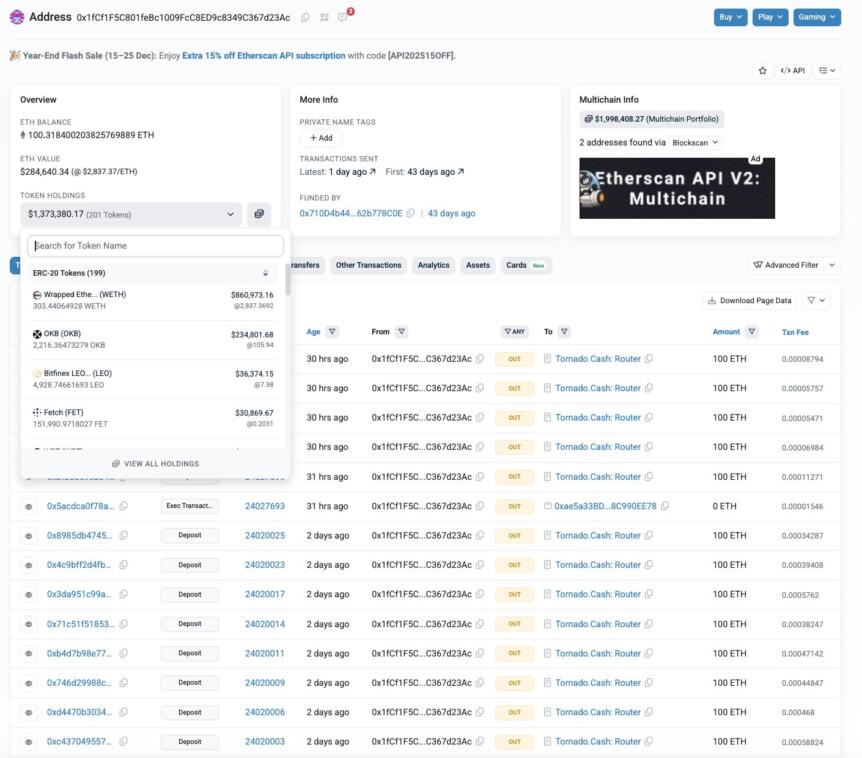


Attacker laundering funds
Attacker laundering funds in batches. Source: PeckShield


Following control of the wallet, the attacker exhibited patience, making Tornado Cash deposits over several weeks, beginning with 1,000 ETH on November 4 and continuing through early December in smaller, staggered transactions. Persistent funds remain on the compromised wallet, now under the attacker’s control. Rudytsia also raised concerns about the wallet’s configuration. The multisig was set as a “1-of-1,” requiring only a single signature for transaction approval—a design that doesn’t technically qualify as multisig and significantly lowers security.


Security experts at Hacken warn that various attack vectors are still viable, including malware infections, phishing, and operational errors such as storing private keys insecurely or using the same device for multiple signers. Abdelfattah Ibrahim, a DApp auditor, emphasized that locking devices in cold storage and verifying transactions outside a user interface are critical mitigation strategies.


Emerging Risks from AI-Generated Exploits


Recent research by Anthropic and the Machine Learning Alignment & Theory Scholars (MATS) demonstrates that advanced AI models can autonomously develop and execute profitable smart contract exploits. In controlled tests, models such as Anthropic’s Claude Opus 4.5, Claude Sonnet 4.5, and OpenAI’s GPT-5 collectively generated exploits valued at $4.6 million, illustrating the potential for autonomous hacking.


In further assessments, these AI models identified previously unknown zero-day vulnerabilities when tested against nearly 2,850 new smart contracts, producing exploits valued at just under $4,000, with costs lower than the expense of generating these exploits. This emerging threat underscores the need for enhanced security measures as AI capabilities rapidly advance within the blockchain space.


https://www.cryptobreaking.com/whale-multisig-hacked-in-minutes/?utm_source=blogger%20&utm_medium=social_auto&utm_campaign=Whale%20Multisig%20Hacked%20in%20Minutes:%20Attack%20Drains%20$40M%20in%20Stages%20

Comments

Popular posts from this blog

Mastercard Launches AI Agent Pay System With Ripple and Solana Help

Mastercard has launched Agent Pay for Machines, a payments system built for autonomous software agents. The service allows AI agents to send and receive payments without direct human action. It brings Ripple, Coinbase, and Solana Foundation into Mastercard’s push for automated digital commerce. Ripple Brings XRPL and RLUSD to Mastercard’s Agent Pay System Mastercard introduced Agent Pay for Machines on June 10 as a tool for machine-led payments. The system targets high-volume and low-value transactions across business and consumer use cases. It also supports automated settlement between software agents and connected machines. Ripple will support the system through the XRP Ledger and its RLUSD stablecoin. The company said that settlement will become more important as automated commerce grows. It also sees blockchain rails as useful for fast and rule-based payments. RippleX senior vice president Markus Infanger said XRPL and RLUSD support enterprise-grade agent payments. He said the tool...

Coinbase's x402 launches AI agents app store for payments

Coinbase-backed x402 has unveiled Agentic.market, a dedicated marketplace aimed at increasing the usefulness of AI agents by aggregating thousands of apps and services that agents can access without any API keys. The rollout positions the platform as a central hub for agents to discover, evaluate, and deploy capabilities across a standardized payments layer. Coinbase product lead Nick Prince described Agentic.market in a video posted on X as a storefront for discovering, comparing, and using x402 services. The marketplace is designed to give both humans and their AI agents access to a wide range of tools—from data feeds to consumer apps—without the friction of managing API credentials. A storefront for discovering, comparing, and using x402 services. Thousands of services. Zero API keys. Powered by x402. Prince added that the market offers a web interface for humans to browse and assess services, alongside a programming layer that lets AI agents autonomously search, filter, and integra...

Top Cryptocurrencies to Watch: BTC, ETH, BNB, XRP, Solana, Dogecoin & More

Market Analysis and Price Predictions for Key Cryptocurrencies Recent market dynamics reveal a cautious sentiment across the cryptocurrency landscape, with Bitcoin struggling to maintain levels above $90,000 and many major altcoins facing downward pressure. Indicators point toward reduced participation from both institutional and retail investors, raising concerns about a potential consolidation phase after notable gains earlier in the year. Bitcoin has fallen below $87,000, reflecting waning demand at higher price points. Institutional fund flows into BTC and ETH ETFs have turned negative, indicating a period of subdued market activity. Active addresses and Binance deposit/withdrawal activities are at annual lows, suggesting market indecision. Most leading altcoins are approaching support levels, with some poised for potential breakdowns. Tickers mentioned: Bitcoin, Ethereum, Binance Coin, XRP, Solana, Dogecoin, Cardano, Bitcoin Cash, Chainlink, Hyperliquid Sentiment: Neutral to Sli...