
Critical Software Vulnerability Discovered in Babylon's Bitcoin Staking Protocol
A newly identified flaw within Babylon's Bitcoin staking infrastructure poses a significant risk to network stability. Developers warn that malicious validators could exploit this vulnerability to disrupt consensus processes, potentially leading to delays in block production during key network periods.
Key Takeaways
- Security flaws have been identified in Babylon's BLS Vote extension, used for validator agreement verification.
- The bug allows malicious validators to omit the block hash when submitting votes, causing consensus issues.
- If exploited, the vulnerability could lead to validator crashes, slowing down block creation during epoch boundaries.
- The issue remains unexploited but poses a threat if not promptly addressed by developers.
Tickers mentioned: None specified.
Sentiment: Neutral
Price impact: Neutral. The vulnerability's potential impact is concerns about network stability, not immediate price fluctuations.
Market context: The discovery underscores ongoing security challenges within emerging Bitcoin DeFi ecosystems amid increasing innovation and investment.
Details of the Vulnerability
A recent GitHub security advisory revealed that Babylon's block signature scheme, known as the BLS vote extension, contains a flaw that could be exploited by malicious actors. This extension is critical, as it proves validator consensus on proposed blocks. The vuln allows validators to deliberately omit the block hash field when sending their votes, which is necessary to confirm the blocks they are voting on.
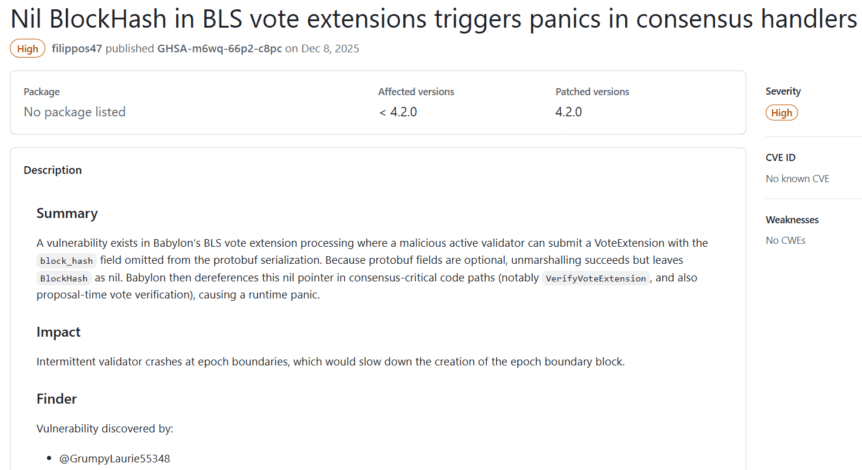
According to a GitHub contributor who disclosed the vulnerability, pseudonymously identified as GrumpyLaurie55348, the bug could cause validator crashes at epoch boundaries by dereferencing a null pointer during critical consensus checking. Such crashes would delay epoch boundary blocks, slowing overall network throughput. An internal runtime panic could occur, disrupting the network's synchronization protocols.
As of now, there are no reports of active exploitation. Nonetheless, security experts warn that malicious actors could potentially abuse this bug if it remains unpatched, risking network performance and security.
Babylon’s Growing Role in Bitcoin DeFi
Despite security concerns, Babylon continues to push forward with its innovative approach to Bitcoin-based decentralized finance (DeFi). The platform recently attracted $15 million in funding from Andreessen Horowitz's crypto arm, a16z Crypto, to advance Bitcoin-native staking and DeFi solutions.
Launched as part of its broader strategy, Bitcoin-native DeFi—referred to as BTCFi—is emerging as a technological frontier, enabled by the Runes protocol introduced during the 2024 Bitcoin halving. This innovation seeks to bring traditional DeFi capabilities directly onto Bitcoin, bypassing the need for wrapped tokens or custodians.
Earlier this month, Babylon partnered with Aave Labs to enable Bitcoin-backed lending on Aave v4. The collaboration aims to facilitate BTC as collateral in a trustless manner, with testing phases scheduled for early 2026 and a public rollout planned for April.
As Babylon advances its ecosystem, security remains paramount. Developers are urged to prioritize patching vulnerabilities to leverage Bitcoin's increasing role within DeFi while maintaining network integrity.
https://www.cryptobreaking.com/babylon-code-vulnerability-threatens-production/?utm_source=blogger%20&utm_medium=social_auto&utm_campaign=Babylon%20Code%20Vulnerability%20Threatens%20Production,%20Causes%20Serious%20Slowdowns%20
Comments
Post a Comment