

U.S. Senate Banking Committee Debates Passage of the 2025 Crypto Market Structure Bill
The passage of the Digital Asset Market Clarity Act of 2025, also known as the CLARITY market structure bill, depends heavily on bipartisan support in the U.S. Senate. Industry experts see this legislation as a crucial step for fostering widespread crypto adoption, particularly among institutional investors who remain cautious due to ambiguous regulations.
Key Takeaways
- The bill requires at least 60 Senate votes to advance, with bipartisan cooperation critical for success.
- Support hinges on at least four Democrats voting with Republicans, following a precedent set by the passage of the GENIUS Act.
- Failure to pass the bill could diminish short-term investor confidence but would have limited industry-wide impact.
- Market outlook remains uncertain, with potential delays until 2027 or beyond depending on political developments.
Tickers mentioned: None
Sentiment: Neutral
Price impact: Neutral. The outcome is largely contingent on political negotiations and could influence sentiment temporarily.
Trading idea (Not Financial Advice): Hold. The legislative gridlock reflects broader regulatory uncertainty that may persist in the near term.
Market context: The legislation's progress is intertwined with ongoing political dynamics ahead of the 2026 midterm elections, which could significantly influence the regulatory landscape.
Legislative Outlook and Industry Impact
The United States Congress is currently debating the Digital Asset Market Clarity Act of 2025, which aims to establish a comprehensive regulatory framework for digital assets. According to Alex Thorn, head of research at the crypto investment firm Galaxy, bipartisan support is essential for the bill's success. Typically, Senate approval requires at least 60 votes, making bipartisan cooperation crucial.
Thorn emphasizes that if Republicans can secure four votes from Democrats, it increases the likelihood that all 17 Democratic senators who voted for the GENIUS Act—a stablecoin regulatory framework—will unite with Republican colleagues to advance the bill. "Advocates for the market structure legislation hope to see similar bipartisanship next week," Thorn stated. "Without it, the bill's chances in 2026 will significantly diminish."
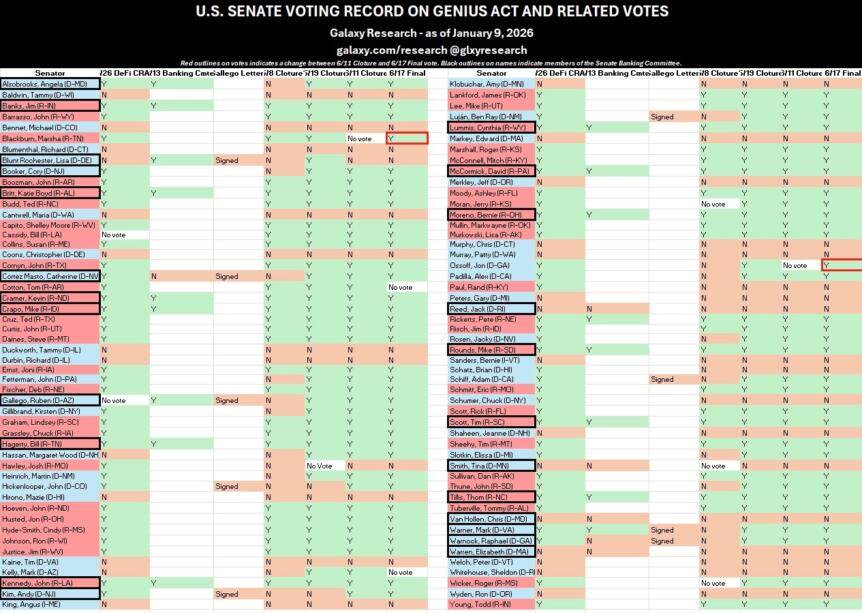
Thorn notes that a successful passage would accelerate crypto adoption, providing regulatory clarity and reassurance to institutional investors wary of regulatory rollback. Conversely, if the legislation stalls, the immediate impact on the industry would likely be minimal, as key policy objectives have already been achieved through earlier pro-crypto initiatives.
However, the political landscape suggests uncertainty, particularly with the 2026 midterm elections potentially delaying future legislative efforts. Industry analysts from TD Cowen recently warned that the crypto market structure bill may not see progress until 2027, possibly not taking effect until 2029 if Democrats regain control of Congress and stall efforts. Notably, the rollback of Trump-era policies beneficial to the crypto sector, artificial intelligence, and the broader tech industry could occur if Republicans lose influence, according to hedge fund manager Ray Dalio.
https://www.cryptobreaking.com/bipartisan-support-needed-in-senate/?utm_source=blogger%20&utm_medium=social_auto&utm_campaign=Bipartisan%20Support%20Needed%20in%20Senate%20Banking%20Committee%20for%20CLARITY%20Act—Expert%20Insights%20
Comments
Post a Comment