
European Economists Urge Public-Centric Digital Euro to Protect Monetary Sovereignty
A coalition of seventy economists and policy experts has issued a call to European Parliament members to support the development of a digital euro that prioritizes the public interest. They emphasize that such a move is vital for maintaining Europe's monetary sovereignty and ensuring access to central bank money in an era increasingly dominated by digital transactions and reduced reliance on cash.
Key Takeaways
- Experts advocate for a public, pan-European digital currency issued by the Eurosystem, not exclusively controlled by private entities.
- The letter warns that without public-centric options, private stablecoins and foreign payment platforms could wield excessive influence over Europe's financial infrastructure.
- Central bank digital currency (CBDC) is positioned as a public good, designed to complement cash, not replace it, with features such as offline payments and tiered remuneration.
- Concerns about privacy, operational costs, and potential disintermediation are central to ongoing debates surrounding the digital euro's implementation.
Tickers mentioned: None
Sentiment: Supportive of a public digital euro
Price impact: Neutral, as the development is at an early stage with policy debates ongoing
Trading idea (Not Financial Advice): Hold, pending further regulatory developments and market adoption
Market context: The push for a digital euro aligns with broader discussions on digital currencies and resilience of sovereign monetary systems amid global digital transformation
Advocacy for a Public Digital Currency
In an open letter published Sunday, leading economists, including former European Bank for Reconstruction and Development vice president José Leandro and renowned French economist Thomas Piketty, call for the European Central Bank (ECB) to prioritize a digital euro that functions as a public good. They argue that in the absence of a strong, publicly controlled digital currency, Europe risks falling under the influence of private stablecoins and major foreign payment providers, such as major technology firms, which could undermine financial independence and resilience during times of stress.
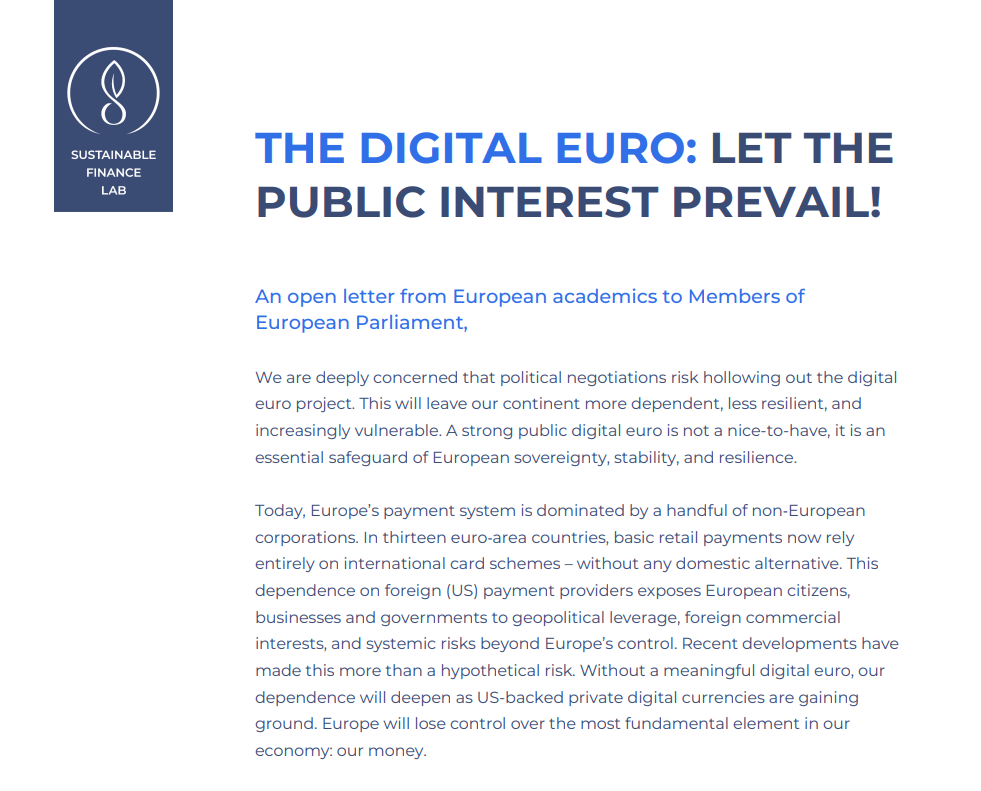
The signatories emphasize that the digital euro should be accessible across the entire euro area, issued by the Eurosystem, and offered free of charge for basic transactions. They suggest that the digital currency should complement physical cash rather than replace it entirely. The letter warns that a hesitating or watered-down approach could lead to increased dependence on private payment solutions, with potential threats to Europe's financial sovereignty. These private options, often controlled by non-European firms, could diminish the resilience and stability of the continent’s payment system, especially during crisis periods.
ECB’s Preparatory Work and Design Considerations
The European Central Bank is currently in the preparation phase of its digital euro project, working on technical frameworks, regulatory guidelines, and features such as offline payments. ECB officials have reiterated the goal of creating a secure and privacy-respecting digital currency that supports a broad range of use cases, including conditional payments and offline functionality, while maintaining anti-money laundering standards.
In a recent speech, ECB Executive Board Member Philip Lane highlighted the importance of balancing innovation with privacy and the continued role of traditional banks in retail payments. The ECB’s technical annexes have analyzed the potential impacts of a digital euro on financial stability, indicating that, with proper safeguards like holding limits of around 3,000 euros, serious risks are unlikely even in adverse scenarios, demonstrating cautious optimism about the project’s stability.
Although some stakeholders express skepticism—particularly regarding costs, operational challenges, and user adoption—the ECB remains committed to advancing a digital euro that upholds European values of privacy and sovereignty. As discussions continue, the focus remains on designing a digital currency that bolsters Europe’s financial independence while addressing practical concerns around implementation and user trust.
https://www.cryptobreaking.com/economists-urge-meps-to-back/?utm_source=blogger%20&utm_medium=social_auto&utm_campaign=Economists%20Urge%20MEPs%20to%20Back%20Digital%20Euro%20in%20Official%20Open%20Letter%20
Comments
Post a Comment