Ethereum: The Linux of the Open Internet of Value


Ethereum's Vision as the Internet's Operating System Draws Closer


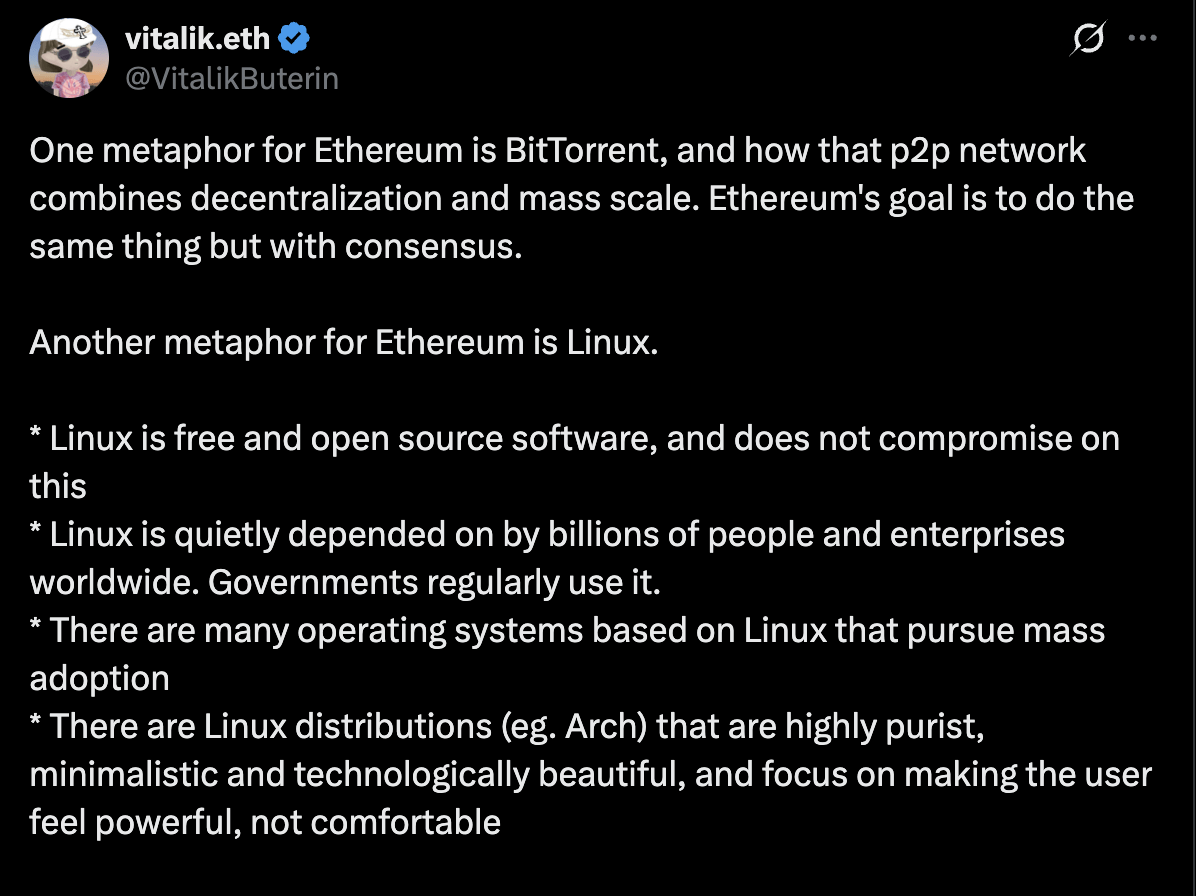
The Ethereum network, often dubbed a decentralized layer-1 blockchain executing smart contracts, is increasingly being likened to an open-source operating system similar to Linux. Ethereum co-founder Vitalik Buterin emphasized that, like Linux, Ethereum's open-source architecture enables extensive customization through layer-2 scaling solutions, fostering scalability and user autonomy.


In an insightful comparison, Buterin explained that just as Linux provides value to billions globally—serving individuals, enterprises, and governments—without sacrificing its decentralized ethos, Ethereum aspires to function as the backbone of the internet. “We must ensure that Ethereum’s layer-1 remains the trusted home for finance, identity, social interactions, and governance, empowering users to operate independently of intermediaries,” he stated.


Linux, Ethereum, Vitalik Buterin, Layer2
Source: Vitalik Buterin


This analogy underscores the long-term vision of Ethereum as a versatile operating system for the internet—facilitating distributed computation, secure value transfer, and consensus on a global scale. Building on this foundation, the Ethereum Foundation aims to create a network that balances scalability with decentralization, ensuring broad participation and resilience.


Expanding Layer-2 Ecosystem and Persistent Challenges


Currently, the Ethereum ecosystem hosts approximately 127 layer-2 networks, according to data from L2Beat. Proponents argue that this diverse ecosystem enhances user options and cements Ethereum’s position as a scalable platform. Layer-2 solutions, from rollups to sidechains, enable high throughput and reduced transaction costs, which are critical for mainstream adoption.


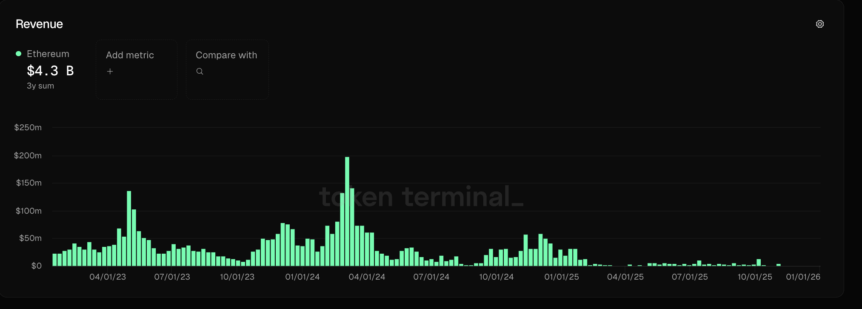
Despite the promising prospects, critics highlight hurdles such as an overabundance of competing layer-2 networks. Some argue that this proliferation leads to ecosystem fragmentation and cannibalizes the base layer’s revenue, which saw a significant decline following the March 2024 Dencun upgrade. The risk is that multiple high-performance chains operate in silos, trapping user liquidity within isolated pools and diminishing the overall user experience.


Ethereum layer-1 revenue
Ethereum layer-1 revenue. Source: Token Terminal


Supporters argue that the modular, rollup-centric scaling approach provides flexibility for experimentation, allowing teams to develop multiple high-throughput chains tailored to diverse use cases. Anurag Arjun, co-founder of Ethereum layer-2 Polygon, noted that this architecture enables innovation by testing different execution environments.


However, he warned that without true interoperability, the ecosystem risks further fragmentation, which could impede liquidity flow and degrade the user experience. Balancing innovation with cohesive integration remains a critical challenge as Ethereum advances toward its vision of a decentralized internet operating system.


https://www.cryptobreaking.com/ethereum-the-linux-of-the/?utm_source=blogger%20&utm_medium=social_auto&utm_campaign=Ethereum:%20The%20Linux%20of%20the%20Open%20Internet%20of%20Value%20

Comments

Popular posts from this blog

Coinbase's x402 launches AI agents app store for payments

Coinbase-backed x402 has unveiled Agentic.market, a dedicated marketplace aimed at increasing the usefulness of AI agents by aggregating thousands of apps and services that agents can access without any API keys. The rollout positions the platform as a central hub for agents to discover, evaluate, and deploy capabilities across a standardized payments layer. Coinbase product lead Nick Prince described Agentic.market in a video posted on X as a storefront for discovering, comparing, and using x402 services. The marketplace is designed to give both humans and their AI agents access to a wide range of tools—from data feeds to consumer apps—without the friction of managing API credentials. A storefront for discovering, comparing, and using x402 services. Thousands of services. Zero API keys. Powered by x402. Prince added that the market offers a web interface for humans to browse and assess services, alongside a programming layer that lets AI agents autonomously search, filter, and integra...

Top Cryptocurrencies to Watch: BTC, ETH, BNB, XRP, Solana, Dogecoin & More

Market Analysis and Price Predictions for Key Cryptocurrencies Recent market dynamics reveal a cautious sentiment across the cryptocurrency landscape, with Bitcoin struggling to maintain levels above $90,000 and many major altcoins facing downward pressure. Indicators point toward reduced participation from both institutional and retail investors, raising concerns about a potential consolidation phase after notable gains earlier in the year. Bitcoin has fallen below $87,000, reflecting waning demand at higher price points. Institutional fund flows into BTC and ETH ETFs have turned negative, indicating a period of subdued market activity. Active addresses and Binance deposit/withdrawal activities are at annual lows, suggesting market indecision. Most leading altcoins are approaching support levels, with some poised for potential breakdowns. Tickers mentioned: Bitcoin, Ethereum, Binance Coin, XRP, Solana, Dogecoin, Cardano, Bitcoin Cash, Chainlink, Hyperliquid Sentiment: Neutral to Sli...

Analyst: Bitcoin can reclaim $100K without a new narrative

Bitcoin has stalled below the $100,000 threshold, marking a run of almost five months without a breakout above that level. As of the latest market close, BTC hovered around $78,250 after a February nadir of about $60,000, underscoring a slow, grinding recovery amid broader market dynamics. In parallel, tech markets—especially AI-focused equities—have captured the spotlight, with investors rotating capital away from crypto in search of different risk-reward profiles. Nvidia (NVDA), the leading AI stock by market cap, has gained about 5.08% since the start of the year, while Bitcoin has faced a roughly 10% dip over the same period, illustrating a diverging performance within risk assets. MN Trading Capital founder Michael van de Poppe suggested that Bitcoin may not require a fresh narrative to push back above $100,000. In a post on X, he asked what narrative would drive BTC to the milestone and concluded that “price moves upwards, and the narrative will create itself.” He continued that ...