
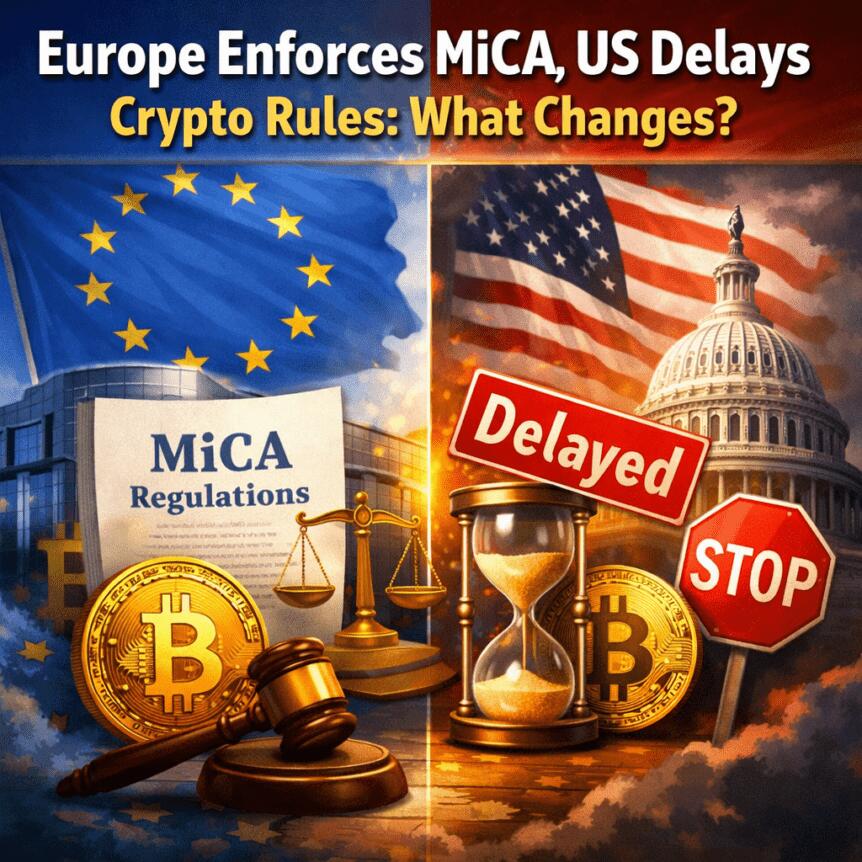
Regulators in Europe and the United States are charting divergent paths for crypto policy, a contrast that could recalibrate where assets are traded, issued, and scaled. In Europe, MiCA has moved from drafting to hard enforcement, delivering a clear, phased timeline intended to harmonize regulation across 27 member states. In the United States, policy-makers and agencies continue wrestling with fundamental questions—how to classify tokens, where market structure fits, and which federal rules will ultimately govern exchanges, wallets, and staking. The MiCA framework began its rollout with publication in the EU Official Journal on June 29, 2023, advancing in stages: asset-referenced tokens and e-money tokens became applicable in 2024, the regime for crypto asset service providers followed by year-end, and a transition window through July 1, 2026. The practical effect is to push firms toward Europe for early expansion planning, budgeting, and product roadmaps that align with explicit regulatory milestones.
Key takeaways
- Europe is moving from drafting to enforcing MiCA, with staged applicability for asset-referenced tokens (June 2024) and crypto asset service providers (December 2024) and a two-year transition window through July 1, 2026.
- The United States remains under a multi-agency, enforcement-led framework, with persistent questions about token classification and market structure awaiting federal legislation.
- MiCA’s single-license model lets a crypto firm authorized in one member state operate across the EU, incentivizing a baseline “home base” in Europe for cross-border growth.
- US ambiguity around asset classification fosters caution in listings and staking, while MiCA’s clearer categories reduce legal uncertainty but raise compliance costs for firms.
- Globally, the US and Europe are diverging in regulatory philosophy—Europe pushing toward a unified rulebook and predictable licensing, the US pursuing a more fragmented, negotiable framework through ongoing debates and bills.
Market context: The regulatory dispute between a unified European approach and aiterative U.S. policy has broad implications for liquidity, risk sentiment, and the pace of crypto product development. Europe’s path is designed to provide predictable licensing and disclosures that can attract institutions seeking a stable operating environment, while the United States continues to grapple with which agency has primacy over different asset classes and activities. The divergence affects how market participants plan listings, custody arrangements, and the structuring of token offerings across borders. For a deeper dive into how MiCA is changing the regulatory landscape, see the overview on Markets in Crypto-Assets Regulation (MiCA).
Sentiment: Neutral
Market context: The evolving regulatory backdrop is shaping risk tolerance, capital allocation, and cross-border collaboration in the crypto ecosystem. Firms are pricing in what it takes to achieve compliant scale in Europe while evaluating how long the U.S. process will take to deliver a coherent framework.
Why it matters
For users and retail participants, the European approach offers clearer disclosures, custody expectations, and licensing standards that can translate into more reliable access to services, albeit with higher ongoing compliance costs. For investors, a well-defined, EU-wide license reduces fragmentation risk when evaluating cross-border products, enabling more confident exposure to crypto assets through regulated venues. For builders, exchanges, and custodians, MiCA’s centralized authorization pathway lowers the friction of entering multiple markets by removing the need to relicense in each jurisdiction after a single approval within the bloc, fostering faster product rollouts and more predictable business plans. The US environment, by contrast, remains riskier from a regulatory certainty standpoint, but it offers deep capital markets and more mature onboarding infrastructures for regulated participants. The ongoing debates on token taxonomy and market structure are not academic—they determine whether platforms must register, what disclosures apply, and which products can be offered domestically. The GENIUS Act and related discussions around stablecoins are part of this broader push toward clarifying issuer oversight, reserve requirements, and consumer protections in the United States.
In Europe, MiCA’s architecture also reinforces stronger AML and anti-terror financing controls, alongside the establishment of the Anti-Money Laundering Authority (AMLA) as part of a broader EU regulatory package. This tightening of controls is designed to reduce illicit use of crypto while preserving space for regulated innovation. For global firms, this convergence means that a compliant European footprint can serve as a base for broader European operations, while the United States remains a critical but evolving market with its own unique requirements and potential exemptions under a consolidated framework in the future.
At a practical level, the two blocs’ approaches influence how liquidity pools are formed, how exchanges compete on listing standards, and how stablecoins are issued and backed. EU venues under MiCA may attract flows from entities seeking clearer authorization, whereas U.S. venues could remain deep but selective, constrained by ongoing uncertainty around classification and registration. The result is a nuanced, multi-speed landscape where policy timing, capital allocation, and regulatory clarity will shape where and how crypto services are built and scaled.
What to watch next
- Track MiCA’s ongoing implementation across member states, including the transition window through July 1, 2026, and how national authorities interpret and apply the framework.
- Follow progress on the Digital Asset Market Clarity Act of 2025, including its proposed federal categorization of digital assets as either commodities or investment contracts and the corresponding agency jurisdiction (CFTC vs SEC).
- Monitor token taxonomy discussions and potential exemptions advanced by the SEC, which could redefine when a token is treated as a security or a commodity and what types of offerings require registration.
- Watch the GENIUS Act and broader stablecoin regulation for issuer oversight, reserve requirements, and consumer protections in the U.S. framework.
- Observe how AML regulation evolves in both blocs, including the EU’s AMLA rollout and any further guidance on crypto-service provider obligations and cross-border compliance.
Sources & verification
- Markets in Crypto-Assets Regulation (MiCA) coverage and the EU’s phased enforcement timeline, including official milestones and ESMA’s anticipated integration into formal regimes — see Markets in Crypto-Assets Regulation (MiCA).
- U.S. regulatory perimeter discussions and the path to a federal framework for digital assets, including token taxonomy debates and how a future law might allocate authority between the CFTC and SEC — see How the new US crypto bill could finally define commodities and securities.
- GENIUS Act provisions on stablecoins, issuer oversight, reserve backing, and consumer protections — see Genius Act: How it could reshape US stablecoin regulation.
- Documentation surrounding the Digital Asset Market Clarity Act of 2025 and its potential impact on registration requirements for digital asset brokers and exchanges with the CFTC or SEC — see Clarity Act of 2025 Final PDF.
Regulatory divergence and its implications for the crypto ecosystem
The European Union’s Markets in Crypto-Assets Regulation represents one of the most ambitious attempts to unify crypto regulation across a large bloc. By introducing a single authorization model, MiCA requires crypto asset service providers to obtain licensing in one competent authority and then operate across the entire EU. This approach reduces the need for multiple licenses and creates a centralized compliance baseline that increases predictability for firms and investors. It also introduces a framework for ongoing disclosures, conduct rules, and market integrity measures that are designed to curb abuse and enhance transparency. The phased rollout—beginning with the official entry into force on June 29, 2023, followed by the applicability of asset-referenced tokens and e-money tokens on June 30, 2024, and the crypto asset service provider regime by December 30, 2024, with a transition period through July 1, 2026—gives operators a clear calendar to plan product roadmaps and capital expenditures. For more detail on the MiCA mechanism and its enforcement trajectory, refer to the EU regulatory overview linked in the article above.
In contrast, the United States remains in a period of policy refinement. The absence of a singular, comprehensive framework means that market participants must navigate a mosaic of agency guidance, ongoing investigations, and proposed legislation. The Digital Asset Market Clarity Act of 2025 proposes a federal structure that would classify assets into two broad categories—digital commodities and investment contracts—placing digital commodities under the CFTC and investment contracts under the SEC. If enacted, this statute would impose new registration duties on certain brokers and exchanges and would establish custody and investor-protection standards that could reshape user experiences and the practicalities of trading and settlement. Until such a law passes, firms must contend with a patchwork of enforcement actions and a moving perimeter for what constitutes a security or a commodity. See discussions on the Clarity Act and token taxonomy for context on evolving U.S. policy approaches.
Meanwhile, discussions around stablecoins are moving toward federal frameworks in the U.S., with the GENIUS Act and related proposals aiming to set issuer eligibility, reserve standards, and redemption rules. These measures seek to provide a safer, more transparent basis for everyday payments while encouraging regulated innovation. At the same time, ongoing debates about token classifications and exemptions under a broader market-structure plan illustrate how policy design can directly influence which products get listed, how custody is handled, and where capital is allocated. The interplay between Europe’s centralized licensure and the U.S.’s decentralized, evolving approach will likely define regulatory benchmarks, capital flows, and platform strategies in the crypto space for years to come, with market participants adapting as each side updates its expectations and compliance requirements.
https://www.cryptobreaking.com/europe-enforces-mica-us-delays/?utm_source=blogger%20&utm_medium=social_auto&utm_campaign=Europe%20Enforces%20MiCA,%20US%20Delays%20Crypto%20Rules:%20What%20Changes?%20
Comments
Post a Comment