
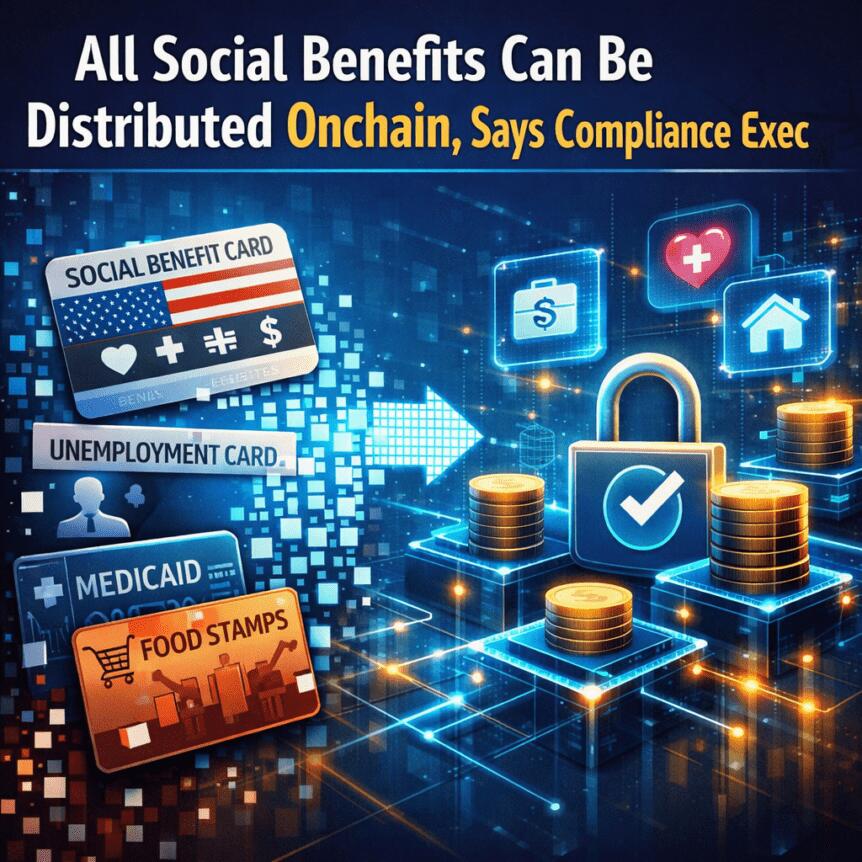
Blockchain technology is increasingly being viewed as a practical backbone for distributing social benefits, though regulatory guardrails remain a central challenge for governments testing on-chain tools. In the Marshall Islands, guidance from Guidepost Solutions on regulatory compliance and sanctions framework accompanies the rollout of a tokenized debt instrument known as USDM1, issued by the state and backed 1:1 by short-term U.S. Treasuries. Separately, the country launched a Universal Basic Income (UBI) program in November 2025, delivering quarterly payments directly to citizens via a mobile wallet. As proponents point out, digital delivery can accelerate provisioning and provide auditable trails for expenditures, but the path to widescale adoption is entangled with anti-money laundering (AML) and know-your-customer (KYC) requirements that regulators say are non-negotiable.
Key takeaways
- Tokenized government debt is expanding, with asset-backed bonds that settle rapidly and offer fractional ownership gaining traction in pilots and policy discussions.
- The Marshall Islands’ UBI program, distributed through a digital wallet since November 2025, exemplifies how on-chain tools can reach citizens directly, pending robust AML/KYC controls.
- Regulators view AML and sanctions compliance as the largest risk in issuing on-chain bonds to the public, underscoring the need for rigorous oversight in tokenized finance.
- Data show a sharp rise in tokenized U.S. Treasuries, illustrating growing demand for programmable settlement and auditable fund flows in public debt markets.
- Analysts forecast meaningful growth for the tokenized bond market, with projections pointing to hundreds of billions of dollars by decade’s end, contingent on regulatory clarity.
Market context: The push toward tokenized government debt and on-chain social benefits sits amid a broader push to modernize public finance and expand financial inclusion. Jurisdictions are piloting tokenized instruments to cut settlement times and reduce transaction costs, while also grappling with the necessary compliance architecture. The United Kingdom has taken a parallel step, with HSBC appointed for a tokenized gilt pilot, signaling cross-border interest in the model. Data from Token Terminal indicate the tokenized U.S. Treasury market has grown more than 50-fold since 2024, highlighting the rapid shift toward on-chain finance in a $X trillion debt ecosystem. Analysts, including Lamine Brahimi, co-founder of Taurus SA, project the tokenized bond market could surge to around $300 billion by 2030, a forecast that reflects both demand for digital liquidity tools and the continuing need for robust governance.
Why it matters
The Marshall Islands’ approach illustrates how tokenization can reshape public finance and social programs alike. By backing a debt instrument 1:1 with short-term U.S. Treasuries and tying it to a regulatory framework shaped by a risk-focused compliance firm, the government aims to attract legitimate investment while maintaining guardrails against misuse. The on-chain UBI experiment is a practical testbed for direct-to-citizen distributions, where quarterly payments flow through a digital wallet rather than traditional channels. The potential benefits—faster disbursement, traceable expenditure lines, and a more inclusive financial system—could extend beyond the Marshall Islands, offering a blueprint for other nations seeking to streamline welfare programs and debt issuance through programmable money.
However, the regulatory reality remains central. AML requirements and sanctions screening are highlighted by experts as the most significant obstacles to broad adoption. Governments issuing tokenized bonds must collect know-your-customer information to ensure funds reach the intended beneficiaries, while also ensuring that sanctions regimes are not breached through on-chain channels. The tension between innovation and compliance is not unique to the Marshall Islands; it is echoed in wider discussions about tokenization of public assets and the need for robust, interoperable standards that can scale across borders without compromising security or oversight.
From an investor and builder perspective, the narrative is equally nuanced. Tokenization promises near-instant settlement and fractional ownership, expanding access to assets that were previously illiquid or inaccessible to ordinary individuals. The growth in the tokenized debt market, as tracked by data platforms like Token Terminal, is often cited as evidence that digital-native debt instruments can coexist with traditional markets while offering new forms of liquidity and programmability. Yet the same data underline that progress hinges on a stable policy environment—one that defines privacy, censorship-resistance, anti-fraud controls, and cross-border enforcement mechanisms. The broader ecosystem’s trajectory will be shaped by how quickly regulators can translate principles into scalable, enforceable rules without stifling innovation.
In parallel, pilots such as the UK gilt initiative and other tokenization efforts illustrate that government-sponsored projects are moving from theory toward real-world applications. The combination of digital governance with financial instrumentation could unlock new funding channels and enable more responsive social programs, provided that the operational and legal frameworks keep pace with technological capability. This synthesis—technological potential matched with disciplined compliance—will determine whether tokenized debt and on-chain welfare tools become enduring components of public finance or remain transient experiments.
What to watch next
- Progress and results from the Marshall Islands’ UBI wallet rollout and any regulatory updates on AML/KYC standards for on-chain benefits.
- Monitoring the UK’s tokenized gilt pilot and any published findings on feasibility, costs, and investor interest.
- Updates to tokenized debt instrument frameworks and sanctions regimes as more governments explore issuance and distribution through blockchain rails.
- New data releases from Token Terminal and other analytics firms tracking growth in tokenized government debt and on-chain settlements.
- Prominent forecasts, such as Taurus SA’s projection of a $300 billion tokenized bond market by 2030, and any revisions based on policy or market developments.
Sources & verification
- Guidance from Guidepost Solutions to the Marshall Islands government on regulatory compliance and sanctions for USDM1 tokenized debt instruments (tokenized debt instrument reference).
- Marshall Islands’ Universal Basic Income program launch in November 2025 via a digital wallet (UBI program reference).
- Analysis and data on the tokenized U.S. Treasuries market growth since 2024 from Token Terminal (growth reference).
- Forecast by Lamine Brahimi, co-founder of Taurus SA, that tokenized bonds could reach $300 billion by 2030 (market forecast reference).
- On-chain debt instrument and tokenized government debt discussions and related policy pilots, including RWA.XYZ and UK gilt pilot context (verification references).
Tokenized debt, digital governance, and the path to inclusive finance
The effort to tokenize government debt and deliver social benefits on-chain sits at the intersection of efficiency, transparency, and risk management. The Marshall Islands’ USDM1 project showcases how a regulatory framework can be crafted to support tokenized debt while maintaining strong sanctions and AML controls. The accompanying UBI initiative demonstrates a pragmatic use case for digital wallets as a means of distributing welfare benefits with auditable spending trails, potentially reducing delays and leakage that can accompany traditional channels. In parallel, the broader market signals—rapid growth in tokenized U.S. Treasuries, governance pilots in the UK, and ambitious market projections—underscore growing institutional and public interest in tokenization as a means to reimagine public finance and social programs. Yet the narrative remains contingent on a reliable compliance scaffold: one that balances innovation with rigorous risk management to safeguard funds and protect citizens. As policymakers, technologists, and financial actors navigate this evolving terrain, the defining question will be whether these on-chain instruments can deliver measurable benefits at scale without compromising the integrity of the financial system.
https://www.cryptobreaking.com/all-social-benefits-can-be/?utm_source=blogger%20&utm_medium=social_auto&utm_campaign=All%20Social%20Benefits%20Can%20Be%20Distributed%20Onchain,%20Says%20Compliance%20Exec%20
Comments
Post a Comment