
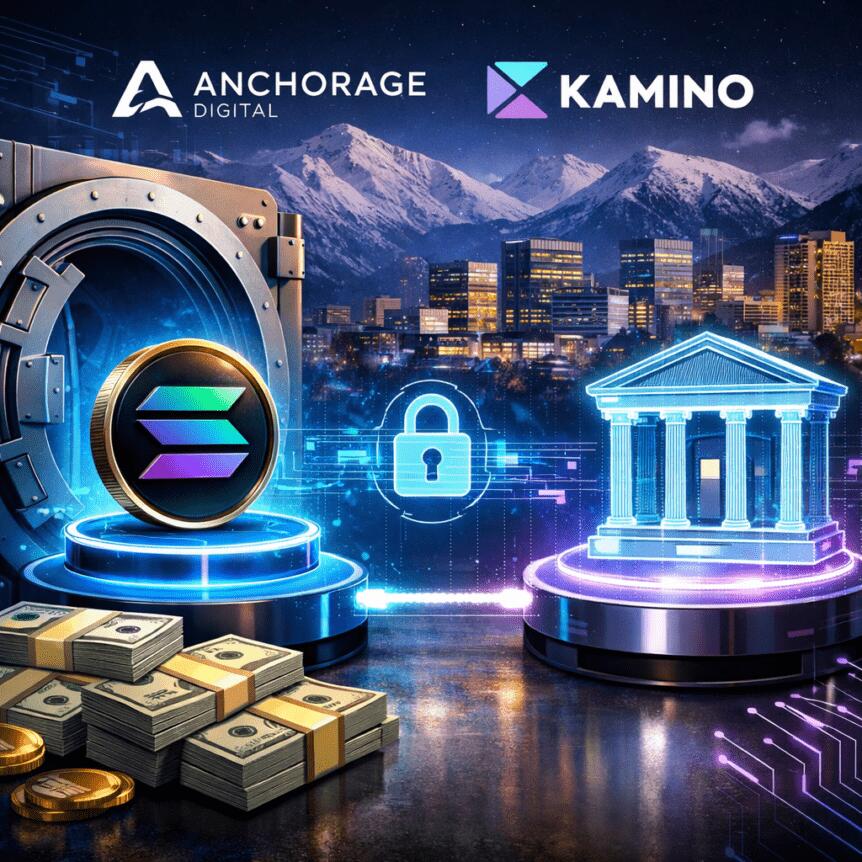
Anchorage Digital, Kamino, and Solana Company are piloting a structure that could ease a longtime friction between traditional finance and DeFi: the ability to borrow against staked tokens without moving assets out of regulated custody. The collaboration expands Anchorage’s Atlas collateral management platform by integrating Kamino, a Solana-based decentralized lending protocol, with a framework that keeps collateral in custodial control. Solana (SOL) ((CRYPTO: SOL)) sits at the center of the arrangement, as the Solana Company treasury—an on-chain asset pool backed by Pantera Capital and Summer Capital—provides a tangible anchor for the program. The goal is to give financial institutions liquidity without forcing them to relinquish staking rewards or move assets into smart contracts that may carry higher regulatory or operational risk.
Key takeaways
- Atlas’s collateral management is being extended to support native staking positions, enabling lenders to use staked SOL as collateral while assets remain in Anchorage’s custody.
- Anchorage acts as collateral manager, setting loan-to-value ratios and margin requirements, and performing liquidation if necessary, removing the direct on-chain custody burden from regulated entities.
- The involved treasury, Solana Company, holds a large SOL position and participates in governance and risk disclosures through its custodial framework and public partnerships.
- The move unfolds amid a broader regulatory debate in the United States around DeFi, with the CLARITY Act aiming to clarify jurisdiction and standards for digital-asset activities.
- Industry groups warn that early draft language does not fully distinguish between centralized intermediaries and decentralized protocols, adding a layer of regulatory risk to institutional adoption.
Tickers mentioned: $SOL
Sentiment: Neutral
Market context: The development mirrors growing institutional interest in DeFi-enabled liquidity while regulators weigh how to apply traditional securities and banking rules to on-chain lending and custody models.
Why it matters
The Anchorage-Kamino-Solana Company arrangement represents a tangible path for institutions to engage with decentralized lending markets without altering their custody and compliance posture. By keeping the collateral in segregated, regulated custody at Anchorage Digital Bank, lenders can maintain certainty around asset segregation, reporting, and risk controls that are typically required for regulated entities. The model reduces a historical hurdle: moving assets into on-chain, non-custodial environments that can complicate lending approvals, risk management, and auditability for banks and asset managers.
From a risk-management perspective, Anchorage’s role as collateral manager—determining loan-to-value caps, margin calls, and potential liquidations—adds a familiar, governance-backed framework to on-chain lending. It gives institutions a governance layer that complements Kamino’s DeFi lending markets, potentially expanding the universe of assets that institutions are comfortable using as collateral. The custody-first approach aims to preserve staking rewards, which for SOL holders can mean ongoing yield while accessing liquidity. This is particularly salient for large treasuries such as Solana Company, which has built a sizable SOL position and participates in ecosystem funding and governance through its holdings.
Regulators, on the other hand, watch closely. The CLARITY Act, which seeks to establish clearer jurisdiction and regulatory standards for digital assets, has become a focal point in policy debates. While supporters argue the bill would reduce uncertainty for market participants, critics counter that it does not fully delineate how decentralized protocols, developers, and governance frameworks should be treated under the law. The tension is evident in industry discussions and public commentary, underscoring that even innovative custody-friendly DeFi solutions must operate within an evolving regulatory landscape. In this context, the Anchorage-Kamino-Solana Company collaboration can be seen as a practical test case: it demonstrates what regulated institutions are willing to try, and where policy gaps may need to be filled to broaden safe participation.
Solana Company’s position—reported to be one of the largest SOL-based treasuries—adds another layer of credibility to the experiment. Its holdings, and the associated disclosures, underscore the willingness of specialized treasury teams to explore on-chain lending as a liquidity tool, provided that custodial safeguards remain intact. The project’s public materials also point to Solana’s ecosystem ambitions and the role of strategic treasury management in supporting on-chain liquidity without destabilizing staking yields or governance processes.
The technical structure hinges on integrating Kamino’s lending protocol with Atlas’s collateral framework. Under the program, a loan would be issued against natively staked SOL, but the actual SOL remains in Anchorage’s segregated custody. That separation matters because it preserves the institution’s regulatory, accounting, and risk-management controls while granting access to liquidity through Kamino’s on-chain markets. Anchorage’s oversight includes monitoring collateral value relative to loan size, maintaining margin requirements, and triggering liquidations if risk thresholds are breached. This model avoids the conventional requirement for institutions to transfer assets into smart-contract-based vaults, a sticking point that has historically limited regulated participation in DeFi lending markets.
The integration was announced in a period when Solana’s ecosystem, including its treasury vehicles, has been under scrutiny for both performance and risk. The Solana ecosystem’s public-facing information notes that the Solana Company treasury holds a substantial stake in SOL, reinforcing the relevance of this development to how large on-chain holders think about liquidity and risk. This event aligns with broader industry interest in on-chain lending, especially where custody remains in regulated environments. For market participants, the arrangement signals a potential template for expanding institutional DeFi exposure without eroding the protections and oversight that banks and trust companies emphasize.
What to watch next
- Regulatory clarity progress on the CLARITY Act and related DeFi governance provisions, including any committee votes or amendments that clarify custody vs. on-chain lending.
- Milestones in the Atlas-Kamino integration, such as go-live dates, onboarding of initial institutional users, and risk-management enhancements.
- Solana Company’s ongoing SOL portfolio disclosures and any new risk disclosures tied to staking yields and on-chain liquidity use.
- Updates from Anchorage Digital Bank on custody controls, compliance reporting, and risk-management metrics as more institutions engage with the structure.
Sources & verification
- Anchorage Digital’s expansion of Atlas collateral management through Kamino integration with Solana Company’s treasury.
- Solana Company treasury data and public disclosures via CoinGecko.
- CLARITY Act overview and DeFi market-structure discussions.
- Public policy discussions and industry meetings surrounding DeFi oversight, including high-level regulatory engagement by the Trump administration.
Market reaction and key details
The collaboration between Anchorage Digital, Kamino, and Solana Company illustrates how institutions may bridge custody-grade risk controls with DeFi liquidity pools. By enabling native staking positions to serve as collateral without a custody transfer, the program could unlock new liquidity channels for regulated entities. The emphasis on collateral management, risk controls, and segregated custody is consistent with a broader trend: institutions seeking to participate in on-chain lending while preserving traditional compliance and reporting regimes. The Solana ecosystem’s treasury dynamics, including Solana Company’s substantial SOL holdings, will be watched closely to see how risk disclosures evolve as the program expands. For practitioners, the approach could inform future collaborations that pair regulated custody with decentralized markets, potentially shaping how banks, asset managers, and corporate treasuries view DeFi liquidity tools.
Key figures and next steps
The project’s practical implications hinge on governance, custody risk controls, and the speed at which regulated institutions feel comfortable expanding their DeFi participation. If the pilot proves scalable and appropriately regulated, it may pave the way for broader adoption of staking-backed liquidity facilities that keep assets under regulated custody while granting on-chain access to lending markets. Observers will be watching for formal go/no-go decisions from participating institutions, any changes to Atlas collateral parameters, and additional asset classes considered for similar custody-preserving lending structures.
https://www.cryptobreaking.com/anchorage-kamino-let-firms-borrow/?utm_source=blogger%20&utm_medium=social_auto&utm_campaign=Anchorage,%20Kamino%20Let%20Firms%20Borrow%20Against%20SOL%20Without%20Moving%20Custody%20
Comments
Post a Comment