
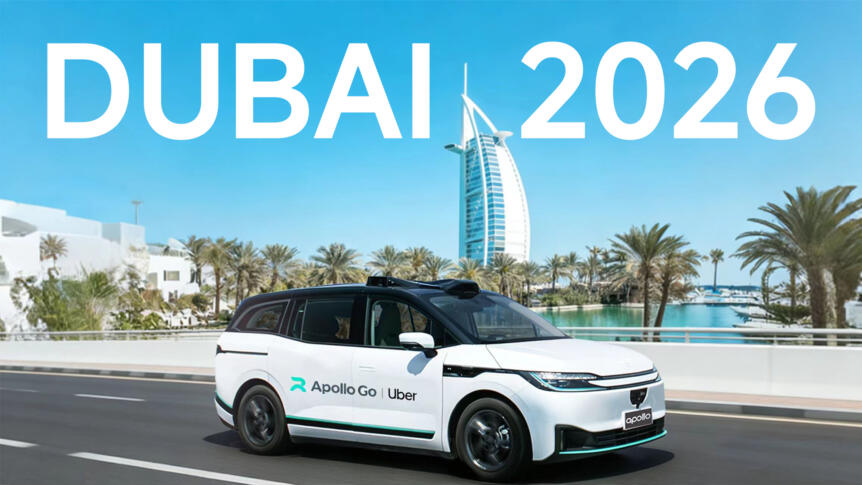
Editor’s note: Baidu and Uber have announced the next phase of their global partnership, bringing Baidu’s Apollo Go autonomous ride-hailing service onto the Uber platform in Dubai, in collaboration with the city’s Roads and Transport Authority. The service is expected to launch in the coming month across select areas of Jumeirah, with expansion planned as operational data is gathered and regulatory approvals progress. The move supports Dubai’s target to make autonomous trips account for 25 percent of all journeys by 2030 and marks another concrete step in integrating large-scale autonomous mobility into an existing, widely used ride-hailing network.
Key points
- Apollo Go fully autonomous vehicles will be bookable directly through the Uber app in Dubai.
- The initial rollout will cover select locations in the Jumeirah area, with phased expansion.
- Riders can be matched via UberX, Uber Comfort, or a dedicated “Autonomous” option.
- Fleet operations will be managed locally by third-party operator New Horizon.
- The deployment aligns with Dubai’s goal of 25 percent autonomous trips by 2030.
Why this matters
This launch places Dubai among a small group of cities testing autonomous ride-hailing at meaningful scale within a mainstream mobility platform. For the region, it signals growing regulatory confidence in driverless technology and reinforces the UAE’s position as a testbed for advanced AI-driven infrastructure. For builders and operators, the integration with Uber lowers barriers to consumer adoption, while providing real-world data on safety, usage, and scalability in dense urban environments.
What to watch next
- The timing and performance of the initial launch in Jumeirah.
- Regulatory approvals enabling expansion to additional districts in Dubai.
- Operational learnings from fleet management and rider adoption.
Disclosure: The content below is a press release provided by the company/PR representative. It is published for informational purposes.
DUBAI, UAE – February 10, 2026 – Baidu, Inc. (NASDAQ: BIDU and HKEX: 9888) and Uber Technologies, Inc. (NYSE: UBER), in partnership with Dubai's Roads and Transport Authority (RTA), today announced the next phase of their global partnership, bringing the Apollo Go autonomous ride-hailing service to the Uber platform in Dubai.
Expected to launch in the coming month, the fully autonomous vehicles will be available via the Uber app across select locations within the Jumeirah area, and the deployment will expand based on operational learnings and regulatory approvals across the city.
This collaboration also aligns directly with Dubai's ambitious goal of having 25% of all transportation trips be autonomous by 2030.
For trips within the service area, passengers will have the opportunity to be matched with an Apollo Go vehicle when booking an Uber Comfort or UberX, or by selecting the “Autonomous” option in the Uber app. Fleet management will be handled by third-party operator New Horizon.
“Bringing Apollo Go to Dubai via the Uber platform marks a pivotal step in our mission to provide safe, efficient, and accessible autonomous mobility worldwide,” said Nan Yang, Vice President of Baidu and General Manager of Overseas Business Unit, Intelligent Driving Group. “As a key deliverable of the strategic partnership between Apollo Go and Uber announced last July, this deployment officially brings our autonomous ride-hailing service to Dubai, utilizing Uber's vast network to turn our shared vision into reality.”
“We're excited to partner with Baidu as we continue to grow our autonomous footprint across Dubai. Just as we helped millions of people try out EVs for the first time, we will expand consumer access to autonomous technology in major cities around the world,” said Sarfraz Maredia, Global Head of Autonomous at Uber. “With more than 20 AV partners already completing millions of autonomous trips annually, Uber is the global platform where the autonomous vehicle industry can launch at scale."
This announcement comes on the heels of another market expansion last December, when the parties announced plans to bring the autonomous ride-hailing service to London, a right-hand drive market, as well as the inauguration of Apollo Go Park in Dubai in January, its first overseas operations and management hub.
As a leading autonomous ride-hailing service provider globally, Apollo Go has logged more than 240 million autonomous kilometers, of which over 140 million kilometers were completed in fully driverless mode. With a global footprint across 22 cities, Apollo Go's weekly ride count has recently surpassed 250,000, and the service has completed more than 17 million cumulative rides as of October 31, 2025.
About Baidu
Founded in 2000, Baidu's mission is to make the complicated world simpler through technology. Baidu is a leading AI company with strong internet foundation, trading on the NASDAQ under "BIDU" and HKEX under "9888." One Baidu ADS represents eight Class A ordinary shares.
About Uber
Uber's mission is to create opportunity through movement. We started in 2010 to solve a simple problem: how do you get access to a ride at the touch of a button? More than 68 billion trips later, we're building products to get people closer to where they want to be. By changing how people, food, and things move through cities, Uber is a platform that opens up the world to new possibilities.
Media Contacts
Baidu
intlcomm@baidu.com
Uber
press@uber.com
https://www.cryptobreaking.com/baidu-and-uber-launch-apollo/?utm_source=blogger%20&utm_medium=social_auto&utm_campaign=Baidu%20and%20Uber%20Launch%20Apollo%20Go%20Autonomous%20Ride-Hailing%20in%20Dubai%20
Comments
Post a Comment