
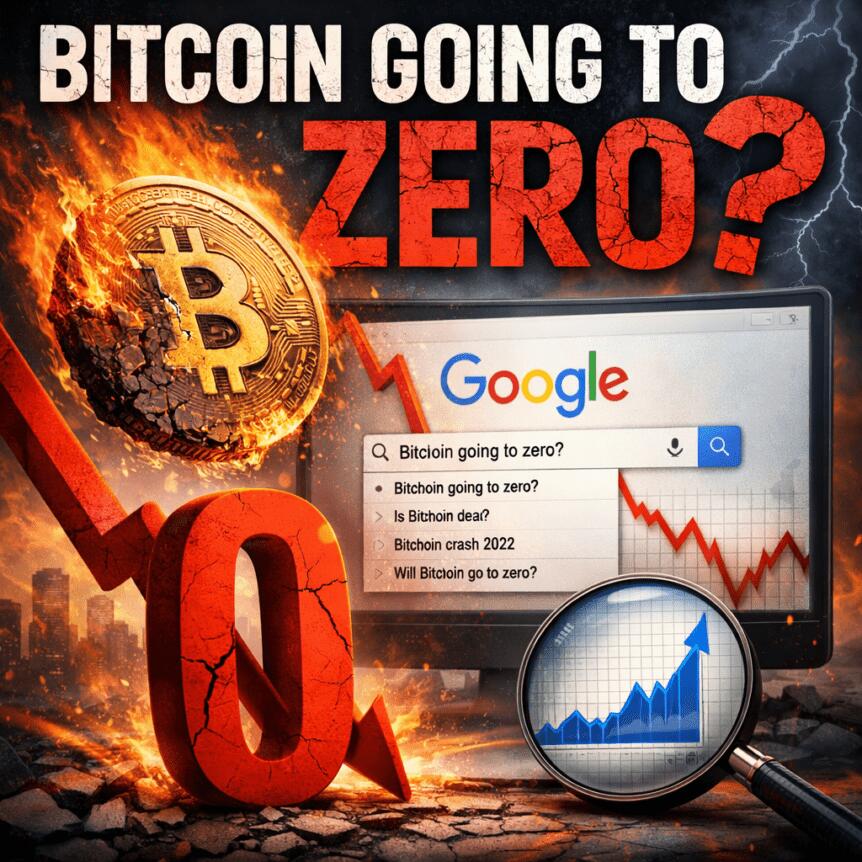
As fear and macro uncertainty weigh on markets, researchers report a spike in Google searches for "Bitcoin going to zero," marking the highest level since the FTX era panic in late 2022. Bitcoin has retreated from its Oct. 6, 2025 all-time high near $126,000 to roughly $66,500 at the time of writing, according to data tracked by Coingecko. The retreat comes as the Bitcoin Fear and Greed Index plunged into extreme fear, a mood reminiscent of past crises, while macro indicators register heightened anxiety that could influence risk appetite across asset classes. In this environment, institutional participants have continued to accumulate BTC even as retail chatter centers on worst-case scenarios, complicating the narrative around downside risk.
Key takeaways
- Google Trends shows searches for "Bitcoin going to zero" reach levels last seen during the November 2022 FTX crisis, signaling amplified fear rather than a narrowing probability of success.
- Bitcoin's price dropped from its Oct. 6, 2025 all-time high near $126,000 to about $66,500, marking roughly a 50% retracement from the peak.
- The Bitcoin Fear and Greed Index sank into extreme fear, with readings around 9, echoing the Terra collapse and the FTX fallout era.
- Macro uncertainty, as captured by global indices like the World Uncertainty Index (WUIGLOBALSMPAVG), sits near record levels, suggesting a cautious backdrop for risk assets.
- Even as headlines skew bearish, institutional buyers — including sovereign wealth funds and large corporates — are quietly increasing BTC exposures, often via ETFs and treasury strategies.
Tickers mentioned: $BTC
Sentiment: Neutral
Price impact: Negative. The asset traded down from its peak, signaling a retreat rather than a renewed uptrend.
Trading idea (Not Financial Advice): Hold. In a setting where macro headwinds and sentiment fluctuate, patience may be prudent given ongoing institutional demand and mixed narrative signals.
Market context: The current mix of macro uncertainty, risk-off sentiment, and evolving ETF flows continues to shape crypto liquidity and price action.
Why it matters
The contradiction at the heart of the current moment is stark: sentiment data — the Google Trends spike for catastrophic outcomes — points to heightened fear, while on the ground, large buyers appear to be amassing BTC. A crypto intelligence study analyzing 650+ crypto media sources found that the fear cycle in 2022 was driven largely by internally cascading failures in centralized lenders and a high-profile exchange crisis, whereas today’s fear is framed more by macro concerns and is amplified by a single bearish voice. The result is a narrative split between public perception and professional activity, a dynamic that can create abrupt shifts in risk appetite.
Bloomberg’s Mike McGlone has emerged as a dominant figure in the current bearish framing, repeatedly warning that Bitcoin could go to zero or near-zero. His stance has been described as a relentless, media-saturated forecast that crypto outlets have repeatedly echoed. The effect is a tightened feedback loop: more coverage feeds more searches, which in turn can influence retail behavior even as professional buyers continue to accumulate. The tension between fear-driven narratives and evidence of continued institutional interest is a key feature of the present market environment.
Nikolic notes that this time around the fear narrative benefits from macro dread, rather than the idiosyncratic shock seen in 2022. “This is not a single event; it’s a composite of price volatility, macro doom, and a prominent bearish voice all converging in a single window,” he said. The discussion around Bitcoin’s prospects is increasingly nuanced: while some voices warn of existential risk, others emphasize resilience and long-term demand, underscoring a market that can remain volatile even as core holders accumulate.
On the price front, Bitcoin’s swing from its October peak to the mid-$60,000s signals a significant retracement rather than a capitulation phase. The price action occurs in a broader risk-off backcloth, where macro indicators such as the World Uncertainty Index show elevated references to global risk and policy uncertainty. While fear in search trends runs hot, official data from on-chain analytics and ETF activity suggest a more complex dynamic than a straight-line decline. The tension between fear-based narratives and steady accumulation by institutions is likely to dominate the near-term discourse as traders weigh tactical entries against longer-horizon exposure.
The narrative around quantum risk has also hung over the market in fits and starts. While the topic has persisted as a backdrop since late 2025, searches for “Bitcoin quantum” surged earlier in the year but have since moderated. In Nikolic’s framing, quantum risk is an amplifier rather than a primary driver of price; it tends to intensify existing bearish sentiment when price action is weak, but it is not by itself a sufficient trigger for a sustained move lower. In this sense, the current spike in “Bitcoin going to zero” queries appears to be a confluence of price backdrop, macro anxiety, and the echo chamber effect of bearish voices in financial media.
Amid the fear narrative, there are tangible signs of demand on the other side of the ledger. Reports tracing ETF flows and corporate treasury strategies show ongoing BTC accumulation by both sovereign wealth funds and major corporations, even as retail chatter fixates on doom scenarios. This dichotomy reinforces the view that the crypto market remains a battleground of narratives, with price action often lagging behind shifts in sentiment and on-chain behavior. The interplay between media cycles, macro risk indicators, and institutional positioning will likely set the tone for the next phase of this cycle.
The broader macro backdrop remains a critical factor. The fear spike around “Bitcoin going to zero” is nested within a climate of record-level uncertainty, underscored by research indicating that spikes in global uncertainty can precede weaker growth and delayed investment. As the market absorbs both the fear-driven headlines and the evidence of ongoing demand, participants should remain attentive to policy signals, ETF development, and any fresh macro data that could recalibrate risk appetite. The rise and fall of emotion in crypto markets continues to be closely tied to global economic cues and the narratives built around them.
For readers seeking anchor points, several sources referenced in this narrative offer context: Google Trends provides the search data illustrating consumer fear; CoinGecko tracks Bitcoin’s price trajectory from its peak to the current level; and macro indicators such as the World Uncertainty Index contextualize the mood against a backdrop of global risk. The discourse around Bitcoin’s future is evolving, and while fear remains a potent force in the short term, it coexists with a persistent undercurrent of institutional support that could help stabilize the market over the longer horizon.
What to watch next
- Price action around the current mid-$60k range and any decisive move toward or away from the $70k level that could alter near-term momentum.
- Updates to the World Uncertainty Index and other macro indicators that might influence risk sentiment and capital allocation in crypto.
- ETF and institutional flow data, including potential shifts in sovereign wealth fund positioning and corporate treasury strategies.
- Regulatory developments or macro-policy signals that could sway the risk environment for digital assets.
Sources & verification
- Google Trends: the query “Bitcoin going to zero” worldwide over the last five years.
- CoinGecko data for Bitcoin price movements, including the Oct. 6, 2025 high and current levels around 66,500.
- Bitcoin Fear and Greed Index and related social discussions.
- World Uncertainty Index (WUIGLOBALSMPAVG) as a macro-risk gauge.
- IMF research on uncertainty spikes and growth implications (Bloom.pdf).
https://www.cryptobreaking.com/bitcoin-going-to-zero-google/?utm_source=blogger%20&utm_medium=social_auto&utm_campaign=Bitcoin%20Going%20to%20Zero?%20Google%20Searches%20Spike%20to%20Highest%20Since%202022%20
Comments
Post a Comment