
A data-driven study of crypto fundraising for 2025 sketches a market in transition: capital is flowing toward later-stage, revenue-generating ventures, while bold early-stage bets give way to disciplined, performance-focused financing. The report shows venture-capital activity in crypto and Web3 remained robust through the year, with quarterly investments in crypto startups exceeding $8 billion—the first sustained pattern since 2022. Total funding for 2025 surpassed $34 billion, roughly double the $17 billion tallied in 2024. A notable shift toward sustainable business models and concrete product-market fit helped steer deal dynamics, with seed rounds contracting as venture funds leaned into maturer rounds. The real-world asset (RWA) space emerged as a standout, attracting more than $2.5 billion in VC commitments as tokenization of traditional assets gained momentum.
Key takeaways
- Crypto venture capital investments topped $8 billion in every quarter of 2025, a first since 2022.
- Total 2025 funding reached about $34 billion, doubling 2024’s $17 billion.
- Seed-stage financing declined by 18%, while Series B rounds surged by about 90%, signaling deeper investor involvement at later stages.
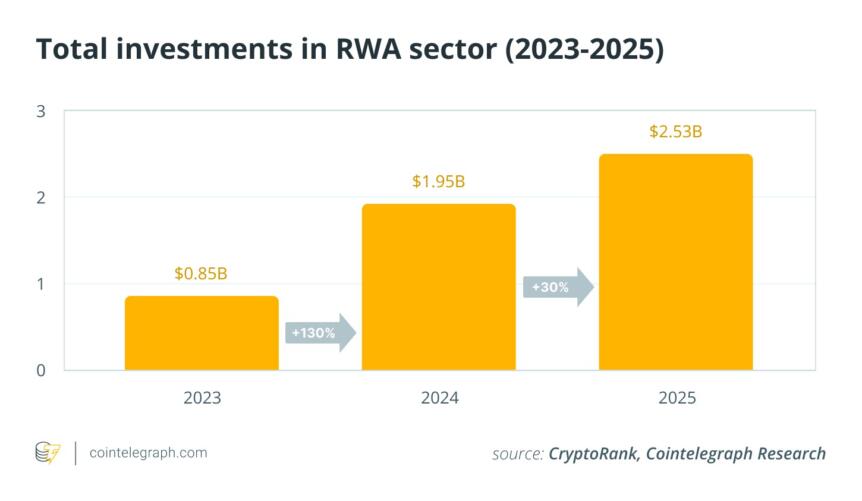
- RWA tokenization funding exceeded $2.5 billion in 2025, underscoring growing appetite for asset-backed crypto innovation.
- Funding for Ethereum layer 2s and modular infrastructure projects fell to $162 million in 2025, a 72% drop from the prior year as the sector became more crowded.
- Overall risk appetite among venture funds cooled in 2025, with a tilt toward more predictable, revenue-focused models amid geopolitical and rate-driven uncertainty.
Market context: The year unfolded against a backdrop of higher interest rates and geopolitical tensions, factors that pushed some investors toward bonds and traditional safe-haven assets while still channeling capital into select crypto subsectors. Sector rotation favored projects with credible monetization paths and scalable product-market fit, reinforcing the narrative that long-horizon capital remains available—not for speculative bets, but for ventures with disciplined growth strategies. This environment also reflected liquidity constraints and risk-off sentiment that tempered exuberance around early-stage ideas, even as corporate financing activity and strategic investments heated up in targeted areas like RWAs and asset-backed platforms.
Why it matters
The reported shift toward later-stage funding and sustainable business models signals a maturation of the crypto venture ecosystem. Startups that can demonstrate durable revenue streams and meaningful user engagement are more likely to attract capital in a year when investors balanced risk with potential real-world utility. The emphasis on product-market fit suggests that founders should prioritize roadmap execution, measurable traction, and path-to-profitability rather than pursuing growth without clear unit economics. For LPs and institutional backers, the data imply a preference for capital deployed where risk is managed and time horizons align with broader yield and risk considerations.
RWAs—tokenized representations of real-world assets—emerged as a focal point within this shift. With capitalization estimates reaching over $38 billion in tokenized RWAs (up 744% since 2022, according to RWA.xyz data), the space has moved from concept to a measurable segment of the crypto market. Venture funding for RWA-related tokenization exceeded $2.5 billion in 2025, reinforcing the perception that traditional assets can be efficiently integrated into decentralized finance, custody, and settlement rails. Yet the size of the RWAs market remains small relative to trillions in fixed income and equities, implying substantial room for expansion if liquidity and regulatory clarity continue to improve. This dynamic matters for investors seeking diversification and for builders pursuing enterprise-grade solutions that connect crypto markets with mainstream finance.
At the same time, the narrative around Ethereum layer 2s and modular infrastructure projects cooled. After a multi-year surge in L2 fundraising, activity in 2025 was notably subdued, with total funding dropping to $162 million—a sizeable decline driven by market saturation as more than 50 Layer 2 chains competed for limited block space and attention. The contraction underscores a broader lesson for builders and investors: in a crowded landscape, differentiation hinges on undeniable value propositions, such as scaling efficiency, security, interoperability, and tangible user adoption rather than sheer portfolio diversity. This shift does not negate the potential of L2 and modular solutions, but it does recalibrate expectations for near-term fundraising momentum and prompts a more selective approach to investment in infrastructure plays. For readers tracking sector health, this pattern aligns with a broader trend of consolidation and maturity within crypto infrastructure as liquidity and risk sentiment evolve.
What to watch next
- Review the full report for deeper sector breakdowns, including regional activity and corporate financing trends.
- Track 2026 fundraising cadence to see whether late-stage momentum persists or a renewed appetite for earlier-stage bets returns.
- Monitor regulatory developments surrounding RWAs, tokenization, and cross-border settlement that could shape market structure.
- Observe M&A and strategic investments within crypto and Web3 as institutional players seek to influence platform ecosystems.
Sources & verification
- VC Activity in Crypto and Web3 Report (PDF) at https://s3.cointelegraph.com/reports/VC_Activity_in_Crypto_and_Web3_Report.pdf
- RWA.xyz data on tokenized real-world assets capitalization and growth
- RWAs in DeFi overview and related analyses linked in the source material
- Coverage on venture-capital shifts, market maturation, and sector-specific funding trends
Crypto VC activity reshapes 2025: signals from the fund-raising data
In 2025, the crypto venture capital landscape reflected a nuanced recalibration of risk and opportunity. The data show that quarterly VC investments in crypto startups repeatedly surpassed $8 billion, signaling durable liquidity despite a cautionary macro backdrop. This pattern—first observed in the wake of 2022–2023 exuberance—illustrates how institutions are allocating capital with a longer time horizon and a sharper focus on returns and resilience. The overall funding for the year reached about $34 billion, a doubling from 2024’s $17 billion, underscoring that capital remained plentiful even as market participants tempered expectations around rapid, early-stage growth. The takeaway is clear: the market is not retreating; it is reallocating toward ventures with validated product-market fit and scalable business models.
Among the standout narratives, real-world assets rose from strategic concept to measurable market momentum. Tokenized RWAs crossed a notable threshold in capitalization, with figures exceeding $38 billion and rising from $4.5 billion in 2022, according to industry data. This growth translated into more than $2.5 billion in VC commitments in 2025 for RWA-focused projects, signaling both investor confidence and the potential for RWAs to anchor a larger portion of crypto’s capital formation. For observers, the trajectory suggests that bridging traditional finance with decentralized infrastructures—through tokenization, custody, and efficient settlement—could become a core growth vector in the medium term.
At the same time, funding for Ethereum layer 2s and related modular infrastructure saw a marked slowdown. After rapid expansion during the preceding years, 2025 recorded only about $162 million in L2-related financing, a drop of roughly 72% versus 2024. Analysts attribute part of the decline to a crowded L2 landscape—more than 50 distinct chains competing for liquidity and network effects—leading investors to demand clearer differentiation and stronger monetization pathways before backing new L2 ventures. The shift does not negate the potential of scaling solutions but reinforces the need for sustainable business models, robust technology, and meaningful adoption metrics to justify continued capital allocation in a crowded field.
Beyond sectoral shifts, the data point to broader changes in VC behavior. Seed-stage funding declined by about 18%, while Series B rounds surged by nearly 90%, illustrating a preference for ventures with proven product-market fit and a clearer path to profitability. This pattern aligns with a risk-off environment where investors are less inclined to back unproven concepts and more inclined to back ventures that can demonstrate realistic growth trajectories and durable earnings potential. In short, 2025’s fundraising dynamics reflect a maturation of the crypto VC ecosystem: capital remains available, but it is increasingly preferential, depth-first, and outcome-driven.
https://www.cryptobreaking.com/crypto-vc-funding-doubled-in/?utm_source=blogger%20&utm_medium=social_auto&utm_campaign=Crypto%20VC%20Funding%20Doubled%20in%202025%20as%20RWA%20Tokenization%20Led%20the%20Way%20
Comments
Post a Comment