
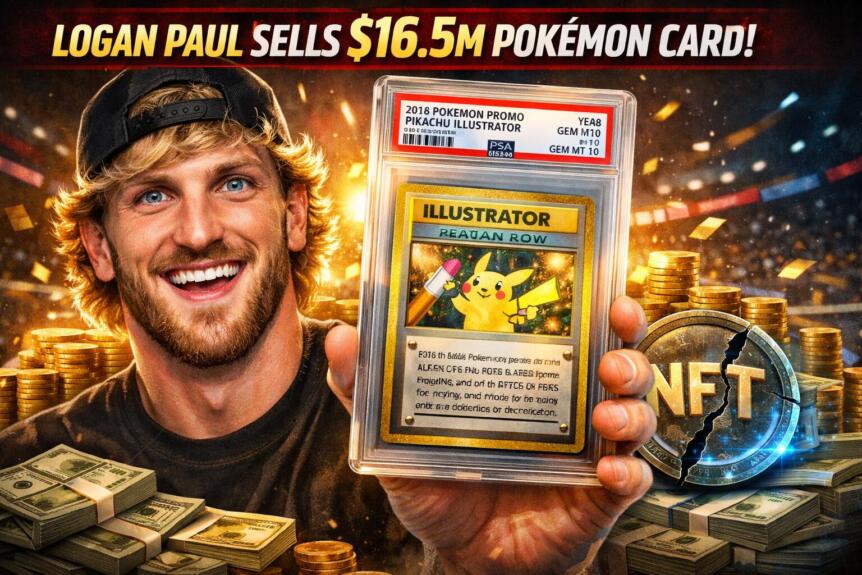
YouTube personality Logan Paul surged back into the headlines in a high-stakes moment for the NFT collectibles world, as the PSA-graded Pikachu Illustrator card sold at auction for 16.492 million dollars, setting a new record for any card sold at public sale. The sale, conducted by Goldin Co, crowned AJ Scaramucci—the son of financier Anthony Scaramucci—as the winning bidder, triumphing over a field that included several seven- and eight-figure offers. Paul had originally acquired the card in July 2021 for about 5.3 million dollars, and the latest auction netted him a substantial gain after fees. The record was celebrated by some, but it also reopened debate about the risks and nuances of tokenizing ownership in rare collectibles.
Key takeaways
- Record-breaking sale: The PSA 10 Pikachu Illustrator card fetched 16,492,000 dollars at auction, the highest price ever paid for a card in a public sale.
- Provenance and rarity: The card is one of 39 created in a 1990s contest, underscoring the scarcity that drives top-tier NFT-like investments in physical collectibles.
- Original purchase and profit: Logan Paul disclosed that he bought the card for about 5.3 million dollars in July 2021, positioning the auction as a multi-year hold with a roughly 8 million dollar post-fee gain.
- Controversy and tokenization concerns: The sale revived scrutiny of Paul’s 2022 fractionalization of the card via Liquid Marketplace, a project that later went offline, triggering regulatory and investor concerns.
- Regulatory and legal echoes: The Ontario Securities Commission pursued a case related to Liquid Marketplace, highlighting ongoing tensions around fractionalized digital assets and investor protections.
Sentiment: Neutral
Market context: The spectacle sits against a broader backdrop of fluctuating demand for non-fungible tokens and tokenized collectibles, where marquee auctions can coexist with a cooling market for digital assets and a wave of platform consolidations or shutdowns that underscore risk management considerations for investors.
Why it matters
The Pikachu Illustrator sale stands as a landmark event in the intersection of traditional collectibles and crypto-adjacent dynamics. It demonstrates that even as the underlying asset is a physical card, the attention, liquidity, and bidding competition surrounding it often mirror the volatile narratives that pervade the NFT space. For collectors, the record price signals a willingness to prize rarity and history, even as other segments of the market struggle with price declines and platform friction.
Yet the deal also spotlights the fragility of fractional ownership models that sought to democratize access to high-value collectibles. The 2022 Liquid Marketplace project, which fractionalized ownership of the Pikachu Illustrator, faced a shutdown that left investors with uncertain returns and prompted a high-profile regulatory response from Canada’s Ontario Securities Commission. While Logan Paul was not named in the OSC's action, the case has become a touchstone in debates over how “slop tokenization” and ambiguous rights structures can affect risk, liquidity, and investor confidence in asset-backed digital securities.
Moreover, the broader NFT market context—characterized by a sharp contraction in market capitalization and recent closures of notable platforms—frames this record as both a triumph of hype and a reminder of the sector’s ongoing maturation. After a surge in early 2026, the NFT market cap has retraced significantly, with high-profile platforms exiting the space and investors recalibrating expectations around utility, royalties, and long-term value creation. The tension between the prestige of a rare physical collectible and the complexities of its digital-era ownership constructs remains central to how future auctions and tokenization experiments will be evaluated.
What to watch next
- Upcoming regulatory or legal clarifications surrounding fractionalized collectibles and their rights in secondary markets.
- Any statements or disclosures from Liquid Marketplace or related platforms about lessons learned, user redress, or restoration of services that impact investor confidence.
- Continuing developments in the NFT and broader collectibles markets, including platform consolidations or new entrants that aim to address custody and liquidity.
- Follow-up reporting on long-term outcomes for investors who participated in the earlier fractionalization and how those experiences influence future tokenization experiments.
Sources & verification
- Auction details and sale price reported by the event organizer and press coverage of AJ Scaramucci’s win.
- Logan Paul’s public remarks on the original purchase price and the subsequent auction, including public posts and commentary.
- Regulatory actions and investor concerns tied to Liquid Marketplace and related class-action or securities inquiries in Canada.
- Context on the NFT market’s recent trajectory, including platform closures and market-cap data from industry trackers.
Record-breaking sale and the evolving risk landscape for tokenized collectibles
The headline-grabbing auction of the PSA-10 Pikachu Illustrator card marks a historic apex for a card that exists at the edge of traditional collecting and modern digital commerce. The card’s rarity is unmistakable: among the 39 instances produced in the 1990s, the PSA 10 grade represents a pinnacle of condition for a specimen so scarce. AJ Scaramucci's victory, reportedly outpacing multiple seven- and eight-figure bids, underscores the enduring appeal of blue-chip collectibles, even as the public eye remains fixed on the equity and crypto markets that often orbit these assets.
Paul’s own timeline adds another layer of interest. He acquired the card in mid-2021 for approximately 5.3 million dollars, and the latest sale delivered an inflow of roughly 16.5 million dollars before fees—a clear example of substantial, multi-year appreciation that can accompany celebrity-backed collectibles. Yet the triumph sits alongside a cautionary tale about the mechanisms used to broaden ownership. The 2022 fractionalization on Liquid Marketplace distributed a sliver of the card’s ownership to dozens of participants, a model that, in practice, has complicated investor returns once the platform went offline and liquidity evaporated for those holders.
Those complexities have sparked a debate about the practical value of tokenizing rare assets. Gabriel Shapiro, general counsel for Delphi Labs, described Paul’s fractionalization as a “classic case of ‘slop tokenization’,” arguing that the token did not convey meaningful property rights and urging investors to review terms of service carefully. Paul countered that Liquid Marketplace’s offline status was outside his control and that he acted to restore the platform so users could withdraw funds, pointing to a partial recovery of only 5.4% of the card’s fractionalized ownership, corresponding to roughly 270,000 dollars in claims.
. @LoganPaul's rare @Pokemon card becomes most expensive ever sold in record-setting auction.
The PSA-10 Pikachu Illustrator went on sale via @GoldinCo and eventually sold for $16,492,000.https://t.co/B1YBUIqhbx
— Guinness World Records (@GWR) February 16, 2026
On the regulatory front, the Ontario Securities Commission filed a case in June 2024 addressing concerns around Liquid Marketplace and similar fractionalized offerings. While Paul was not named in that action, the proceedings have become a focal point for discussions about investor protections, disclosure standards, and the responsibilities of platforms that tokenize ownership interests in high-value assets. The broader backdrop is equally instructive: the NFT market has cooled after a strong start to 2026, with several prominent marketplaces winding down operations in recent weeks, and total market capitalization for NFTs having declined substantially from earlier highs. These dynamics contextualize why a new all-time high for a traditional collectible can still coexist with a tougher environment for digital-native assets.
Beyond the headlines, the Pikachu Illustrator sale raises questions about long-term value creation in the digitized era. On one hand, the public’s willingness to bid aggressively for a single, storied card signals persistent demand for scarcity and provenance. On the other hand, the liquidity and governance structures surrounding fractional ownership demand rigorous scrutiny as the sector evolves. For collectors, investors, and builders alike, the case underscores the importance of clear terms, verifiable rights, and robust custody arrangements as the line between physical collectibles and digitalized ownership becomes increasingly blurred.
https://www.cryptobreaking.com/logan-paul-sells-16-5m/?utm_source=blogger%20&utm_medium=social_auto&utm_campaign=Logan%20Paul%20Sells%20$16.5M%20Pokémon%20Card,%20Years%20After%20Fractional%20NFT%20Row%20
Comments
Post a Comment