
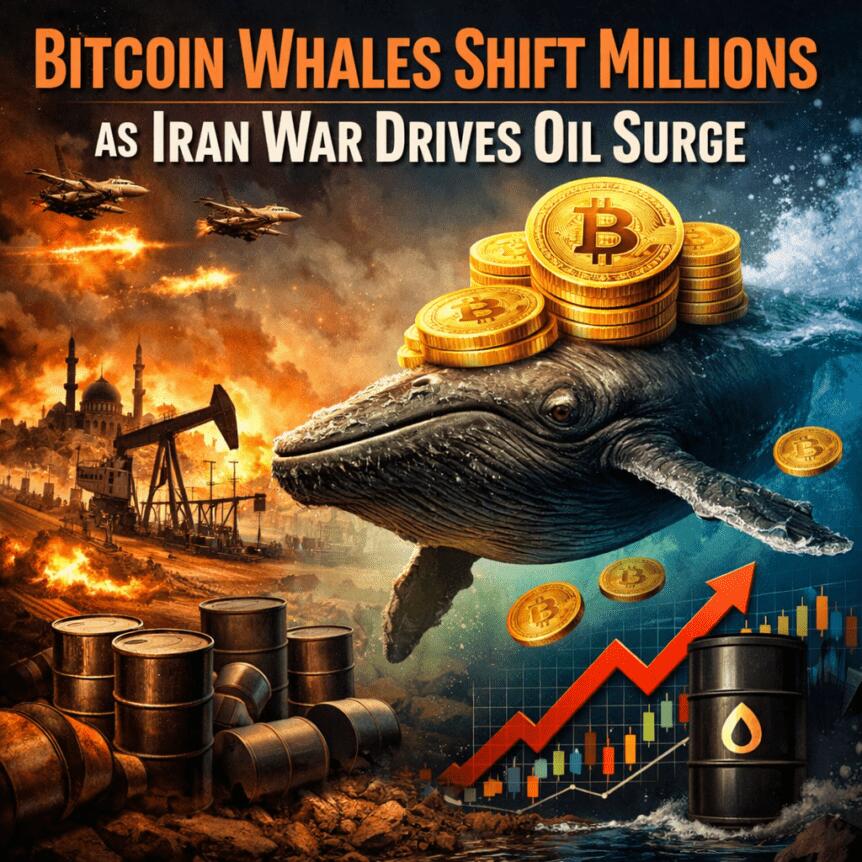
Bitcoin slid as geopolitical shocks in the Middle East reverberated through energy markets, pushing crude prices higher and prompting a fresh round of profit-taking among long-term holders. Large, one-time transfers—conducted by an ancient BTC whale and one of the earliest adopters—added to the sense that risk appetite was evaporating as investors weighed the intersection of conflict, energy supply concerns, and crypto exposure.
Blockchain trackers reported notable moves from historical bitcoin wallets on the same day that Brent crude surged past $119 per barrel before retreating, and European energy prices spiked in response to attacks on gas infrastructure in the region. The broader macro backdrop has crypto traders watching for where the next large liquidity shift might come from, as the balance between risk-off sentiment and perceived safe-haven demand remains unsettled.
Key takeaways
- A long-destined bitcoin whale moved 1,000 BTC to Binance on Wednesday, after purchasing 5,000 BTC around 13 years ago. The address reportedly still holds roughly 1,500 BTC, worth about $106 million at current prices.
- One of the earliest BTC holders, Owen Gunden, transferred 650 BTC to Kraken on the same day, marking his first substantial sale in five months. He previously liquidated a large portion of his stack, around 11,000 BTC, in a prior period.
- Bitcoin traded around $70,400, down about 5% over 24 hours, as traders weighed the conflict-driven energy shock against ongoing macro uncertainty. Gold also softened, dipping roughly 4% to around $4,686 per ounce.
- Geopolitical events linked to Iran, Israel, and Qatar pushed energy benchmarks higher, with Brent briefly tipping above $119 before retreating, and WTI testing the $100 level in intraday moves.
- Analysts characterized the move as part of a broader risk-off shift rather than a straightforward move into safe-haven assets, underscoring ongoing questions about how crypto assets react to geopolitical stress.
Whale activity amid macro turmoil
Data from Arkham indicates that the so-called “bc1ql” whale—one of the most famous address labels in the bitcoin ecosystem—sent 1,000 BTC to Binance on Wednesday. The address originally acquired 5,000 BTC about 13 years ago and remains a significant UTXO holder, with roughly 1,500 BTC still in reserve, according to Onchain Lens analysis of the wallet’s balance history.
Meanwhile, Owen Gunden—one of the earliest BTC holders—moved 650 BTC to Kraken on the same day. Lookonchain reported this as his first sizeable sale in five months, part of a pattern of selective liquidity operations during a period of heightened macro noise.
Aurelie Barthere, principal research analyst at crypto intelligence platform Nansen, noted that the BTC sell-off appeared to be connected to a broader risk-off phase driven by the energy shock in the Middle East. “BTC began to sell off yesterday around noon CET, following the escalation of the war between Iran and Israel and the attack on gas infrastructure in Qatar,” she told Cointelegraph, adding: “If we fail to hold the $70K–$71K level, we could return to the previous range of approximately $60K–$71K.”
Energy markets in flux deepen crypto uncertainty
The same day, energy markets reacted decisively to the regional tensions. Brent crude surged past $119 per barrel before easing to about $114.77, while West Texas Intermediate moved in a similar range, briefly touching $100 before trading near $96.50, according to Trading Economics. The price action underscores how geopolitical catalysts can quickly translate into risk-off dynamics across traditional and digital asset markets.
New developments in the region further intensified market attention. Reports emerged that Israel conducted strikes on Iran’s South Pars gas field—a component of the world’s most prolific natural gas reserve, which Iran shares with Qatar. The South Pars field has long been a focal point for debates about regional energy security and its potential spillover effects on energy prices globally. In the wake of the strikes, energy headlines dominated market screens, with Western wholesale gas prices in Europe and the UK spiking as European buyers weighed potential supply disruptions.
These energy-market ripples helped propel a narrative that the crypto market’s recent risk-off move is not a pure flight-to-safety among crypto bulls, but rather a broader shift away from risk assets in a period of heightened geopolitical risk. As Barthere put it, the interplay between energy prices, macro risk, and crypto exposure is still ambiguous—investors will be watching whether bitcoin can defend the key psychological level around $70,000.
Bitcoin’s price path amid a mixed risk environment
Bitcoin’s price action reflected a cautious stance among traders. As of early European trading hours, BTC traded around $70,440, down roughly 5% on the day, according to CoinMarketCap data. The pullback mirrors a concurrent decline in gold, which shed about 4.2% to roughly $4,686 per ounce, signaling that even traditional haven assets were not immune to the risk-off tone at the time.
Analysts stressed that this is not a straightforward “buy-the-dip” moment for all investors. Rather, it is a climate in which macro shocks, energy-market volatility, and geopolitical risk converge to shape liquidity flows. The key question for participants is whether BTC can hold the $70,000–$71,000 zone, which may prove pivotal in determining whether the market stabilizes in the near term or if the next leg down tests lower ranges.
“If we fail to hold the $70K–$71K level, we could return to the previous range of approximately $60K–$71K,” Barthere summarized, highlighting how quickly support levels can become contested when macro drivers shift abruptly. In this environment, traders and investors may need to consider both on-chain signals, such as whale balance movements, and off-chain indicators, including energy pricing and geopolitical risk proxies, to calibrate risk and potential hedges.
What remains uncertain is how durable the current risk-off mood will prove, and whether fresh catalysts—such as diplomatic developments or escalations in regional tensions—will reorient flows toward or away from digital assets. Market participants will be watching for any signs that key support holds and whether larger players—whether legacy funds or new entrants—adjust their allocations in response to evolving macro conditions.
As the situation in the Middle East continues to unfold, investors should keep a close eye on on-chain movements from long-held wallets, shifts in correlated markets like oil and gold, and the evolving narrative around bitcoin’s role in a high-uncertainty environment. The coming days could reveal whether this is a temporary liquidity squeeze or the first stage of a longer adjustment in crypto demand amid a broader macro pivot.
Readers should watch forthcoming updates on energy-market developments and on-chain whale activity, which together may illuminate the next leg for bitcoin’s price and its evolving relationship with traditional financial markets.
https://www.cryptobreaking.com/bitcoin-whales-shift-millions-as/?utm_source=blogger%20&utm_medium=social_auto&utm_campaign=Bitcoin%20whales%20shift%20millions%20as%20Iran%20war%20drives%20oil%20surge%20
Comments
Post a Comment