
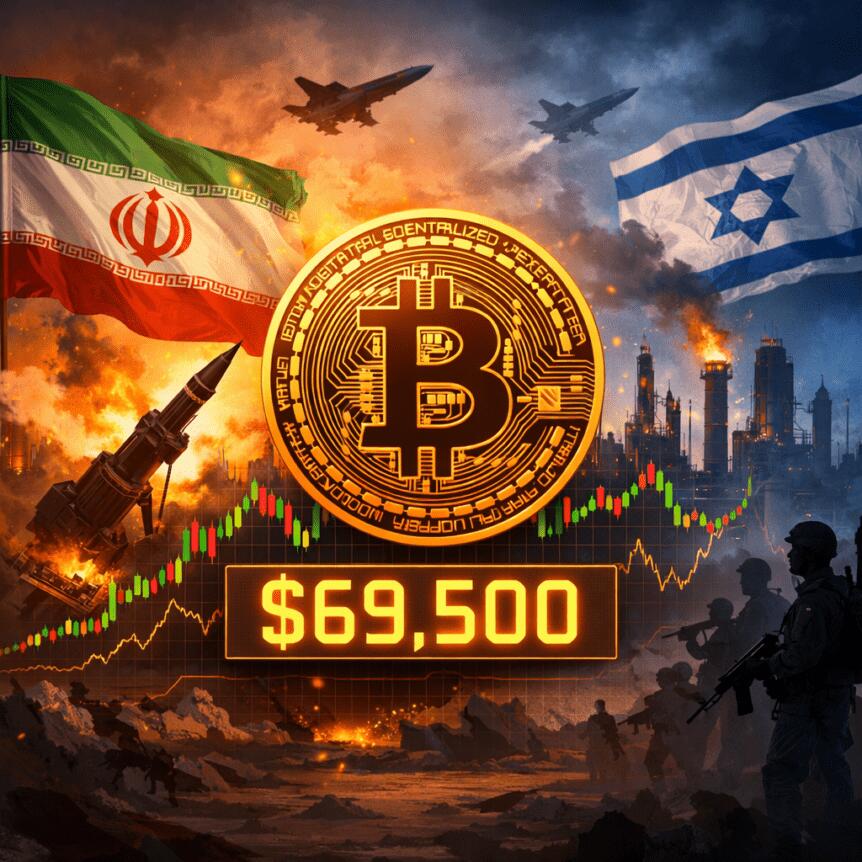
Bitcoin slipped below the $70,000 mark as macro risk assets came under pressure amid renewed Middle East tensions, renewing questions about BTC’s sensitivity to broader markets. The September session saw BTC pull back after a brief sprint to around $71,800 earlier in the week, with traders watching how the next move would unfold in an environment where oil, equities, and geopolitical risk remain intertwined.
Analysts described the scene as a palpable test for Bitcoin’s resilience in a risk-off backdrop, with some arguing that a potential regime shift—where BTC behaves less like traditional risk assets—could be forming, even as others warn that volatility and downside risk persist until macro momentum cools.
Key takeaways
- Bitcoin briefly fell through the $70,000 level as macro selling pressure hit risk assets, with intraday moves signaling continued volatility.
- Oil hovered near $95 per barrel, and U.S. stock indices opened lower as tensions in the Middle East and related supply concerns weighed on sentiment.
- Market color from QCP Capital framed the price action as a balancing act by policymakers, suggesting authorities are aiming to maintain stability even as geopolitical risks linger.
- Some observers saw early signs of a Bitcoin regime shift, with higher-lows patterns suggesting emerging strength that could challenge traditional risk asset correlations if sustained.
- Technical readings pointed to a contested footing around the 200-week average, with the metric around $68,300 acting as a ambiguous boundary and keeping the near-term outlook nuanced.
Macro backdrop and price dynamics
As U.S. markets opened, BTC traded on the back foot, losing roughly 1.5% on the day and retreating from an early-week push toward the $72,000 area. In traditional markets, the Nasdaq Composite slipped, while gold struggled to push decisively past $4,450. Oil’s oscillation—tending toward $95 per barrel after an initial retreat—reflected ongoing concerns about energy flow. The broader geopolitical backdrop, including tensions in the Strait of Hormuz and regional developments, kept risk sentiment on edge and complicated the path for a clear risk-on/risk-off regime for crypto assets.
Analysts pointed to the interplay between oil prices, sanctions headlines, and macro liquidity as a frequent driver of short-term Bitcoin moves. In such a climate, a single headline can shift correlations as traders reassess leverage, hedging needs, and the role of BTC within diversified portfolios.
Resilience, regime shift, and what it could mean for BTC
Market observers have debated whether Bitcoin’s current action signals a broader shift in how it behaves relative to traditional risk assets. QCP Capital, in its Market Color briefing, argued that President Trump’s handling of geopolitical risk and market stability creates a difficult balancing act: equities sit near key support, inflation pressures continue to influence expectations for rate hikes, and policymakers cannot afford to spur additional volatility. In this view, BTC’s relative steadiness in the face of rising tensions could reflect structural factors such as lower systemic leverage or, more intriguingly, the early stages of a regime shift where BTC does not track risk assets in the same way as before.
Indeed, several traders highlighted constructive technical signs, even as the overall backdrop remains fragile. Michaël van de Poppe pointed to a pattern of higher lows forming since the February crash, suggesting increasing strength if support holds. He cautioned, however, that the picture isn’t “out of the woods” yet, noting that higher lows can still trigger liquidity waves if markets move toward those levels. For a potential bullish runway, he pointed to a target in the high range around $77,000 to $80,000 if Bitcoin sustains the current support area.
On the other side of the spectrum, some analysts warned that weakness could reemerge. A well-known trader warned about a possible Bart Simpson-style pattern playing out on lower timeframes, underscoring the risk that a relief rally could falter without broader macro improvement. Such viewpoints reflect the ongoing tug-of-war between short-term momentum and longer-term structural factors shaping BTC’s trajectory.
Technical reading and near-term implications
The technical picture remains nuanced. The 200-week exponential moving average (EMA), around $68,300, has not delivered a definitive answer on support or resistance, allowing for continued choppiness in the near term. Some market participants suggest that BTC could trade within a broader range until macro catalysts clarify the directional bias, while others argue that strength in the form of higher-lows could precede a renewed upside leg if key levels hold through resistance tests.
In this environment, near-term risk management becomes paramount. Traders are watching whether Bitcoin can maintain the recent higher-lows trajectory, how it behaves around the critical $70,000 level, and how external factors such as oil prices and geopolitical headlines influence liquidity and collateral dynamics in the crypto market.
What readers should watch next
jolts in macro sentiment, particularly around Middle East developments and oil supply expectations, will be crucial in shaping Bitcoin’s path over the coming sessions. A sustained hold above the $70,000 threshold, coupled with a clear push beyond the mid-$70,000s, could renew optimism for the next leg higher. Conversely, renewed downside pressure—especially if macro risk appetite deteriorates—could see BTC retest lower supports in the near term.
Market participants will also be parsing the evolving relationship between Bitcoin and traditional risk assets, as crypto traders increasingly weigh whether a regime shift is underway or if current moves are simply a pause within a longer, volatile cycle.
This article synthesizes market observations and analysis from the period, reflecting published commentary and price action without asserting new claims beyond the cited material.
https://www.cryptobreaking.com/geopolitical-tensions-with-iran-leave/?utm_source=blogger%20&utm_medium=social_auto&utm_campaign=Geopolitical%20Tensions%20With%20Iran%20Leave%20Bitcoin%20Hovering%20Near%20$69.5K%20
Comments
Post a Comment