
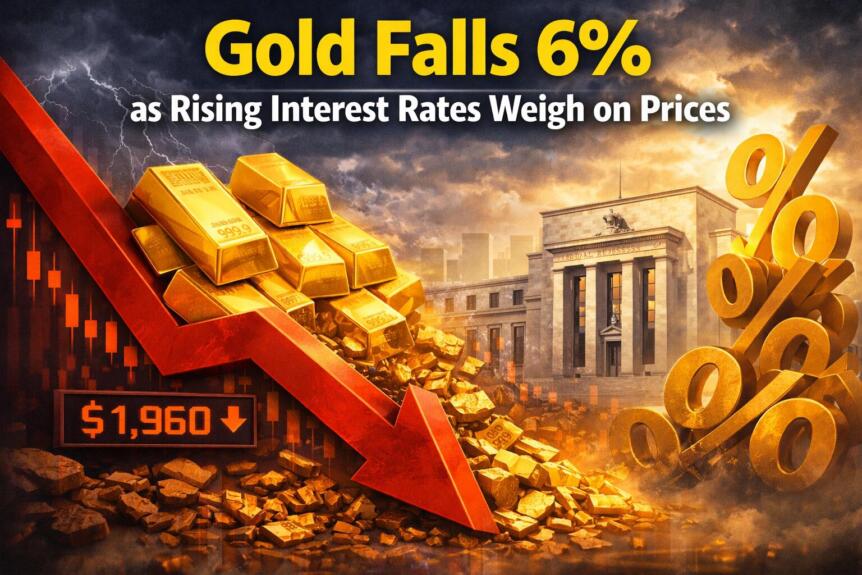
This press release reports a sharp decline in gold prices, which fell 6% on Monday after a 10% slide last week as macro conditions shifted. March is shaping up as one of the weakest months on record, with prices down about 21% since the month began. The move is tied to rising inflation expectations and a evolving rate outlook, alongside higher oil prices driven by regional conflict. Investors are pushing back expected US rate cuts and pricing in the possibility of faster hikes in the UK and Europe. The report notes ETF outflows and profit-taking in a broader liquidation phase, while central-bank purchases provide longer-term support.
Key points
- Gold fell 6% on Monday after a 10% decline last week, with March down nearly 21% from the month's start.
- US 10-year Treasury yield rose by about 0.5 percentage point to 4.421%, its highest since summer 2025.
- ETF outflows and profit-taking are contributing to a broader liquidation in bullion markets.
- Central-bank purchases provide ongoing structural support for gold over the longer term.
Why it matters
Gold’s appeal as a safe-haven asset is tested by higher yields and a shifting rate outlook, while ongoing central-bank purchases provide longer-term support; this combination suggests near-term volatility may persist for investors and markets. The dynamics affect traders, asset allocators, and policymakers assessing risk and diversification in a volatile macro environment.
What to watch
- Near-term volatility as markets adjust to higher rate expectations and inflation dynamics.
- Any shifts in rate expectations in the US, UK, and Europe based on evolving policy signals.
- Ongoing central-bank purchases and ETF flows shaping bullion demand.
Disclosure: The content below is a press release provided by the company or its PR representative. It is published for informational purposes.
Gold Slumps 6% as Interest Rates Rise
Abu Dhabi, UAE – March 23, 2026: Gold prices have come under significant pressure, falling 6% on Monday after a 10% decline last week, as shifting macroeconomic conditions weigh heavily on the precious metal. March is now shaping up to be one of the weakest months on record for gold, with prices down nearly 21% since the beginning of the month.
Traditionally viewed as a safe-haven asset during periods of geopolitical uncertainty, gold is currently facing headwinds from rising inflation expectations and a rapidly evolving interest rate outlook. The escalation of conflict in the Middle East has driven oil prices higher, fueling inflation concerns and prompting markets to reassess monetary policy expectations.
Investors are increasingly abandoning expectations of interest rate cuts in the United States, while preparing for the possibility of faster rate hikes in the UK and Europe. This shift has significantly altered the investment landscape, reducing the appeal of non-yielding assets such as gold.
At the same time, yields on US government bonds have surged, with the 10-year Treasury yield rising by nearly 0.5 percentage points since the start of the month to 4.421%—its highest level since the summer of 2025. Higher yields are strengthening currencies and exerting downward pressure on equities, further diminishing the relative attractiveness of gold.
In addition, the market is experiencing a wave of profit-taking following gold’s strong performance last year, when prices rose by approximately 66%. This has contributed to a broader liquidation phase, marked by ETF outflows, forced selling, and investors closing positions to offset losses in other asset classes.
Despite these short-term challenges, structural support for gold remains intact, particularly from ongoing central bank purchases, which have underpinned the longer-term bullish trend.
Jakub Rochlitz, Market Analyst at eToro, commented: “Gold is currently caught between two opposing forces. While geopolitical tensions would support demand for safe-haven assets, the inflationary impact of rising energy prices is driving expectations of higher interest rates, which is weighing heavily on gold.
What we are seeing resembles a classic liquidation phase, with investors taking profits after last year’s strong rally and repositioning in response to changing macro conditions. In the near term, volatility is likely to remain elevated as markets adjust to these dynamics.
Looking further ahead, the long-term outlook for gold has not been entirely undermined. Its performance will depend on how the geopolitical situation evolves, how inflation trends develop, and how central banks respond.”
https://www.cryptobreaking.com/gold-drops-6-amid-rising/?utm_source=blogger%20&utm_medium=social_auto&utm_campaign=Gold%20Drops%206%%20Amid%20Rising%20Interest%20Rates%20
Comments
Post a Comment