
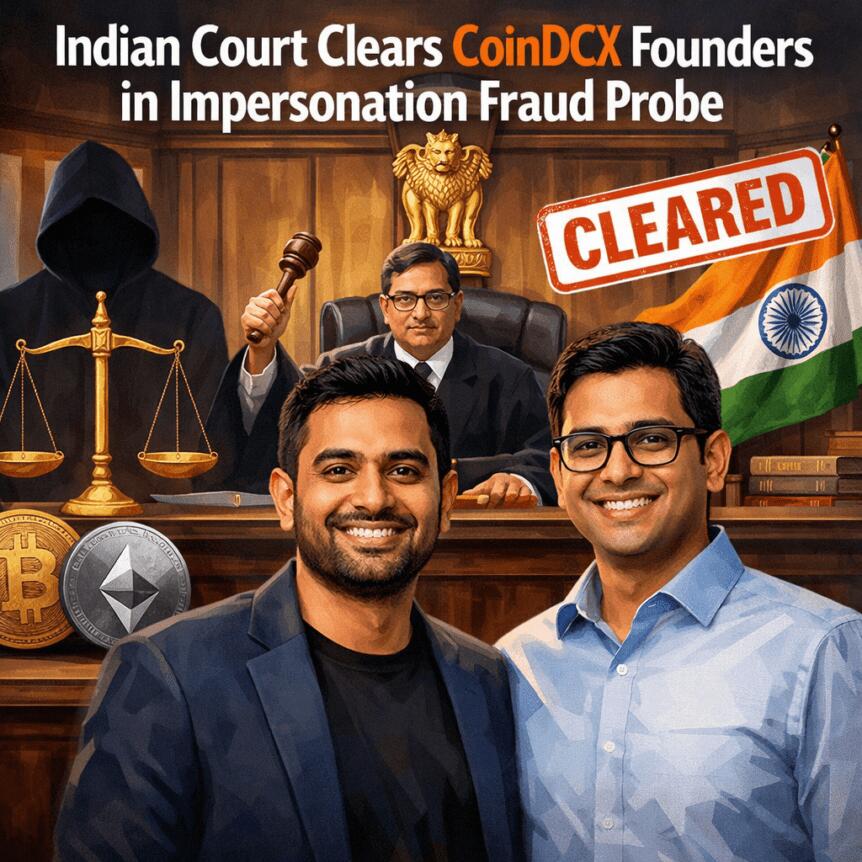
A Thane magistrate court in India has granted bail to CoinDCX co-founders Sumit Gupta and Niraj Khandelwal after a 71 lakh rupee cheating complaint tied to a fake trading platform impersonating the Indian crypto exchange. The March 23 common order found no prima facie case against the founders, who were questioned and remanded over the weekend amid allegations they defrauded an investor. The court noted that the informant had admitted in court that another person, not the applicants, was involved in the fraudulent scheme and that an amicable settlement had been reached in the matter.
In a move that underscores the ongoing risk of impersonation in the crypto space, CoinDCX responded on March 24 via X (formerly Twitter), saying the proceedings reinforced a third‑party impersonation scenario. The firm emphasized that the fraud occurred on a counterfeit site, coindcx.pro, which has no connection to CoinDCX. The company urged users to verify domains and interact only with the exchange’s official platform and social profiles.
Key takeaways
- The Thane court granted bail to CoinDCX co-founders Sumit Gupta and Niraj Khandelwal after ruling there was no prima facie case, based on the information available at the initial stage of the investigation.
- The alleged fraud involved a lookalike site, coindcx.pro, described by CoinDCX as unaffiliated with the company, illustrating a broader impersonation risk facing Indian crypto platforms.
- Judges noted that the informant had filed an affidavit stating another accused, Rana, had repaid the cheated amount, and that the founders were not present at the café in Mumbra where the deal occurred. The matter was described as amicably settled, reducing the likelihood of evidence tampering claims.
- CoinDCX publicly framed the incident as a case of third‑party impersonation, reinforcing the need for users to verify domains and interact only with official channels to curb phishing and scam risk.
- The case highlights the ongoing tension between fast‑moving crypto‑sector growth in India and the persistent risk of brand impersonation, phishing, and counterfeit platforms targeting investors and users.
Legal framing: What the bail order reveals
The court’s order indicates that the investigation officer had “no objection” to releasing Gupta and Khandelwal on bail, a procedural signal often used when authorities see insufficient immediate evidence to justify continued detention. The magistrate also observed that the accused were not present at the location of the alleged offense and that the informant acknowledged in court that another individual could have represented themselves as the accused to defraud the investor. The “amicable settlement” between the informant and the principal accused further complicated the prosecution’s case, suggesting a potential resolution that could limit the scope of trial proceedings.
Both founders were released on bail upon a bond of 50,000 Indian rupees (about $530) with conditions to cooperate with the investigation and stand trial if required. While bail offers temporary relief from detention, it does not conclude the merits of the underlying allegations, and the case could proceed if prosecutors pursue further charges or uncover new evidence.
Impersonation, phishing, and the risk to users
The broader context of this episode is the rising incidence of impersonation and phishing aimed at India’s crypto ecosystem. CoinDCX’s statement frames the incident as part of a pattern in which fraudsters mimic well-known brands and create lookalike platforms to deceive investors. The company urged users to validate domain names, avoid responding to offers from unverified sources, and rely on the exchange’s official channels for trading and communications. For readers watching regulatory developments, this case underscores why incident‑response and security best practices are increasingly central to crypto firms’ operating models.
The incident also resonates with a wider industry concern: how to differentiate legitimate platforms from counterfeit sites, especially when the lookalikes copy branding and user interfaces with alarming fidelity. For investors and traders, the episode reinforces the practical need to scrutinize URLs, bookmark official sites, and remain vigilant against phishing attempts that can surface even when a high‑profile exchange is involved. CoinDCX’s emphasis on third‑party impersonation will likely feed into ongoing industry conversations about brand protection and user education as structural responses to fraud risk.
For those seeking more background on security best practices in crypto, industry observers often highlight the importance of confirming site authenticity and using hardware wallets for large holdings, in addition to platform‑level protections and verifications. As fraud schemes evolve, platforms may increasingly adopt stricter identity checks, domain monitoring, and rapid takedown processes to reduce exposure to impersonation. Readers can follow updates through official exchange communications and regulatory disclosures as the case unfolds.
Impact on CoinDCX and market trust
From a market trust perspective, the bail decision points to the complexity of policing a fast‑growing crypto landscape in which legitimate ventures are sometimes entangled with opportunistic fraud. While the court’s ruling removes a layer of immediate personal risk for the founders, the broader case keeps investors’ attention on the structural challenges of brand protection and consumer safety in crypto. CoinDCX’s public response—framing the incident as impersonation—seeks to reassure users while spotlighting the need for robust checks beyond a single exchange’s controls.
The case also intersects with ongoing regulatory discourse in India about crypto activity, consumer protection, and enforcement. As authorities sharpen their focus on compliant operations and risk controls, exchanges may face increased expectations to demonstrate transparent incident handling, rigorous verification processes, and proactive user education. For now,CoinDCX’s stance emphasizes that users should treat only official nodes of communication as authoritative and stay vigilant against lookalikes and spoofed platforms.
Readers should monitor subsequent updates from the court regarding the status of the investigation and any further filings. While the bail order provides temporary clarity on the personal risk to the founders, it does not close the door on potential civil or criminal follow‑ups, nor does it diminish the ongoing need for improved security protocols across the sector. The event serves as a reminder that, in crypto’s rapid expansion, legitimacy and trust hinge as much on governance and consumer safeguards as on product innovation.
CoinDCX’s March statements and the court’s March order together illustrate a broader narrative: as crypto platforms scale in India, the risk environment for users grows more complex, demanding heightened scrutiny of websites, vigilant due diligence, and continuous investor education. The industry will likely watch closely how enforcement bodies evolve their investigations and what technical and regulatory measures exchanges adopt to prevent impersonation and safeguard user funds.
What remains uncertain is how the case will proceed beyond the bail stage—whether prosecutors will pursue further charges or whether the amicable settlement will influence future proceedings. Investors and users should stay tuned for continued coverage of the investigation’s trajectory and any policy developments that could shape brand protection standards across India’s crypto landscape.
https://www.cryptobreaking.com/indian-court-clears-coindcx-founders/?utm_source=blogger%20&utm_medium=social_auto&utm_campaign=Indian%20court%20clears%20CoinDCX%20founders%20in%20impersonation%20fraud%20probe%20
Comments
Post a Comment