
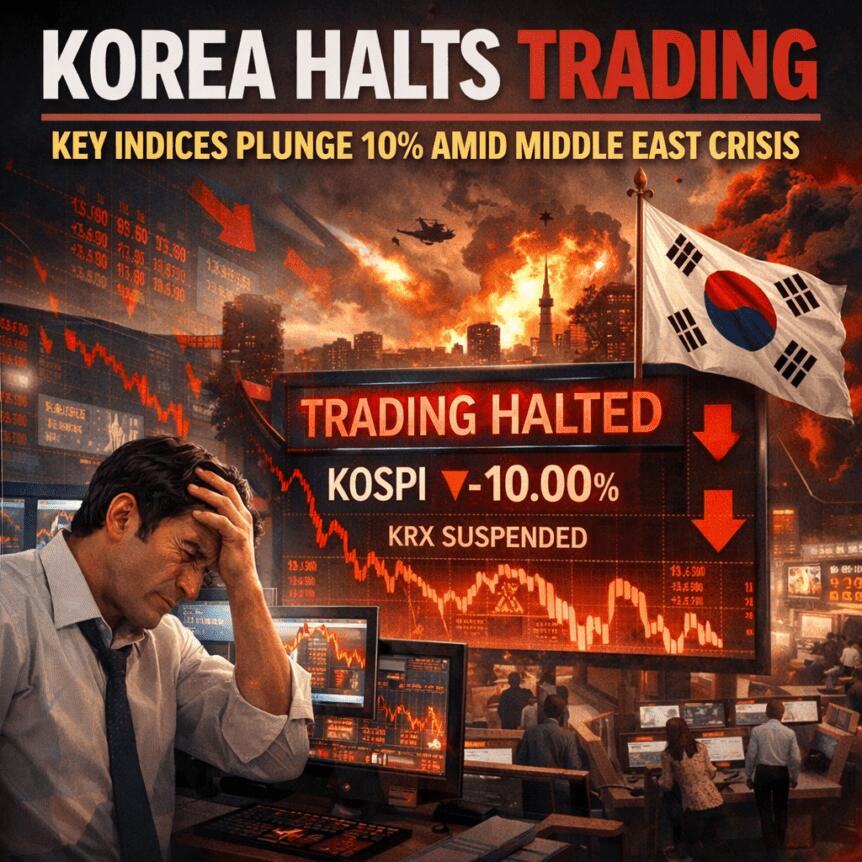
Escalating Middle East tensions triggered a rapid risk-off across global markets on Wednesday, capping a week of sharp moves in equities, oil, and crypto. In Seoul, South Korea’s Kospi and Kosdaq plunged more than 10% during morning trading, triggering circuit breakers as the session logged its worst since August 2024. Across the region, Japan’s Nikkei and Topix fell near 4%, while Hong Kong’s Hang Seng and the Shanghai Composite ceded ground as tensions rippled through risk assets. Oil surged, with Brent crude up about 14% to $82 a barrel and WTI near $75 as traders priced in potential supply disruptions. Amid the volatility, crypto markets, though pressured by macro risk-off, slipped only modestly—total capitalization around $2.39 trillion, down about 0.5% on the day per CoinGecko.
Key takeaways
- Asian equities sold off aggressively: Kospi and Kosdaq fell more than 10% in morning trading, with Japan’s Nikkei and Topix down roughly 4%.
- Oil spiked on supply fears: Brent jumped to about $82/bbl and WTI to around $75/bbl since the Feb. 28 strikes, signaling heightened risk to energy markets.
- Crypto markets showed relative resilience but remained pressured: total crypto capitalization dipped about 0.5% on the day, with year-to-date losses around 21% on CoinGecko data.
- Analysts described the move as a black-swan event for some segments of the market: trading halts in Korea reflected the speed of the unwind, even as investors sought safe harbors.
- The episode underscored how geopolitics can spill into crypto and traditional markets alike, with ongoing attention to oil flows and macro risk sentiment shaping price action.
Sentiment: Neutral
Price impact: Negative. A broad risk-off environment contributed to a modest pullback in crypto total capitalization and broader risk assets.
Market context: The incident highlights ongoing sensitivity of crypto markets to macro shocks, liquidity dynamics, and geopolitical headlines, with leading tokens acting as potential indicators of risk appetite depending on the regime.
Why it matters
The rapid, cross-asset sell-off illustrates how geopolitics can compress liquidity across markets in a short period. For crypto traders, the day reinforced that digital assets remain tethered to macro sentiment even as they often diverge in duration and amplitude from traditional equities. Bitcoin (CRYPTO: BTC) and Ethereum (CRYPTO: ETH) were observed by market participants as part of a broader risk framework, with price action reflecting the tug-of-war between safe-haven demand and exposure to global macro shocks. While some investors view BTC and ETH as hedges against systemic risk, the immediate reaction here suggested a tempered response in the face of a broader equity rout and energy-market volatility.
The oil shock compounds concerns about cost pass-through to consumers and the potential impact on global growth. With Brent crude cresting to the low $80s and U.S. energy benchmarks rallying, energy equities and downstream actors could see increased volatility in the near term. The move also raises questions about supply-chain resilience and the pace at which shipping lanes, including the Strait of Hormuz, might be affected—factors that have historically fed into speculative positioning in crypto markets as traders reassess inflation risk and capital allocation.
On the crypto side, the day’s data from CoinGecko showed a comparatively contained downside relative to equities, underscoring a nuanced market dynamic. The sector has weathered a rough start to the year, with total capitalization down roughly 21% year-to-date, a reflection of shifting risk sentiment, regulatory chatter, and evolving macro narratives. Yet in moments of heightened risk, some investors gravitate toward digital assets as alternative stores of value or liquidity pools, while others retreat to stable assets or cash equivalents. The net effect is a crypto market that, while sensitive to macro headlines, has demonstrated a degree of periodic isolation from the worst daily stress seen in traditional markets.
The discourse around the crisis has also fed into social and analytical discourse around safe-haven assets. Gold has been highlighted in parallel coverage as a potential beneficiary when geopolitical risk intensifies, a narrative that adds further complexity to how investors evaluate cross-asset diversification in the current environment. For now, traders are weighing the immediacy of price moves against longer-term implications for inflation, interest rates, and the global policy backdrop, with several high-frequency indices showing renewed volatility as headlines evolve.
What to watch next
- Monitor the oil price trajectory and any official statements on Middle East tensions that could affect supply chains and shipping lanes.
- Observe BTC and ETH price action for signs of shifting risk appetite, particularly if macro headlines intensify or easing measures appear.
- Track regulatory developments or central-bank commentary that could influence liquidity conditions and market stability.
- Watch geopolitical updates around Hormuz and broader regional security, which could re-ignite volatility across equities and crypto.
- Follow liquidity metrics across exchanges and DeFi platforms to assess how the market absorbs shocks in the near term.
Sources & verification
- Channel News Asia reporting on the Kospi/Kosdaq sell-off and regional market reactions to Middle East tensions.
- OilPrice coverage of oil-price moves tied to strikes and shipping-line risk in the Strait of Hormuz.
- CoinGecko data showing crypto market capitalization movement on the day in question.
- Google Finance figures for regional indices such as the Kospi, used to corroborate price movements.
- Cointelegraph coverage referencing gold as a safe-haven narrative amid Middle East tensions and macro uncertainty.
Global risk-off shock reverberates through markets and crypto
Global markets entered a day of elevated risk-off sentiment as geopolitical frictions intensified, driving a swift reallocation away from risk assets. In Seoul, the Kospi and Kosdaq both fell by more than 10% in early trading, triggering circuit breakers that halted further descent and underscoring the speed at which liquidity can drain from equities when headline risk spikes. The weakness did not stop there. Across major markets, the Nikkei and Topix lost roughly 4%, while Hong Kong’s Hang Seng and China’s Shanghai Composite also trended lower, painting a broad canvas of risk aversion that spilled into commodities and, eventually, crypto markets.
Analysts described the move as a multifaceted shock—from supply-side risk in oil markets to the potential implications for global growth. The Strait of Hormuz loomed in the background as a focal point of risk: threats to shipping lanes can quickly elevate energy costs and raise inflation expectations, complicating the outlook for central banks that have already started to recalibrate monetary policy in response to macro pressures. In a day characterized by cross-asset stress, oil jumped, with Brent crude climbing to around $82 a barrel and WTI near $75, signaling a persistent risk premium attached to the geopolitical narrative. This oil dynamic feeds into a broader corridor of volatility that can test liquidity cushions across financial markets, including crypto.
Within the crypto sphere, the market tracked a different script. Total crypto capitalization declined by roughly 0.5% on the day, settling near $2.39 trillion, a modest reaction relative to the broader equity rout. That divergence is not unfamiliar to seasoned market observers; Bitcoin (CRYPTO: BTC) and Ethereum (CRYPTO: ETH) have historically shown episodic resilience or vulnerability depending on the dominant risk tone and liquidity conditions. The current environment, marked by higher macro-uncertainty and a potential shift toward safe-haven assets, could set the stage for a more prolonged period of volatility in crypto markets, even as some participants cite inherent hedging narratives behind BTC and ETH as reasons for a measured, if hesitant, bid.
For now, the discourse continues to unfold in real-time. Statements from political leaders and the pace of any escalation will be critical: traders are watching for any escalation in conflict terms, regulatory signals, and policy responses that might either dampen risk or amplify it further. In parallel, observers are keeping a close eye on gold’s performance as a benchmark for safe-haven demand, a theme that has gained renewed attention in contemporaneous coverage of geopolitical risk. The synthesis of these signals will inform how crypto markets navigate the evolving macro landscape in the weeks ahead, as market participants weigh inflation implications, liquidity dynamics, and the broader risk sentiment that governs every corner of the financial spectrum.
https://example.com/placeholder.js
https://www.cryptobreaking.com/korea-halts-trading-as-key/?utm_source=blogger%20&utm_medium=social_auto&utm_campaign=Korea%20Halts%20Trading%20as%20Key%20Indices%20Plunge%2010%%20Amid%20Middle%20East%20Crisis%20
Comments
Post a Comment