
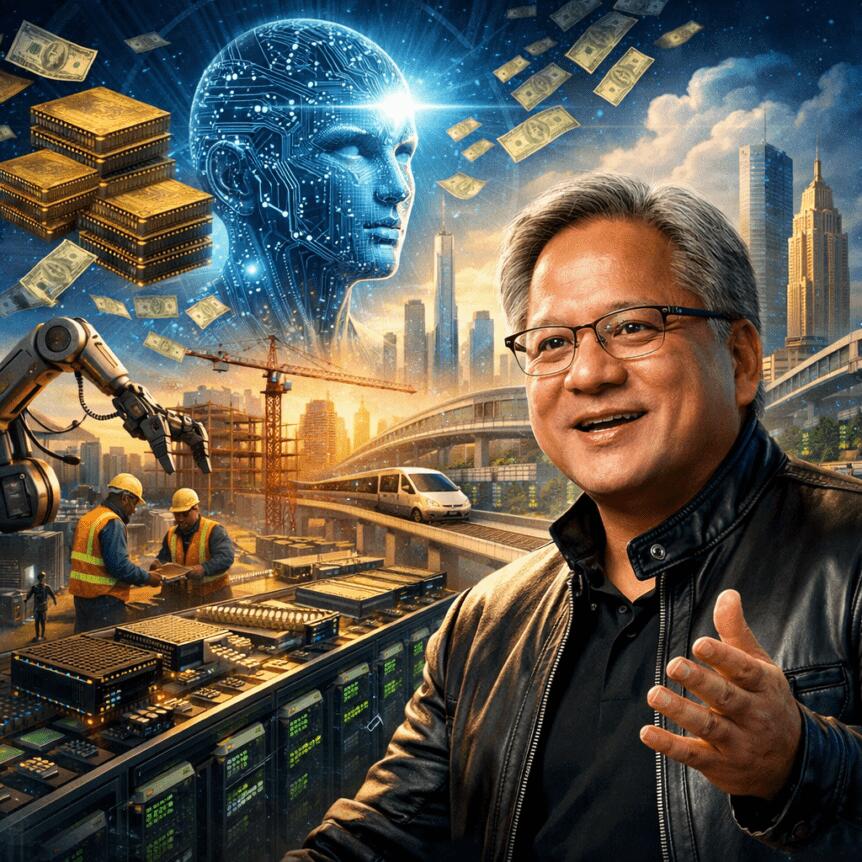
Artificial intelligence is being reframed as a fundamental utility rather than a purely productivity unlock, according to Jensen Huang, the founder of Nvidia. In a blog post this week, Huang portrays AI as essential infrastructure on par with electricity and the internet. He argues the facilities that design chips, operate data centers, and deploy AI applications represent the largest infrastructure buildout in human history. The sentiment is tempered by the recognition that the job of constructing and maintaining this ecosystem will be enormous, spanning a wide array of skilled trades. The analysis arrives as Nvidia (NVDA) continues to benefit from surging demand for AI hardware, a cycle that has propelled its stock higher in the past 18 months. (EXCHANGE: NVDA)
Huang’s “five-layer cake” concept frames AI infrastructure as a stacked, interdependent system. In his view, energy supplies the base; AI chips drive computation; the underlying infrastructure enables services and platforms; AI models provide reasoning and intelligence; and applications translate capabilities into real-world use cases. The blog argues that the architecture must be rebuilt almost from scratch to accommodate autonomous reasoning, real-time inference, and on-demand intelligence, rather than merely following stored instructions. This restructuring implies not only new factories and fabs but also a reimagining of operational workflows across industries. The five-layer framework has quickly become a touchstone for executives and policymakers contemplating how to allocate capital and talent in the AI era.
AI isn’t a single model. It’s a full stack.
Energy. Chips. Infrastructure. Models. Applications.
That’s the five-layer cake powering the largest industrial buildout in history — and the jobs, factories and AI applications rising with it. pic.twitter.com/rwxO6fdTnE — NVIDIA Newsroom
Huang notes that much of this infrastructure has yet to exist and requires a workforce that is still in short supply. The emerging demand for AI data centers—capable of housing powerful GPUs, high-speed networks, and robust cooling—will demand electricians, plumbers, steelworkers, network technicians, and operators. These are not entry-level roles; they require specialized training and experience, aligning with a broader push for skilled labor across advanced manufacturing and digital-enabled services. As the AI buildout accelerates, Huang argues, the scale of the opportunity will extend beyond any single country or sector, touching a wide spectrum of industries and geographies.
The AI boom’s corporate beneficiaries have become a focal point for investors. Nvidia, already a dominant supplier of AI accelerators, has emerged as one of the biggest winners in the current cycle. Its shares have surged more than 1,300% since 2023, a rally that followed the public release of ChatGPT and the ensuing AI race. The company’s role at the center of both the hardware ecosystem and the software-enabled AI pipeline has reinforced its status as a core proxy for AI demand, even as critics argue the cycle may be tempered by regulatory scrutiny, supply chain constraints, and macro headwinds. (EXCHANGE: NVDA)
Within this broader narrative, Huang’s comments echo a larger industry trend: the AI data-center expansion is reshaping employment patterns and wage prospects in specialized trades. A recent wave of corporate restructurings—at Block, Pinterest, and Dow—has highlighted how AI-enabled efficiency and automation are influencing staffing decisions. Block, Inc. announced a large-scale workforce reduction, a move its co-founder attributed in part to AI-enabled restructuring. Pinterest and Dow also cited AI as a driver for workforce reductions, underscoring a common theme: automation and AI adoption can compress roles while intensifying demand for high-skilled positions in AI hardware, data-center operations, and software engineering. Analysts at Goldman Sachs have characterized AI-driven layoffs as visible but modest, suggesting the macro impact on unemployment might be gradual even as the technology accelerates. (EXCHANGE: SQ)
The story also intersects with broader market dynamics. Nvidia’s ascent underscores the hardware supply chain’s centrality to AI-enabled growth, a trend that has implications for other technology equities and for sectors linked to data-center energy consumption. The AI infrastructure cycle is a reminder that the push into AI is not merely a software upgrade; it is a capital-intensive, global effort that requires policy alignment, capital allocation, and a capable workforce. As capital continues to flow into data centers, chip manufacturing, and related services, the demand for skilled labor, reliable power, and resilient networks is likely to remain a core feature of the investment landscape. (EXCHANGE: NVDA)
AI’s footprint in the economy is expanding rapidly, and Huang’s framework suggests a multi-decade horizon for the buildout. AI data centers will need not only hardware but also the operational expertise to install, maintain, and secure complex systems. The labor market for skilled trades—traditionally insulated from pure software cycles—could see persistent demand for technicians who can design, install, and upgrade AI-ready infrastructure. This reality may influence everything from wage dynamics to vocational training programs, and it could even shape incentives for crypto mining and other power-intensive activities that rely on cost-effective, scalable AI-capable hardware and energy platforms. The net effect is a gradual, rather than explosive, reallocation of resources toward AI-enabled capabilities across industries. (EXCHANGE: PINS; EXCHANGE: DOW)
As the AI narrative matures, investors and policymakers will be watching how the five-layer cake translates into real-world deployments and jobs. Huang’s estimate that “hundreds of billions” have already been invested, with trillions more to come, highlights the scale of the opportunity—and the risk of bottlenecks in supply chains, talent, and regulatory frameworks. In parallel, financial markets will assess whether the AI infrastructure cycle can sustain a broader earnings and growth trajectory for hardware suppliers, cloud providers, and software developers delivering AI-powered services. The cross-currents—tech capex, energy demand, labor shortages, and macro risk sentiment—will continue to shape how this AI era unfolds. (EXCHANGE: NVDA; EXCHANGE: SQ; EXCHANGE: PINS; EXCHANGE: DOW)
Why it matters
For investors, Huang’s framework reframes AI from a short-term optimization trend to a structural, capital-intensive expansion that will require a steady inflow of funding and a highly skilled workforce. The implied long horizon for infrastructure expenditure could sustain demand for AI accelerators, data-center gear, and software ecosystems for years, potentially supporting a more durable equity narrative for hardware-centric players and cloud providers. For builders and operators, the emphasis on a multi-layer stack underscores the importance of resilient, scalable energy, cooling, and networking capabilities. It also highlights the need for training pipelines that can deliver electricians, technicians, engineers, and operators who understand AI workloads from edge to core. For policy and macro participants, the discussion points to the macroeconomic implications of a large-scale industrial transition that could influence employment, wage dynamics, and regional competitiveness as nations compete to attract investment in AI-enabled infrastructure.
From a market-structure perspective, the AI infrastructure wave intersects with broader sectoral trends, including data-center consolidation, hyperscale capacity expansion, and the ongoing evolution of industrial tech. While the short-term price moves in any given stock or token can be volatile, the longer-term signal is one of sustained, capital-intensive growth in a space that sits at the convergence of compute, energy, and human capital. Crypto markets, which have historically been sensitive to energy pricing, risk sentiment, and technology cycles, may experience indirect effects as AI-driven optimization and automation influence energy demand, hardware pricing, and risk-off/ risk-on dynamics across tech-heavy equities. The net takeaway is a cycle that rewards suppliers of AI hardware, creators of AI software, and the labor ecosystem that will build and maintain the infrastructure of the AI era.
What to watch next
- Capital expenditure plans from Nvidia and peers to expand AI data-center capacity, with quarterly updates and guidance.
- Trends in skilled-labor supply for AI infrastructure, including training program developments and wage indicators for electricians, network technicians, and operators.
- Regulatory developments affecting AI deployment, energy efficiency standards, and data-center permitting in key markets.
- Announcements of new AI-enabled products or services from leading cloud providers and hardware suppliers, including integration of AI models into enterprise workflows.
Sources & verification
- Jensen Huang’s blog post outlining the “five-layer cake” framework: https://blogs.nvidia.com/blog/ai-5-layer-cake/
- Article discussing AI data centers and bitcoin mining considerations: https://cointelegraph.com/news/ai-data-centers-local-resistance-bitcoin-mining
- NVIDIA becomes a leading AI boom beneficiary (AI hardware dominance): https://cointelegraph.com/news/nvidia-becomes-first-4t-market-cap-company-on-ai-boom
- Block, Inc. layoffs attributed to AI-driven restructuring: https://cointelegraph.com/news/jack-dorsey-block-cuts-4000-jobs-ai-restructuring
- Pinterest and Dow announcements linking AI to workforce reductions: https://cointelegraph.com/news/ai-use-work-causing-brain-fry-say-researchers
- Goldman Sachs analysis on AI-driven layoffs and unemployment trends: https://finance.yahoo.com/news/goldman-sachs-warns-ai-fueled-layoffs-could-raise-the-unemployment-rate-this-year-chart-154251740.html
What the story means for the market
The trajectory Huang sketches positions AI infrastructure as a multiyear, capital-intensive cycle that could recalibrate how investors value hardware suppliers, cloud platforms, and enterprise software tied to AI workloads. As the industry navigates talent shortages, energy considerations, and macro uncertainties, the sector’s performance will hinge on the pace of data-center expansion, the efficiency of AI training and inference pipelines, and the alignment of policy with rapid technology adoption.
//platform.twitter.com/widgets.js
https://www.cryptobreaking.com/nvidias-huang-ai-will-boost/?utm_source=blogger%20&utm_medium=social_auto&utm_campaign=Nvidia's%20Huang:%20AI%20will%20boost%20jobs;%20trillions%20in%20infrastructure%20
Comments
Post a Comment