
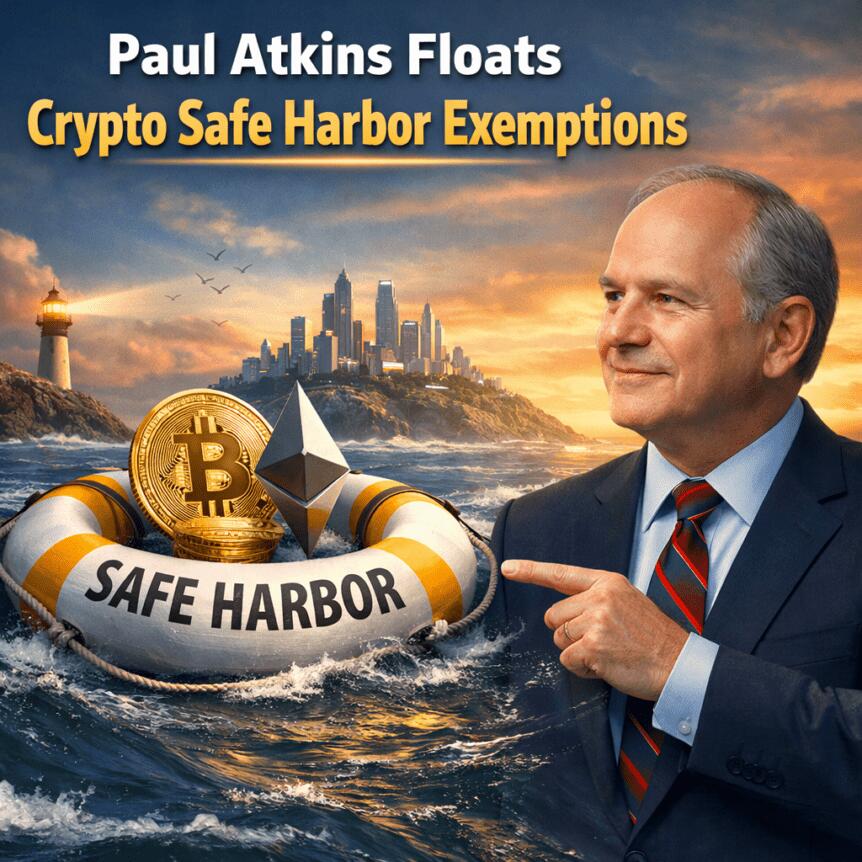
Washington, DC — The regulatory landscape for digital assets continues to evolve as policymakers explore a regulatory runway intended to unlock capital for crypto ventures while preserving investor protections. In remarks at a crypto lobby event, SEC Chair Paul Atkins laid out a concrete concept: a safe harbor framework built around three pillars designed to give crypto issuers a bespoke path through the U.S. regulatory maze. The agenda arrives as the agency and the Commodity Futures Trading Commission simultaneously issued interpretive guidance aimed at clarifying when crypto assets are securities and how non-security tokens could fall under securities laws. The moment underscores a shift from diagnostic debates to concrete regulatory mechanisms that could shape how projects fund themselves in the near term.
Our interpretation on crypto assets—grounded in existing law and informed by extensive public input—acknowledges what the former administration refused to recognize...
Most crypto assets are not themselves securities.
— Paul Atkins (@SECPaulSAtkins) March 17, 2026
Key takeaways
- The core proposal centers on a “safe harbor” that comprises a startup exemption, a fundraising exemption, and an investment contract safe harbor, aiming to provide a tailored regulatory runway for crypto projects to mature without surrendering investor protections.
- A startup exemption would permit crypto firms to raise a defined amount or operate for a set period, granting regulatory latitude to reach maturity while maintaining guardrails.
- The fundraising exemption would allow investment contracts involving crypto to raise capital up to a defined threshold within a 12-month window while remaining exempt from certain registration requirements under securities laws.
- The investment contract safe harbor would offer issuers and buyers clarity about when a given asset falls under securities laws, with conditions tied to the issuer’s ongoing commitments and the asset’s lifecycle.
- The idea relies on a trigger related to “permanently ceased all essential managerial efforts” behind an asset, signaling when protections and securities obligations would apply or end.
Market context: The discussion comes amid broader regulatory debates about how to harmonize investor protection with crypto innovation, all while lawmakers weigh market-structure legislation. As talks on a comprehensive framework progress, the industry watches how these proposed exemptions could interact with enforcement policies and evolving guidance on token classifications.
Why it matters
The proposal signals a potential shift toward regulatory clarity that could reduce ambiguity for issuers and investors alike. By outlining concrete exemptions, the plan aims to supply a predictable pathway for raising capital in the United States, which could encourage domestic projects to scale without provoking unintended securities-law exposure. For crypto builders, a defined startup timeline or a capped fundraising window could translate into more confident planning and strategic fundraising rounds, potentially accelerating product development and deployment.
However, the approach also raises questions about what constitutes sufficient “managerial effort” and how the safeguards would be enforced as projects evolve. Critics may worry that a patchwork of exemptions could create inconsistent standards across token types or trigger uneven treatment for similar offerings. The balance hinges on careful calibration of thresholds and sunset provisions that preserve investor protections while preventing regulatory uncertainty from stifling innovation.
From a broader perspective, the move illustrates regulators’ intent to move beyond abstract classification toward actionable scaffolding. The adoption of a safe harbor framework could influence how other jurisdictions view crypto fundraising, potentially shaping international comparability and cross-border fundraising strategies. As the public comment process unfolds, market participants will be watching for details on eligibility, disclosure requirements, and how the exemptions would interface with existing exemptions or exemptions under state law.
What to watch next
- Proposed rules for the exemptions are expected to be released for public comment in the coming weeks, providing a concrete blueprint to assess implementation challenges.
- Congress continues negotiations around market-structure legislation; observers will monitor whether the Clarity Act or related bills advance, given the current stall in the Senate.
- Regulators may issue additional guidance clarifying the boundaries between securities and non-securities in practice, potentially refining the scope of the safe harbor framework as real-world applications emerge.
- Industry groups and lawmakers will assess how the safe harbor interacts with enforcement actions, investor protections, and international regulatory developments that could affect competitiveness and innovation.
Sources & verification
- Paul Atkins, remarks at a Washington, DC crypto lobby event and the proposed three-part safe harbor framework: https://www.sec.gov/newsroom/speeches-statements/atkins-remarks-regulation-crypto-assets-031726
- Joint SEC-CFTC interpretation on crypto assets not securities: https://cointelegraph.com/news/sec-interpretation-crypto-assets-not-securities
- Clarity Act and related legislative context referenced by industry coverage: https://cointelegraph.com/news/clarity-act-crypto-united-states-congress-galaxy-digital
- Industry context on evolving crypto regulation and 2025 changes: https://magazine.cointelegraph.com/how-crypto-laws-changed-2025-further-2026/
- Public stance and timing noted in the accompanying tweet: https://twitter.com/SECPaulSAtkins/status/2034012012460556526?ref_src=twsrc%5Etfw
Regulatory safe harbors and the path forward for crypto exemptions
The conversations surrounding a safe harbor framework crystallize a broader theme in U.S. regulatory policy: the desire to foster a constructive environment where startups can raise capital without facing indefinite regulatory ambiguity, while ensuring that investors are adequately protected from risk. Atkins framed the proposed exemptions as a way to tailor regulation to the realities of crypto markets, acknowledging the need for bespoke pathways in an industry with unique funding dynamics and rapid product lifecycles.
The startup exemption envisions a defined early phase during which projects can attract capital or operate with a clear regulatory runway, offering a predictable timeline as teams build products, recruit communities, and develop governance mechanisms. The fundraising exemption would target investment contracts that involve crypto—allowing issuers to raise up to a specified amount within a year without triggering full securities registration. The investment contract safe harbor, meanwhile, would articulate a threshold beyond which token issuers and buyers would be subject to securities laws, potentially offering certainty about when protections apply as the asset matures or as project commitments change.
Crucially, Atkins emphasized that the safe harbor would be triggered by a specific condition: when an issuer has “permanently ceased all essential managerial efforts” promised for the asset. This condition is intended to prevent perpetual ambiguity around the status of a token and to provide a clear point at which securities obligations become applicable. The approach seeks to balance entrepreneurial flexibility with the safeguards designed to protect investors in complex, evolving markets.
In parallel, regulators clarified that most crypto assets are not themselves securities, while still outlining circumstances under which securities rules may apply to non-security assets. The interpretive action reflects an attempt to harmonize traditional securities law with the realities of a diverse digital-asset landscape, where token models range from payments rails to governance tokens and beyond. Industry observers note that the framework could affect fundraising strategies, disclosure practices, and how projects structure token distributions. The designation of a safe harbor would be a practical step toward reducing regulatory friction for compliant offerings, even as broader questions about market structure, transparency, and enforcement persist.
As the public comment period looms, the crypto sector will be watching for precise definitions, numerical thresholds, and procedural steps that will determine how readily these exemptions can be deployed. While the regulatory impulse is to create a more navigable route for compliant issuances, the ultimate success of such a framework will hinge on its ability to scale with innovation, deter fraud or misrepresentation, and mesh with international standards. The interplay between this proposed framework and ongoing legislative efforts—such as the stalled Clarity Act—will matter for how quickly and comprehensively the U.S. market can align with evolving global norms.
https://www.cryptobreaking.com/paul-atkins-floats-crypto-safe/?utm_source=blogger%20&utm_medium=social_auto&utm_campaign=Paul%20Atkins%20Floats%20Crypto%20Safe%20Harbor%20Exemptions%20
Comments
Post a Comment