
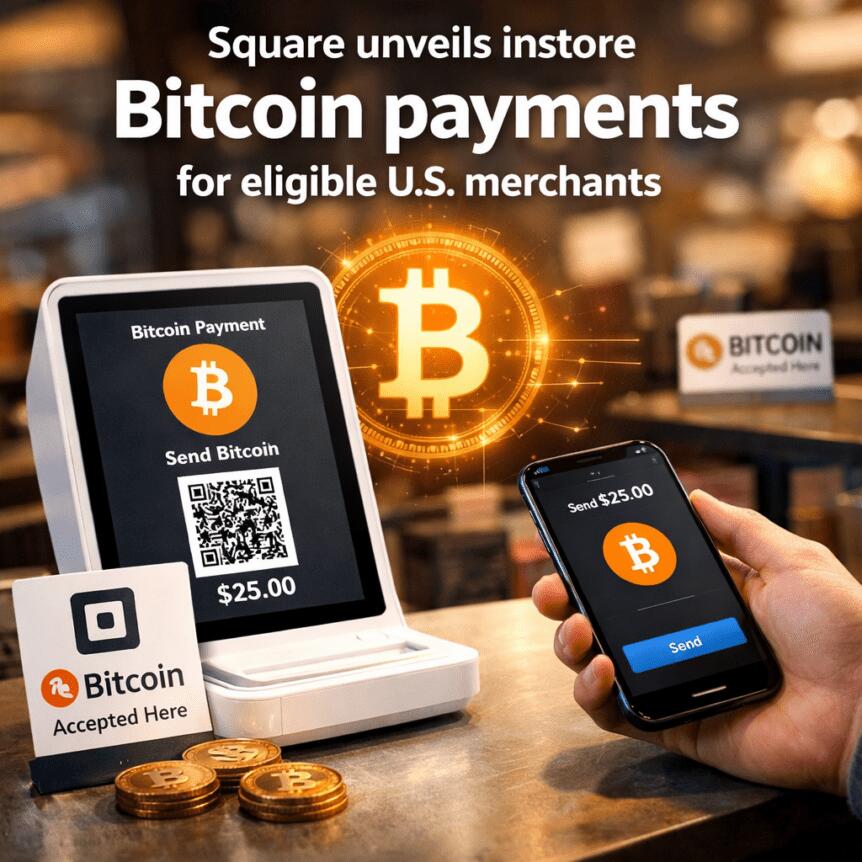
Block’s Square unit is quietly expanding Bitcoin acceptance at its point-of-sale terminals across the United States. The rollout, described by Miles Suter, Block’s Bitcoin product lead, as an automatic feature for eligible US merchants, begins today and will ramp up over the coming weeks. The move marks a tangible step toward treating Bitcoin as everyday money in commerce, with cash-like clarity for merchants and customers alike.
Under the new program, eligible US sellers will have Bitcoin payments enabled by default. When customers pay in BTC, merchants will receive US dollars by default, and they will also have the option to automatically stack Bitcoin from daily sales. Square said the system converts transactions instantly to cash at checkout, eliminates extra setup for merchants, and promises near-instant settlement. Importantly, merchants do not need to hold Bitcoin themselves, and Square is waiving processing fees through 2026. The feature does not currently extend to New York, with verification requirements in place for eligible merchants. Square first sketched out this rollout in May, signaling a broader strategy to normalize Bitcoin in everyday retail flows.
Block’s leadership highlighted the effort as part of a broader push to integrate Bitcoin into conventional commerce. In a post on X, Suter described the feature as a step toward “Bitcoin as everyday money,” while Jack Dorsey—an early advocate of Bitcoin—reposted the update. Square’s plan aims to enable millions of businesses to accept Bitcoin without the typical custody and volatility friction that has historically deterred merchants from adopting crypto payments. By design, the system keeps Bitcoin away from the merchant’s balance sheet, converting receipts to USD and delivering cash-like settlement promptly.
From a risk and cost perspective, the arrangement is notable for its simplicity and potential to unlock new liquidity channels for merchants who want exposure to Bitcoin without taking on balance-sheet obligations. The company’s messaging emphasizes that, despite the Bitcoin payments option, merchants are not required to hold BTC, and there will be zero processing fees through 2026. The rollout aligns with Block’s broader belief that Bitcoin can function as a reliable form of everyday money in a retail setting, a philosophy echoed by other fintechs and traditional finance players exploring crypto-backed credit and payment rails.
Block’s balance sheet and Bitcoin footprint add another layer of context to this rollout. According to BitcoinTreasuries.net, Block ranks as the 14th-largest publicly traded holder of Bitcoin, holding 8,883 BTC on its balance sheet, with an average cost per coin around $32,939. This position underscores Block’s willingness to align its corporate strategy with Bitcoin exposure as the payments giant tests consumer-facing use cases that could broaden BTC’s merchant and consumer footprint over time.
Key takeaways
- Square begins automatic Bitcoin payments at its U.S. point-of-sale terminals for eligible merchants, with USD payouts by default and a phased rollout expected to complete within the month, including a target of all Square merchants by Nov. 10.
- The feature promises instant conversion to cash at checkout, near-instant settlement, no extra merchant setup, and zero processing fees through 2026, while allowing merchants to opt to stack Bitcoin from daily sales.
- Block sits among the largest corporate Bitcoin holders with 8,883 BTC, placing it as the 14th-largest publicly traded holder, according to BitcoinTreasuries.net, and illustrating a strategic alignment between its payments business and digital-asset exposure.
- The broader Bitcoin-adoption trend continues to expand beyond payments into lending and credit, with major fintechs and traditional lenders piloting BTC-backed financing and crypto-collateral programs that could reshape how users access liquidity and funding.
Square’s rollout and its implications for merchants
At its core, Square’s initiative lowers a number of traditional barriers to crypto acceptance. Merchants will not need to manage private keys, wallets, or crypto custody. Instead, the system handles the integration, converts BTC to USD at the point of sale, and settles funds into conventional cash flows with minimal delay. The approach mirrors a broader trend in which crypto rails are being repurposed to improve merchant cash flow and reduce friction for everyday commerce.
From a strategic standpoint, the move could act as a proving ground for broader merchant adoption of Bitcoin payments, especially if the model proves scalable across varying industries and geographies within the United States. While the NY exclusion remains a procedural note, early adopters may serve as a bellwether for how merchants perceive Bitcoin’s role in cash flow management and consumer payments. The emphasis on automatic enabling, zero fees through 2026, and optional Bitcoin stacking is designed to give merchants confidence that cryptos can function as a financial feature rather than a speculative risk on their balance sheets.
Industry observers will be watching closely to see whether consumer demand aligns with merchant uptake. If customers increasingly prefer to pay with BTC, the combination of instant settlement and streamlined processing could create a feedback loop that nudges more merchants to participate, potentially accelerating Bitcoin’s merchant utility beyond a niche use case.
Bitcoin-backed lending and the widening financial web
The Square development sits within a larger wave in which Bitcoin is increasingly woven into credit and financing infrastructures. In January, Nexo rolled out a zero-interest lending product that allows holders of BTC and ETH to borrow against their assets through fixed-term, predefined repayment schedules. The offering previously existed in a more limited form within private and OTC channels, and Nexo reported that it facilitated more than $140 million in borrowing in 2025.
Also in January, Coinbase reintroduced Bitcoin-backed loans in the United States, enabling users to borrow up to $100,000 in USDC against BTC held on the platform. In February, Kraken followed suit with fixed-rate crypto loans for Pro users, offering loans collateralized by digital assets at 10%–25% APR for terms up to two years. These moves highlight a broader willingness among crypto and traditional finance platforms to leverage crypto holdings as adaptable collateral and liquidity sources.
Beyond crypto-native platforms, banks and lenders are experimenting with crypto-backed credit in more conventional forms. Rate, a US mortgage lender, launched a program that allows borrowers to use verified cryptocurrency holdings to meet underwriting requirements without liquidating assets. And recently, Coinbase and Better Home & Finance introduced a structure enabling borrowers to pledge crypto as collateral for down payments on mortgages aligned with Fannie Mae standards. Taken together, these developments signal a convergence of crypto capital markets with mainstream lending, potentially expanding access to capital for crypto holders while introducing new risk management and regulatory considerations for lenders and borrowers alike.
What these developments suggest is a market-wide tilt toward treating Bitcoin and other digital assets as usable financial tools—collateral, collateral-backed credit, and even everyday payment rails—rather than solely as stores of value or speculative instruments. For investors and builders, the trajectory indicates increasing demand for robust, regulated, and user-friendly interfaces that bridge crypto assets with conventional financial products, plus ongoing scrutiny from regulators as products scale.
Looking ahead, observers will want to see how Square’s merchants respond in the next cycle of adoption, whether more payment processors adopt similar automatic BTC features, and how state regulations—especially in jurisdictions excluded from early access—shape the pace of rollout. The broader question remains: can Bitcoin payments become a reliable everyday utility for mainstream merchants, and will lenders’ willingness to extend credit against crypto tighten or loosen as the ecosystem matures?
As the market tests these rails, readers should monitor both merchant feedback and the evolving regulatory landscape to gauge how quickly crypto-enabled payments and credit lines might become mainstream components of everyday finance.
https://www.cryptobreaking.com/square-unveils-instore-bitcoin-payments/?utm_source=blogger%20&utm_medium=social_auto&utm_campaign=Square%20unveils%20instore%20Bitcoin%20payments%20for%20eligible%20U.S.%20merchants%20
Comments
Post a Comment