
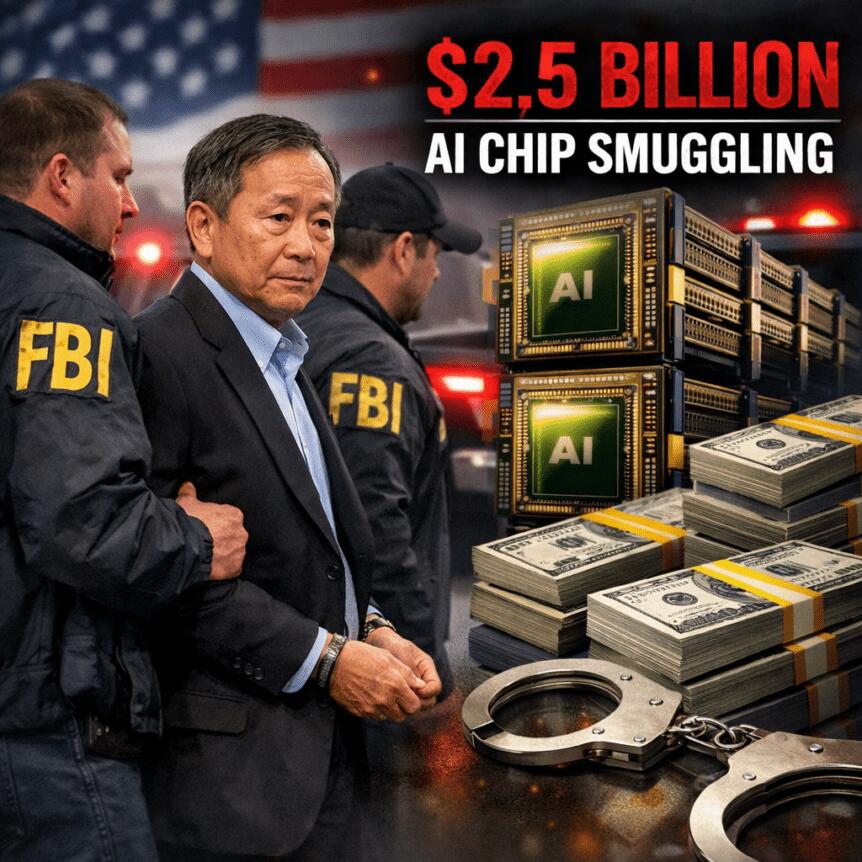
The U.S. Justice Department has unsealed an indictment charging Yih-Shyan “Wally” Liaw, the co-founder of Super Micro Computer, Inc., along with sales executives Ruei-Tsang “Steven” Chang and Ting-Wei “Willy” Sun, in what prosecutors describe as a multi-billion-dollar scheme to route advanced artificial intelligence server hardware to China. Super Micro itself was not charged, and the company says it is cooperating with investigators and distancing itself from the alleged actions.
According to the Justice Department, the defendants conspired to sell billions of dollars’ worth of servers containing sensitive, controlled GPUs to buyers in China, in violation of U.S. export-control laws. The alleged scheme, spanning 2024 and 2025, involved concealing the true nature of the clientele and the shipments, with prosecutors asserting that roughly $2.5 billion in servers were moved to a Chinese company, including about $510 million in sales during April and May 2025 alone.
Federal investigators described a range of concealment techniques, including fabricating documents, staging counterfeit equipment to pass audits, and using a pass-through intermediary to mask the true end customer. The FBI’s New York Field Office linked the scheme to the defendants’ efforts to obscure the sale of high-performance server hardware used in data centers and other critical operations.
“These defendants allegedly fabricated documents, staged bogus equipment to pass audit inventories, and used a pass-through company to conceal their misconduct and true clientele list,” said James Barnacle, Jr., FBI assistant director in charge of the New York Field Office. The defendants will face proceedings in the Northern District of California, with Liaw and Sun already in custody and Chang listed as a fugitive outside the United States.
Key takeaways
- The Justice Department indicted Yih-Shyan Liaw, Ruei-Tsang Chang, and Ting-Wei Sun for alleged export-control violations tied to selling servers with advanced GPUs to China; Super Micro is not charged.
- The alleged scheme spanned 2024–2025, involving about $2.5 billion in server sales, including $510 million in April–May 2025.
- Liaw and Sun have been arrested and are to appear in U.S. court, while Chang remains a fugitive.
- Super Micro publicly distanced itself from the actions, stating they contravene the company’s policies and controls and stressing ongoing cooperation with investigators.
- Trading after the announcement showed immediate market reaction, with Super Micro’s stock falling in after-hours trading by about 13% to around $26.71.
Allegations, scope and the case timeline
At the center of the indictment is a concerted effort to export cutting-edge server technology to China in ways that circumvent U.S. export controls. Prosecutors describe a pattern of misrepresentation and mislabeling designed to obscure the true buyers and destinations of the servers, which included high-end GPUs subject to regulatory restrictions. The government says the defendants blended legitimate sales with false documentation and a network of intermediaries to mask the ultimate customer, enabling billions of dollars in transactions that should have faced heightened scrutiny.
The scope of the alleged activity, as laid out by the DOJ, covers deals executed over a period that extended into 2025, with particular emphasis on shipments and the corresponding audit trails used to validate those shipments. The department’s filing highlights the alleged use of fake inventories and other deceptive practices to facilitate the export of controlled hardware.
Corporate response and investor lens on Super Micro
In a statement shared with Cointelegraph, Super Micro said the defendants’ actions would be treated as a violation of its internal policies and compliance controls. The company asserted that it has not been named as a defendant in the indictment and emphasized its commitment to cooperating with authorities as the case proceeds.
From an investor perspective, the development raises questions about governance, supply-chain compliance, and the risk profile of suppliers involved in high-performance data-center hardware. Super Micro’s public response signals an attempt to isolate the enterprise from the criminal allegations while acknowledging the seriousness of the DOJ’s findings. The firm’s stock reaction underscores the market’s sensitivity to regulatory actions, particularly when a supplier in the high-stakes AI infrastructure space faces potential enforcement risk.
Regulatory backdrop and broader implications for the sector
The charges come amid heightened scrutiny of export controls related to advanced semiconductors, GPUs, and other high-performance components that enable AI workloads. Authorities have increasingly scrutinized how hardware can be channeled to jurisdictions where policy constraints are tight, prompting suppliers to strengthen due-diligence, due-process, and auditing across their distribution networks. The case may serve as a testbed for enforcement approaches and risk management practices among tech manufacturers with global supply chains.
For buyers and partners, the episode underscores the importance of transparent procurement, rigorous compliance testing, and robust record-keeping. It also highlights the reputational and financial exposure companies face when allegations of illicit export practices surface, even if the company itself is not charged.
What comes next for the case and the market
The DOJ’s indictment sets the stage for judicial proceedings in the Northern District of California. Liaw and Sun have been detained and are scheduled for court appearances, while Chang remains at large. As the legal process unfolds, observers will watch for additional charges, potential settlements, and further disclosures about the supply chain arrangements involved in the alleged scheme.
In the near term, investors and industry stakeholders will assess how the case could influence export-control enforcement, supplier risk assessments, and collaboration agreements with major tech players that rely on advanced AI-capable hardware. Market participants will also be watching whether the charges prompt broader due-diligence changes among data-center buyers and integrators who source cutting-edge GPUs and servers.
According to the Justice Department, the investigation reflects the government’s continued vigilance over sensitive technologies and the channels through which they reach restricted markets. As authorities press forward, the industry will need to navigate tighter compliance requirements and the potential for further enforcement actions tied to similar cross-border technology transfers.
Readers should stay tuned for court developments and any additional detail about Chang’s status, as well as updates on how Super Micro and its partners adjust governance practices in response to this high-profile case.
https://www.cryptobreaking.com/super-micro-co-founders-arrest/?utm_source=blogger%20&utm_medium=social_auto&utm_campaign=Super%20Micro%20co-founder's%20arrest%20in%20alleged%20$2.5B%20AI%20chip-smuggling%20case%20
Comments
Post a Comment