
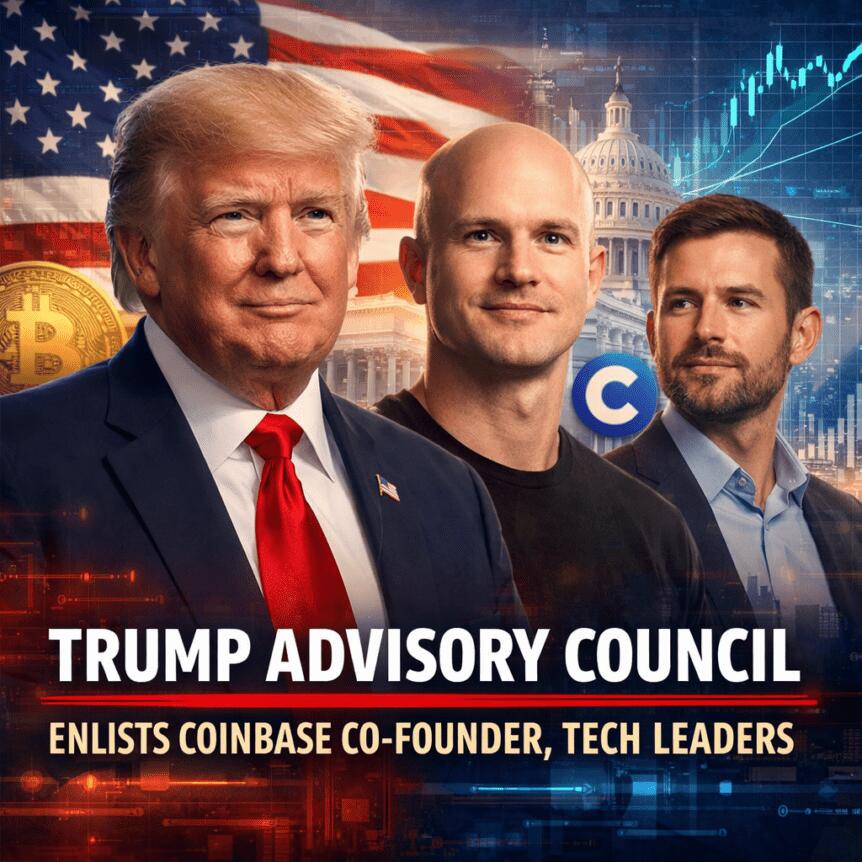
US President Donald Trump announced 13 appointees from the crypto, blockchain, AI, and technology sectors to his re-established Council of Advisors on Science and Technology (PCAST), a body revived by executive order in January 2025. The White House said the council would advise the president on matters involving science, technology, education, and innovation policy.
The administration signaled that the panel could ultimately expand to as many as 24 members, with many additional appointments expected in the near term.
Among those named were Meta CEO Mark Zuckerberg, Coinbase co-founder Fred Ehrsam, Nvidia CEO Jensen Huang, and Oracle chief technology officer Larry Ellison, illustrating a cross-section of social media, crypto, semiconductors, and enterprise software leadership on the panel.
The White House noted that the council will be co-chaired by White House AI and crypto czar David Sacks and Trump’s science adviser Michael Kratsios. The January executive order re-establishing PCAST assigns it the task of advising the President on science, technology, education, and innovation policy.
News of the appointments comes as the White House last week released a national AI framework, urging Congress to pass legislation that would preempt state-level rules in favor of a unified federal approach. In parallel, Trump has pressed Republicans to advance the SAVE America Act—legislation requiring proof of citizenship to register to vote, saying on March 8 that he “will not sign other bills” until it passes.
Key takeaways
- The reconstituted PCAST adds 13 members from crypto, AI, and broader tech sectors with potential to influence policy on innovation, regulation, and national strategy.
- High-profile names attached to the roster include Mark Zuckerberg, Fred Ehrsam, Jensen Huang, and Larry Ellison, underscoring a cross-industry reach into social platforms, crypto infrastructure, and enterprise tech.
- The council’s leadership is set to be co-chaired by David Sacks and Michael Kratsios, tying together White House AI strategy and science-oriented policy oversight.
- The appointment aligns with a broader White House push on AI governance and technology policy, coming shortly after the administration’s AI framework and amid ongoing crypto-market regulation debates in Congress.
A tech-forward advisory body and its potential influence
The expansion of PCAST signals more than a ceremonial lineup. By bringing together founders and executives with hands-on experience in platform design, digital assets, and advanced computing, the White House appears intent on shaping policy that could affect research funding, national quantum and AI initiatives, data privacy standards, and the coordination of federal tech programs across agencies.
David Sacks’ designation as a co-chair reflects the administration’s approach to integrate perspectives from both AI development and crypto policy circles. Michael Kratsios, who serves as Trump’s science adviser, complements that mix with a governance mindset focused on policy execution and regulatory clarity. In this arrangement, the council could become a sounding board for national strategies on emerging technologies, including how the U.S. competes with international peers in AI, cloud infrastructure, and digital assets infrastructure.
The membership itself reads like a snapshot of today’s technology leadership: a social media chief executive, a crypto infrastructure founder, a semiconductor and AI hardware chief, and an enterprise software veteran. While PCAST has historically concentrated on scientific and technical policy, the current lineup raises the potential for a more explicit bridge between innovation ecosystems and federal policy objectives.
Context: AI policy, frameworks, and the political timetable
Its emergence comes on the heels of the White House’s national AI framework, which calls for a cohesive federal approach to artificial intelligence governance. By emphasizing federal action, the administration is signaling that it intends to steer the discussion beyond uneven state-by-state regulation, a point of interest for developers, users, and investors navigating AI deployment timelines and risk management.
Meanwhile, the political calendar around crypto regulation remains contentious. The House previously passed a comprehensive digital asset market structure bill, known in policy circles as the CLARITY Act, in July 2025. The Senate, however, has faced recurring obstacles, including recesses and a government funding standoff, and progress has stalled on moving the measure through the upper chamber. The outlook for federal crypto law is further complicated by industry pushback on certain provisions and the balance lawmakers seek between consumer protection, market integrity, and innovation incentives.
The Senate Agriculture Committee did advance its version of the market structure bill in January, but a planned markup in the Senate Banking Committee—where securities-law implications are central—was postponed after Coinbase CEO Brian Armstrong indicated the bill did not align with the company’s views as written. As of midweek, no new date had been set for a Banking Committee markup, leaving the overall timeline uncertain. Industry concerns over how the framework would handle stablecoins and yields have contributed to the cautious pace surrounding legislative action.
Taken together, the PCAST appointments and the ongoing congressional debates map a broader moment for policy signals. Investors, developers, and users are watching how the White House’s staffing choices translate into concrete regulatory directions—particularly around AI governance, digital asset policy, and the interoperability of federal rules across federal agencies.
What to watch next in policy and markets
Looking ahead, several questions will shape the near-term crypto and tech policy landscape. First, how quickly will the White House fill out the remaining PCAST seats, and what subfields or sectors will be prioritized in those appointments? Second, will the AI framework influence legislative strategy in Congress, accelerating a more unified approach to technology regulation that could affect innovation pipelines and government procurement?
On the legislative front, the CLARITY Act saga offers a bellwether for how the Administration and Congress balance market structure clarity with industry concerns. If the Senate resumes movement and addresses securities considerations and stablecoin policy in a compatible form, it could set the stage for a federal framework that supersedes piecemeal state rules. Conversely, extended stalemate would maintain a degree of regulatory ambiguity that could impact capital flows and project timelines across the crypto and crypto-adjacent tech sectors.
For market participants and builders, the development underscores a potential shift in how federal policy-makers engage with crypto-native ecosystems. The inclusion of influential industry leaders on PCAST may foreshadow more active, policy-informed collaboration between government and industry—an environment where technical feasibility, consumer protection, and innovation incentives must be balanced in real time.
As the administration moves to fill out PCAST and Congress weighs next steps on market structure legislation, observers should monitor the administration’s public messaging, any future staffing announcements, and committee-level activity in the Senate. The coming weeks could reveal the degree to which this White House strategy translates into tangible policy shifts, regulatory clarity, and a clearer path for crypto and AI developers navigating the U.S. regulatory landscape.
Readers should stay tuned for updates on who joins PCAST in the coming months and how the council’s guidance might influence federal research funding, education policy, and enforcement priorities across science and technology domains.
https://www.cryptobreaking.com/trump-advisory-council-enlists-coinbase/?utm_source=blogger%20&utm_medium=social_auto&utm_campaign=Trump%20Advisory%20Council%20Enlists%20Coinbase%20Co-Founder,%20Tech%20Leaders%20
Comments
Post a Comment