
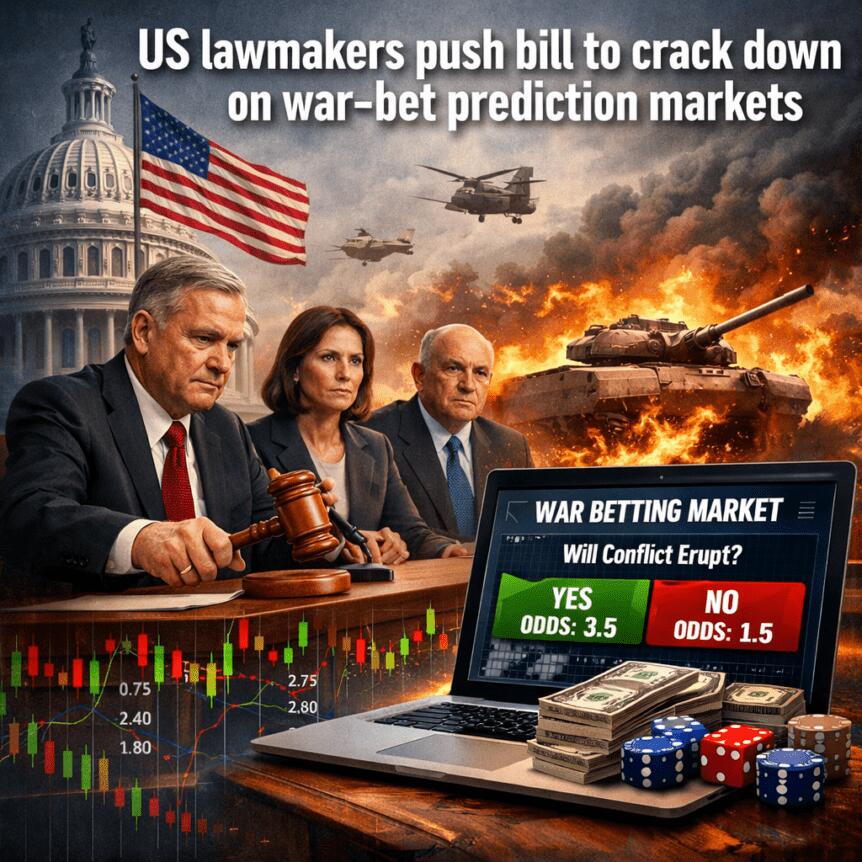
Two Democratic lawmakers in the United States have formally introduced a bill aimed at curbing what they describe as government-insider trading risk tied to prediction markets. The BETS OFF Act, unveiled in a joint effort by Representative Greg Casar of Texas and Senator Chris Murphy of Connecticut, targets platforms whose markets place bets on sensitive government actions. The move follows a spate of high-profile bets linked to potential U.S. action in the Middle East, prompting questions about the role of real-time markets in shaping or amplifying political decisions.
Key takeaways
- The BETS OFF Act was introduced by Rep. Greg Casar and Sen. Chris Murphy in response to suspicious bets on international conflict scenarios, including a possible war involving the U.S., Israel, and Iran.
- The bill seeks to prohibit event contracts tied to sensitive government decisions and federal functions, effectively narrowing the scope of markets like Polymarket and Kalshi.
- The push comes amid continued regulatory scrutiny of prediction markets, following earlier proposals such as Sen. Adam Schiff’s DEATH BETS Act targeting war, terrorism, assassination, and deaths.
- Public discourse around insider information is central: lawmakers argue decisions in the Situation Room should not be swayed by financial positions on open markets.
- Industry声音 remains mixed—Polymarket defends the value of crowd wisdom, while Kalshi limits certain military action forecasts, reflecting divergent approaches to risk and governance in prediction markets.
Market context: The debate over prediction markets sits at the intersection of financial innovation, governance, and national security. As lawmakers push for tighter controls, market operators face clarifications on what kinds of forecasts can be legally listed, while observers watch whether broader crypto-asset and derivatives markets will influence or respond to policy changes.
Why it matters
At the heart of the BETS OFF Act is a concern that insider information—or access to non-public policy deliberations—could be translated into lucrative bets on the outcomes of military or other sensitive actions. Rep. Casar framed the issue around the possibility that “someone sitting in the situation room” could be empowered by market positions in decisions of life and death. The proposed legislation would restrict event contracts tied to government operations and major federal actions, which would notably limit the kinds of bets that platforms like Polymarket and Kalshi can offer on foreign policy and national security events.
The controversy is not purely theoretical. Earlier in the year, Sen. Schiff introduced the DEATH BETS Act, which emphasizes prohibition of markets listing events connected to war, terrorism, assassination, and deaths. The parallel push from multiple offices signals a growing concern among U.S. lawmakers about how prediction markets intersect with public policy and accountability. As markets, regulators, and political actors continue to navigate these questions, the debate intensifies around whether such platforms should be allowed to operate with the same latitude as other forms of speculative markets—and what safeguards are necessary to prevent misuse.
On the platforms themselves, Polymarket has positioned its operations as a way to harness collective intelligence for better forecasting, emphasizing the value of crowd-sourced signals during volatile periods. Kalshi, by contrast, has taken a more constrained stance for certain high-stakes scenarios, choosing not to list contracts on specific military actions or other sensitive geopolitical outcomes. The tension underscores a broader governance question: can prediction markets deliver genuine societal value without creating incentives that could distort policy or provoke manipulation?
Concerns about safety and legitimacy have also resonated beyond the markets’ floors. A Times of Israel military correspondent reported receiving death threats related to coverage of the Iranian missile strike date, underscoring the real-world stakes involved when financial markets entwine with geopolitics. Such incidents amplify the call for clearer boundaries around which events can be bet on and under what conditions, particularly when coverage intersects with ongoing conflict and public safety considerations.
Why it matters
Prediction markets have long claimed to distill “wisdom of the crowd” into probabilistic forecasts on a range of topics, from elections to sporting events. The current controversy places a sharp spotlight on how such frameworks function when sensitive geopolitical actions are on the line. If lawmakers succeed in restricting certain classes of contracts, the markets’ ability to reflect near-term probabilities on foreign policy may be curtailed. That could alter how information flows in high-stakes environments and potentially shift shifts in risk pricing across related derivative markets.
For policymakers, the BETS OFF Act represents a legislative attempt to recalibrate the balance between innovation and guardrails. The bill’s proponents argue that ensuring decisions about war and peace are not influenced by betting markets is essential to preserving the integrity of national security processes. Critics, however, may contend that market-based signals can illuminate risk and improve transparency—if properly designed with safeguards. The unfolding policy discussion will likely test the resilience and adaptability of prediction-market platforms, as well as the broader ecosystem of crypto- and mainstream financial markets intertwined with these services.
What to watch next
- Prospective committee hearings and floor votes on the BETS OFF Act, including potential amendments clarifying the scope of prohibited contracts.
- Regulatory clarifications from U.S. agencies overseeing prediction markets and related financial instruments, potentially addressing enforcement mechanisms and permissible product design.
- Updates on Kalshi’s and Polymarket’s product offerings in response to any new regulatory guidance or legislative actions.
- Ongoing reporting on insider-information concerns connected to policy decisions and how such concerns may influence market design and investor protection measures.
Sources & verification
- Official statements from Representative Greg Casar and Senator Chris Murphy announcing the BETS OFF Act, and the legislative text when released.
- Public statements and policy positions from Polymarket on the role and limits of prediction markets in current events.
- Kalshi’s publicly stated market scope and its approach to sensitive geopolitical contracts, including any restrictions on military action forecasts.
- Past congressional actions and debates around prediction markets, such as the DEATH BETS Act introduced by Senator Adam Schiff.
Key figures and next steps
Market participants and policy observers will be watching how lawmakers articulate the balance between innovation and safeguards in prediction markets. The BETS OFF Act joins a broader set of questions about the accountability of platforms that monetize forecasts on sensitive events. If enacted, the legislation could reorient product design, risk controls, and the permissible scope of bets offered to the public. Until then, Polymarket and Kalshi—along with other platforms—continue to operate within the existing regulatory framework while navigating the evolving political discourse surrounding insider information, elections, and foreign policy risk.
What to watch next (summary)
- Legislative votes or committee actions on the BETS OFF Act and its potential amendments.
- Regulatory clarifications issued by relevant U.S. agencies about prediction-market operations.
- Platform policy adjustments by Polymarket and Kalshi in response to new rules or enforcement actions.
- Ongoing media reporting on insider-information concerns and related safety incidents tied to market-driven forecasts.
https://www.cryptobreaking.com/us-lawmakers-push-bill-to/?utm_source=blogger%20&utm_medium=social_auto&utm_campaign=US%20lawmakers%20push%20bill%20to%20crack%20down%20on%20war-bet%20prediction%20markets%20
Comments
Post a Comment