
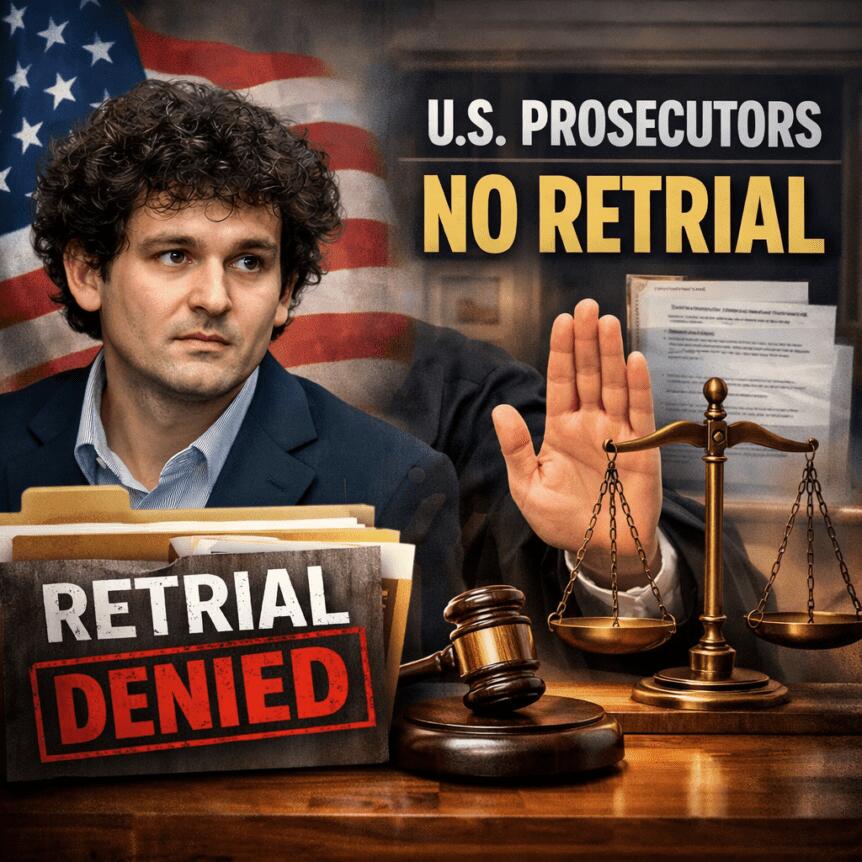
Prosecutors asked a federal judge to deny Sam Bankman-Fried’s bid for a new trial, arguing that the former FTX chief failed to meet the legal standard for retrial. The filing arrives as Bankman-Fried continues to press post-conviction appeals while the fallout from FTX’s collapse remains a touchstone for regulators and investors alike. In the February motion, prosecutors contend that testimony from former FTX executives Ryan Salame and Daniel Chapsky does not rise to “newly discovered evidence” and therefore should not warrant another trial, according to court documents cited by Bloomberg. The broader case — which culminated in a November 2023 verdict on seven counts of fraud and conspiracy and a 25-year prison sentence — continues to unfold through procedural challenges rather than fresh courtroom battles. The legal trajectory now centers on whether the retrial motion will proceed and how the Second Circuit will handle ongoing appeals.
Key takeaways
- Prosecutors maintain that the bar for retrial is not met because the witnesses cited by the defense were known to the defense before the 2023 trial, undermining the claim of newly discovered testimony.
- The defense argues that testimony from Salame and Chapsky could alter the government’s portrayal of FTX’s finances, potentially weakening the prosecution’s narrative.
- Judge Ronnie Kaplan has not yet ruled on whether the motion for a new trial will move forward; prosecutors were ordered to respond by March 11.
- Bankman-Fried remains engaged in an appellate battle in the US Court of Appeals for the Second Circuit, separate from the retrial motion.
- Public speculation about possible presidential pardon has accompanied the legal proceedings, though public signals from political figures have varied and progress remains uncertain.
Tickers mentioned: $BTC, $ETH
Sentiment: Neutral
Market context: The case sits at the intersection of a high-profile enforcement effort against a failed crypto exchange and broader concerns about market integrity, investor protections, and regulatory clarity in the wake of FTX’s collapse.
Why it matters
The pursuit of a retrial in Sam Bankman-Fried’s case underscores how federal courts handle post-conviction challenges in complex financial fraud prosecutions tied to the crypto sector. The defense’s argument revolving around “newly discovered evidence” hinges on whether testimony from Salame and Chapsky truly represents information that could alter the outcome of the trial, or whether it is something the defense could have anticipated given the broader context of FTX’s finances. The prosecutors’ counterargument, grounded in standard legal thresholds, is a reminder that retrials are far from routine and require tangible, timely facts that could meaningfully shift juror conclusions.
Beyond the courtroom mechanics, the proceedings carry implications for market sentiment, investor trust, and the regulatory posture toward crypto entities. The case has already shaped debates about how closely government witnesses’ accounts align with the realities of a quickly evolving crypto business, and whether retrospective disclosures can meaningfully affect previously admitted narratives. As the Second Circuit review progresses, the crypto industry will watch for signals about how aggressively courts will test witness credibility and financial disclosures in high-stakes prosecutions tied to digital-asset platforms.
On the political front, the possibility of a presidential pardon has lingered alongside courtroom developments. While public comments from figures such as former President Donald Trump have varied, the absence of a clear public commitment to pardon Bankman-Fried leaves the legal avenues—appeal, retrial, or other remedies—as the dominant channels for potential relief. The interplay between criminal rulings and political signals continues to shape expectations about how the sector is treated at the highest levels of government, even as the immediate judicial question remains narrowly focused on the retrial standard and the admissibility of newly presented testimony.
The procedural cadence in this matter remains precise: the defense’s motion was filed in February, prosecutors were directed to file a response by March 11, and the court will then decide whether the retrial request advances to a full consideration. In parallel, Bankman-Fried’s appeal in the Second Circuit proceeds on its own timetable, potentially setting up a long legal saga that could influence how future cases are framed and adjudicated in the crypto space.
What to watch next
- March 11: Deadline for prosecutors’ response to the retrial motion, and any subsequent ruling on whether the motion will proceed.
- Judicial rulings in the Second Circuit regarding the ongoing appeal of Bankman-Fried’s conviction and sentence.
- Any new filings or突inations from the defense that could outline additional grounds for post-conviction relief.
- Related public statements or filings from the parties that could influence the narrative around FTX’s finances and the government’s portrayal at trial.
Sources & verification
- Bloomberg report detailing prosecutors’ response and the status of the retrial motion, including the claim that the witnesses cited by the defense were not newly discovered (Bloomberg: sam-bankman-fried-shouldn-t-get-new-trial-prosecutors-argue).
- Cointelegraph articles covering SBF’s retrial efforts, the government’s response, and related court actions (SBF new trial fraud case; SBF trial court government response; FTX SBF Caroline Ellison Donald Trump; Donald Trump no pardon SBF).
- Public information on Bankman-Fried’s November 2023 conviction on seven counts and the subsequent 25-year sentence (as reported in coverage linked above and related Cointelegraph reporting).
Retrial bid in the SBF case: prosecutors push back as court awaits ruling
The dispute over whether Sam Bankman-Fried deserves a fresh trial centers on the nature of new testimony and what constitutes newly discovered evidence. Prosecutors argue that the proffered witnesses — Salame and Chapsky — were known to the defense before the 2023 trial, calling into question the legal standard for a retrial. This stance is grounded in the procedural framework that governs post-conviction relief, where the bar for presenting new facts that could alter a jury’s verdict is intentionally high. If the court accepts the prosecutors’ reasoning, the retrial request could be dismissed without a full evidentiary hearing.
From the defense side, the motion contends that the witnesses’ testimony could significantly reshape the government’s portrayal of FTX’s financial condition prior to its collapse. The defense argues that Salame and Chapsky could undermine the government’s accounting narrative and, by extension, the jurors’ understanding of the company’s inner workings. The tension between these positions highlights the delicate balance courts must strike between administrative efficiency and ensuring that any potentially exculpatory information is weighed fairly.
Judge Kaplan’s determination will hinge on whether the defense can demonstrate that the testimony constitutes a material discovery that was not reasonably accessible at trial and could have altered the outcome. The government’s response, due by March 11, will likely crystallize the judge’s approach to the motion. If the court signals that it will permit further argument or even a limited evidentiary hearing, the retrial process could extend well beyond a single ruling, prolonging a saga that has already spanned multiple years.
Bankman-Fried’s broader legal journey includes an ongoing appeal in the Second Circuit, adding another layer of complexity to an already intricate case. While the retrial matter is distinct from the appellate path, both avenues collectively shape the fate of one of the crypto industry’s most consequential legal episodes. The conviction and sentencing in 2023 marked a watershed moment, but the post-conviction phase continues to reverberate through courtrooms and industry discourse, influencing risk assessments, regulatory expectations, and the broader narrative surrounding accountability in crypto markets.
https://www.cryptobreaking.com/us-prosecutors-urge-judge-to/?utm_source=blogger%20&utm_medium=social_auto&utm_campaign=US%20prosecutors%20urge%20judge%20to%20deny%20SBF%20retrial%20bid,%20report%20says%20
Comments
Post a Comment