
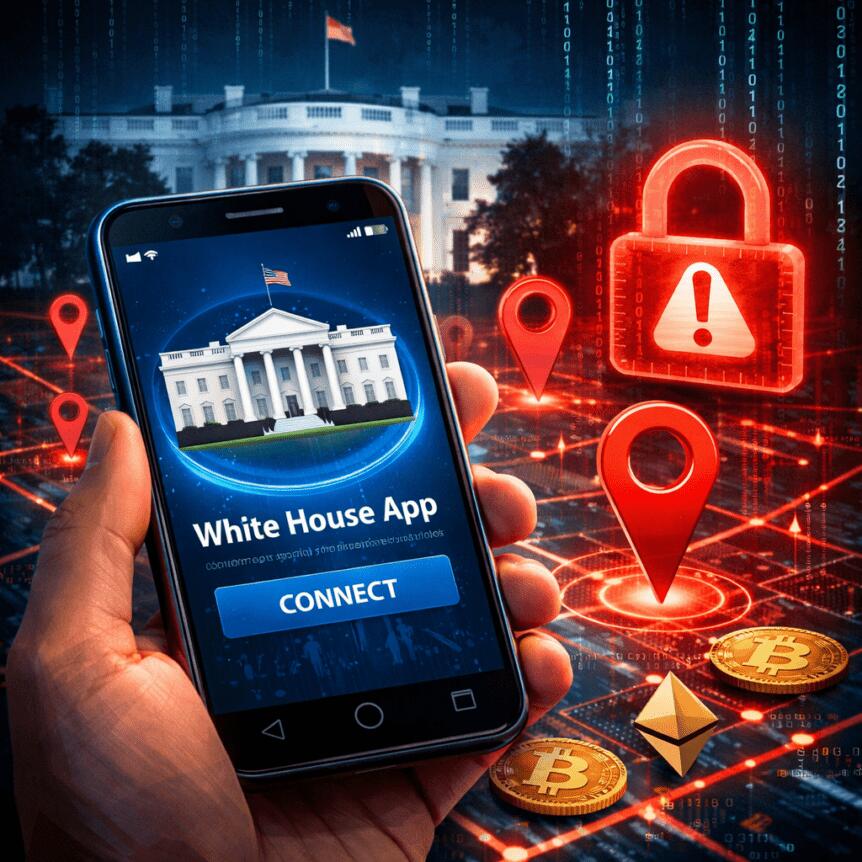
A government app released this week has ignited a debate over location-tracking, data collection and security, with researchers and privacy advocates urging closer scrutiny of the permissions it requests. The White House rolled out the app on Friday, framing it as a direct line to the administration for breaking news, livestreams and policy updates.
Critics say the app’s permission model raises questions about privacy, especially since store listings on Google Play and Apple’s App Store do not display explicit warnings about the requested access. The White House privacy policy describes data handling that appears broader than the app’s stated use, noting it automatically stores information such as the originating IP address and other basic data, and that it may retain subscriber names and email addresses—even though providing that information is not required to use the app.
On its face, the app is marketed as a transparent communications channel, but independent analyses have flagged unusual data-collection aspects, particularly the inclusion of location services in a tool that shows no obvious location-based features such as maps, geofenced content or weather. A software developer who uses the X handle Thereallo, together with Adam, a security engineer and infrastructure architect, identified code that could enable GPS access on the device. They argue that GPS usage in this context is atypical and merits closer examination. For context, their observations have not been independently verified.
Adam noted that the mere presence of location capabilities could introduce risk, particularly if such functionality can be activated by an update or is exploited by a malicious actor. “There is no map, no local news, no geofencing, no events near you, no weather. Nothing in the app that requires location,” he said, underscoring the mismatch between expected use and the permissions being requested.
Security assessment and risk vectors
Thereallo published a deeper analysis suggesting the app could contain code that would allow tracking a device every 4.5 minutes when foregrounded and every 9.5 minutes in the background, though this claim has not been independently validated. The researchers emphasized that while the app still requires permissions, the underlying tracking infrastructure could be activated with a minimal trigger in the right conditions. In addition to GPS data, they flagged the collection of notification interactions, in-app message clicks and phone numbers.
“No servers were probed. No network traffic was intercepted. No DRM was bypassed. No tools were used that require jailbreaking. Everything described here is observable by anyone who downloads the app from the App Store and has a terminal.”
The discussions have also touched on broader security concerns. Adam warned that the app’s security may be vulnerable to interception or manipulation by skilled actors on the same Wi‑Fi network, such as in public spaces, or by users with jailbroken devices capable of runtime modification. He cautioned that the combination of permissive data access and weak defenses could open doors to data leakage or altered behavior if an attacker gains foothold in the device’s communications stack.
Researchers have cited external posts and analyses to support their findings. For example, a detailed security write-up by Thereallo references a decompilation of the app and points to potential telemetry and data-access pathways. Additional context has circulated around accompanying discussions on social media, including posts that surfaced on X.
Policy gaps and broader implications for users and markets
Within the crypto and broader digital-privacy communities, the episode underscores a recurring theme: the trust users place in digital tools—whether a government app or a crypto wallet interface—depends on clear, auditable data practices and minimal, justified permissions. While the White House app is not a crypto product, the situation matters to builders and users who rely on public-facing platforms for custody, identity verification and timely communications. It highlights how privacy-by-design considerations—especially around location data and telemetry—are increasingly front and center for any digital service that touches sensitive information.
From a regulatory perspective, the divergence between what is stated in privacy policies and what is visible in store listings can become fertile ground for scrutiny. Google Play indicates that personal data may be collected during download and use, while Apple’s App Store directs users to the White House privacy policy for further details. The absence of visible, explicit warnings about location permission on the storefronts could be interpreted as a disclosure gap, prompting calls for clearer consent and more transparent user notifications in government apps and similar public-interest deployments.
As policymakers and technologists digest the incident, several questions loom: Why is location access required at all for a news-and-updates app with no geolocation features? Will the administration publish an independent security assessment or a clearer privacy-by-design pledge? And how might these disclosures influence future digital-government projects and the adoption of privacy-enhancing technologies in more sensitive domains?
Industry watchers may also consider the broader market implications. The episode touches on a tension that resonates across the crypto ecosystem: the need for robust, transparent security postures in any platform that handles user data or communications. For users, the key takeaway is to monitor disclosures around permissions and to expect clearer explanations about why location data is being requested, especially for government-run software that arrives with high public visibility.
In the near term, observers should watch how the White House and its contractors respond. Clarifications on the necessity of location permissions, any forthcoming security audits, and possible revisions to privacy disclosures will be important signals about how seriously authorities intend to uphold privacy as public digital services scale.
For readers and market participants, the episode reinforces a practical takeaway: privacy and security commitments in public-facing tech—whether for government apps or crypto services—are only as credible as the transparency and accountability that accompany them. Continued scrutiny and independent testing will likely shape how such apps evolve and how users balance convenience with data safety in an increasingly digital world.
https://www.cryptobreaking.com/white-house-app-sparks-privacy/?utm_source=blogger%20&utm_medium=social_auto&utm_campaign=White%20House%20app%20sparks%20privacy%20worries%20over%20location%20data%20for%20crypto%20
Comments
Post a Comment