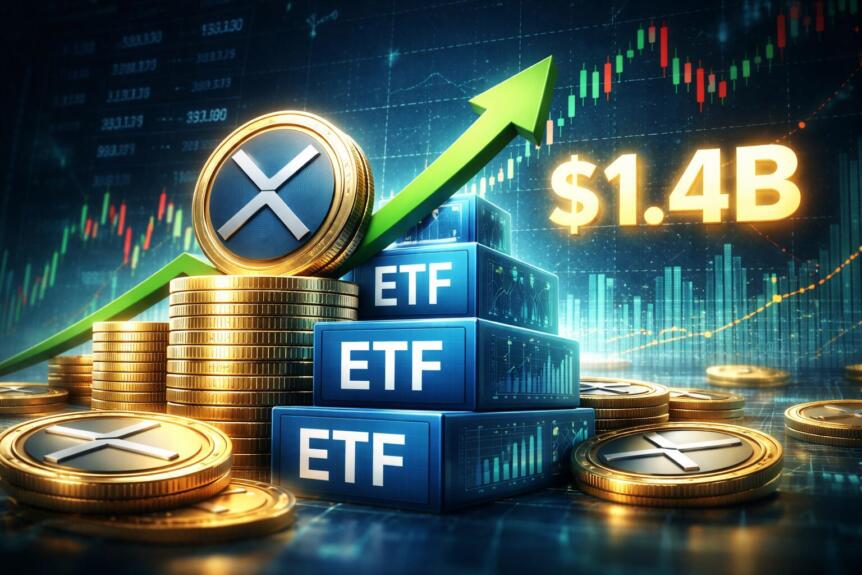
XRP ETFs Record $1.4 Billion Inflows Despite Market Volatility


Exchange-traded funds (ETFs) tracking the cryptocurrency XRP have attracted approximately $1.4 billion in cumulative inflows since their launch, according to recent data from analysts at Bloomberg Intelligence. The figures suggest sustained investor interest in XRP-based investment products despite ongoing volatility across the broader digital asset market.

https://twitter.com/JSeyff/status/2031372706076369289

XRP ETFs Attract Investors Despite Market Volatility


According to data provided by analyst James Seyffart, capital has been slowly draining into XRP-oriented ETFs since their launch. This is due to the fact that the inflows have continued despite the variation in price on the altcoin, indicating a steady institutional demand.

According to market observers, the ETFs provide an institutional investor with a regulated way of gaining exposure to digital assets without having to hold the cryptocurrencies themselves. Consequently, asset managers and other large institutions have become more and more familiar with ETFs as a vehicle to gain exposure to crypto.

This milestone of $1.4 billion was reached at a time when the XRP had been experiencing price adjustments in the general cryptocurrency market. Generally, decline in the asset prices may lower the inflows of investors, but the XRP based ETFs have registered positive fund flows.

Analysts observe that the ETF structure is mostly appealing to long-term investors who can see price declines as possible buying points. Such strategies are widely used among asset managers and institutional investors who tend to consider short-term fluctuations as a longer investment period.

ETFs Expand Regulated Access to Cryptocurrency Investments


ETFs have emerged as one of the most visible financial products that enable investors to be exposed to cryptocurrencies in regulated financial markets. Through traditional investment brokerage accounts, investors are able to buy or sell crypto-linked investments without buying and holding digital tokens.

In the case of XRP, an increase in the number of ETF products may greatly increase market inclusion, especially among those investors who are more comfortable with traditional financial instruments, as opposed to managing actual crypto trading.

The long-term inflows into XRP-bound funds might indicate the increased trust of institutional investors in the cryptocurrency industry. Analysts often view ETF inflows as a long-term demand in new asset classes.

Should the trend persist, analysts believe that ETF demand will become one of the most important metrics to look at as far as future performance and institutional adoption of XRP are concerned.

https://www.cryptobreaking.com/xrp-etfs-record-1-4/?utm_source=blogger%20&utm_medium=social_auto&utm_campaign=XRP%20ETFs%20Record%20$1.4%20Billion%20Inflows%20Despite%20Market%20Volatility%20

Comments

Popular posts from this blog

Mastercard Launches AI Agent Pay System With Ripple and Solana Help

Mastercard has launched Agent Pay for Machines, a payments system built for autonomous software agents. The service allows AI agents to send and receive payments without direct human action. It brings Ripple, Coinbase, and Solana Foundation into Mastercard’s push for automated digital commerce. Ripple Brings XRPL and RLUSD to Mastercard’s Agent Pay System Mastercard introduced Agent Pay for Machines on June 10 as a tool for machine-led payments. The system targets high-volume and low-value transactions across business and consumer use cases. It also supports automated settlement between software agents and connected machines. Ripple will support the system through the XRP Ledger and its RLUSD stablecoin. The company said that settlement will become more important as automated commerce grows. It also sees blockchain rails as useful for fast and rule-based payments. RippleX senior vice president Markus Infanger said XRPL and RLUSD support enterprise-grade agent payments. He said the tool...

Coinbase's x402 launches AI agents app store for payments

Coinbase-backed x402 has unveiled Agentic.market, a dedicated marketplace aimed at increasing the usefulness of AI agents by aggregating thousands of apps and services that agents can access without any API keys. The rollout positions the platform as a central hub for agents to discover, evaluate, and deploy capabilities across a standardized payments layer. Coinbase product lead Nick Prince described Agentic.market in a video posted on X as a storefront for discovering, comparing, and using x402 services. The marketplace is designed to give both humans and their AI agents access to a wide range of tools—from data feeds to consumer apps—without the friction of managing API credentials. A storefront for discovering, comparing, and using x402 services. Thousands of services. Zero API keys. Powered by x402. Prince added that the market offers a web interface for humans to browse and assess services, alongside a programming layer that lets AI agents autonomously search, filter, and integra...

Solana Policy Institute Calls on SEC to Safeguard DeFi Developers from Overly Strict Regulations

US Crypto Policy Innovation: Advocates Push for Clear Regulations and Developer Protections The Solana Policy Institute has urged the U.S. Securities and Exchange Commission (SEC) to differentiate between centralized crypto exchanges and non-custodial decentralized finance (DeFi) software. The nonprofit emphasizes that developers creating and publishing non-custodial code should not be classified as intermediaries, advocating for balanced regulation that fosters innovation without compromising security or legality. Key Takeaways Advocates call for regulatory clarity distinguishing between non-custodial DeFi protocols and centralized exchanges. The Institute argues that applying traditional securities laws to DeFi code risks stifling innovation and pushing activity offshore. Authorities are encouraged to adopt a custody-and-control-based framework to clarify legal liabilities. Legislation proposals aim to shield developers from legal liabilities associated with blockchain code and activ...