
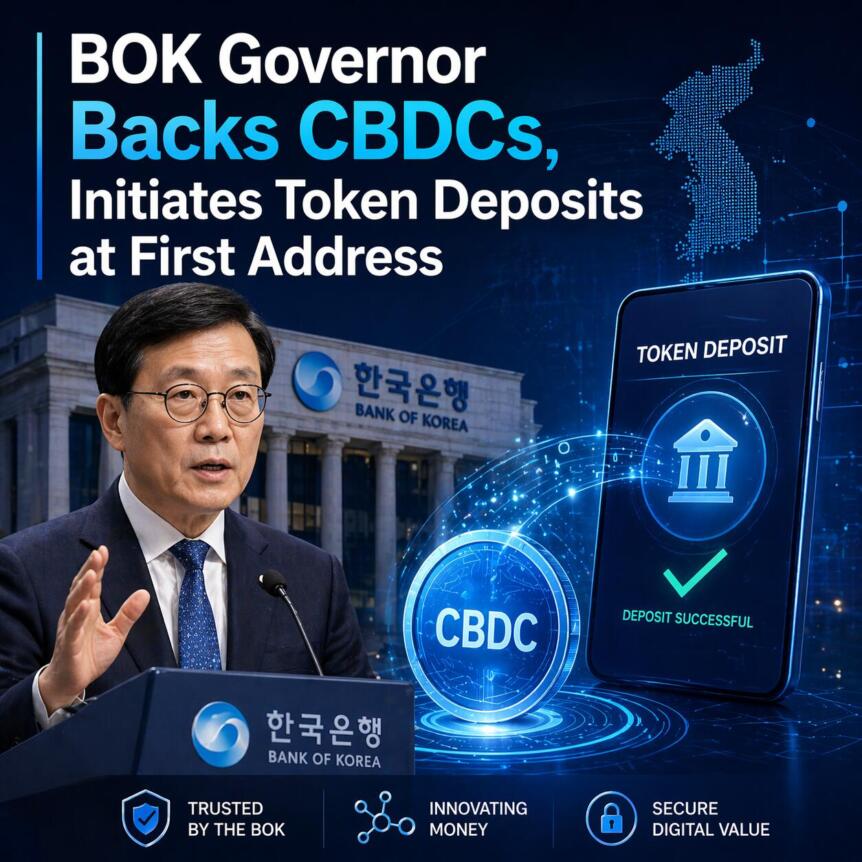
The Bank of Korea’s new governor is signaling a clear push into digital money experiments, framing central bank digital currencies (CBDCs) and tokenized deposits as a core part of Korea’s monetary toolkit. Shin Hyun-song, who began a four-year tenure after a Seoul inauguration ceremony, outlined a pragmatic path for the central bank to advance the second phase of its wholesale CBDC pilot and deepen international cooperation around digital payments.
In his first public address since taking office, Shin affirmed the Bank of Korea’s plan to push ahead with Project Hangang—the wholesale CBDC initiative designed to test blockchain-based settlement for large-value transactions—marking a step toward broader digital-finance capabilities. He also highlighted international collaboration efforts, including the Agora Project—a BIS-led consortium launched in April 2024 with seven central banks to explore cross-border tokenization and more efficient settlement. Shin argued these efforts will elevate the won’s standing in a digital-payments environment.
While Shin did not explicitly mention stablecoins in his inaugural remarks, previous reporting suggested openness to won-denominated stablecoins as part of Korea’s broader digital-monetary strategy. Reuters noted that Shin appeared receptive to such instruments when he was nominated as governor, though the formal speech did not reiterate that stance. The regulatory framework for stablecoins in Korea remains a point of contention, with lawmaker and regulator debates about whether won-pegged tokens should be limited to banks or opened to non-bank players.
Beyond central-bank digital money, Shin’s remarks come amid continuing regulatory discussions around the country’s stablecoin framework—and a broader push to integrate tokenized assets into public and cross-border payments. Cointelegraph has reported on the stalled bill and ongoing debates over whether issuance should be concentrated in traditional banking institutions or allowed to fintech and tech firms as well.
Key takeaways
- The Bank of Korea, under new Governor Shin Hyun-song, formalizes a push to advance Phase II of the wholesale CBDC pilot (Project Hangang) and to strengthen digital-monetary policy.]
- Shin ties Korea’s CBDC program to broader international cooperation on tokenization, citing the Agora Project as a strategic vehicle for cross-border payment efficiency and the won’s digital prominence.
- Domestic debates over won-denominated stablecoins remain unresolved; previous reporting indicates openness to such instruments, but the inaugural speech did not explicitly endorse them.
- A separate government-led initiative will test tokenized deposits for public spending, with a Sejong City pilot slated to begin and a full rollout planned for Q4 2026 as part of a regulatory sandbox.
Phase II of Hangang: Korea’s CBDC experiment intensifies
Shin’s inaugural remarks reinforced the Bank of Korea’s commitment to advancing the second phase of Project Hangang, a blockchain-backed wholesale CBDC effort designed to explore settlement workflows, liquidity management, and resilience in large-value transactions between financial institutions. The move sits within a broader strategy to modernize the financial system and reduce settlement risk through programmable money. The Hangang project is positioned as a practical test bed for credibility, interoperability, and security in a digital-money regime that could influence both domestic markets and regional payments corridors.
The emphasis on a phased, deliberate rollout reflects a central-bank approach that prioritizes stability and policy credibility as digital money concepts move from pilot labs toward potential real-world use cases. Shin’s framing suggests that the central bank sees CBDCs not as a speculative venture but as a core instrument for maintaining price and financial stability in an increasingly digitized economy.
Global coordination on asset tokenization
Shin highlighted ongoing international collaboration as a crucial element of Korea’s digital-monetary strategy. The Agora Project, an initiative launched by the Bank for International Settlements and seven central banks, seeks to explore how tokenization can improve cross-border payments and settlement efficiency. By aligning with global peers on standards, interoperability, and risk management, Korea aims to ensure that any domestic pilot is compatible with international liquidity and settlement rails. In Shin’s view, such cooperation could help elevate the status of the won in the evolving digital-payment landscape.
The BIS-backed effort sits alongside Korea’s own experiments, signaling a broader push to understand how tokenized digital assets can be integrated into current financial infrastructures without sacrificing security or monetary sovereignty. Market participants are watching how these international collaborations translate into concrete policy and technical frameworks that could shape regional and global payment flows in the years ahead.
Domestic stablecoins debate and regulatory context
The Korean policy environment around stablecoins remains unsettled. Earlier reporting indicated that Shin was open to won-denominated stablecoins, a stance that could influence how lawmakers frame future legislation. However, the current public address did not reiterate a stance on stablecoins, leaving the regulatory pathway ambiguous. A key point of contention is whether the issuance of won-pegged tokens should be restricted to commercial banks or opened to non-bank fintech and tech firms, a debate that continues to divide regulators and legislators.
Cointelegraph’s coverage of South Korea’s stablecoin framework highlights the tension between fostering innovation and maintaining financial stability and consumer protections. As the policy conversation evolves, market participants should monitor whether the government clarifies licensing paths, custody requirements, and reserve standards for any future stablecoin framework.
Tokenized deposits for government spending: testing digital public finance
On the public-finance front, Korea’s Ministry of Economy and Finance is moving to test blockchain-based payments for selected government expenditures as part of a regulatory sandbox for distributed ledger technology. The plan envisions tokenized deposits used to execute government spending, with a full rollout targeted for the fourth quarter of 2026. The initial phase will launch in Sejong City, under a framework that imposes limits on timing and eligible spending categories to manage risk while evaluating real-world applicability in public finance.
The pilot underscores a pragmatic approach: use a controlled environment to assess the feasibility, governance, and fiscal implications of tokenized deposits in government operations. If successful, this experiment could inform wider adoption of tokenized public-finance tools and potentially influence how sovereign payments are settled in a digitized economy.
What to watch next
Shin’s tenure signals that Korea intends to keep CBDCs and tokenized finance at the center of its monetary strategy, balancing innovation with stability. Key questions for the coming months include how Phase II Hangang will test interoperability with existing payment rails, what concrete standards emerge from Agora-like cooperation, and how lawmakers resolve the won-stablecoin debate. The Sejong-based tokenized-deposit pilot will also be a focal point, offering early indications of how tokenized public-finance tools could scale in a regulated environment.
https://www.cryptobreaking.com/bok-governor-backs-cbdcs-initiates/?utm_source=blogger%20&utm_medium=social_auto&utm_campaign=BOK%20Governor%20Backs%20CBDCs,%20Initiates%20Token%20Deposits%20at%20First%20Address%20
Comments
Post a Comment