
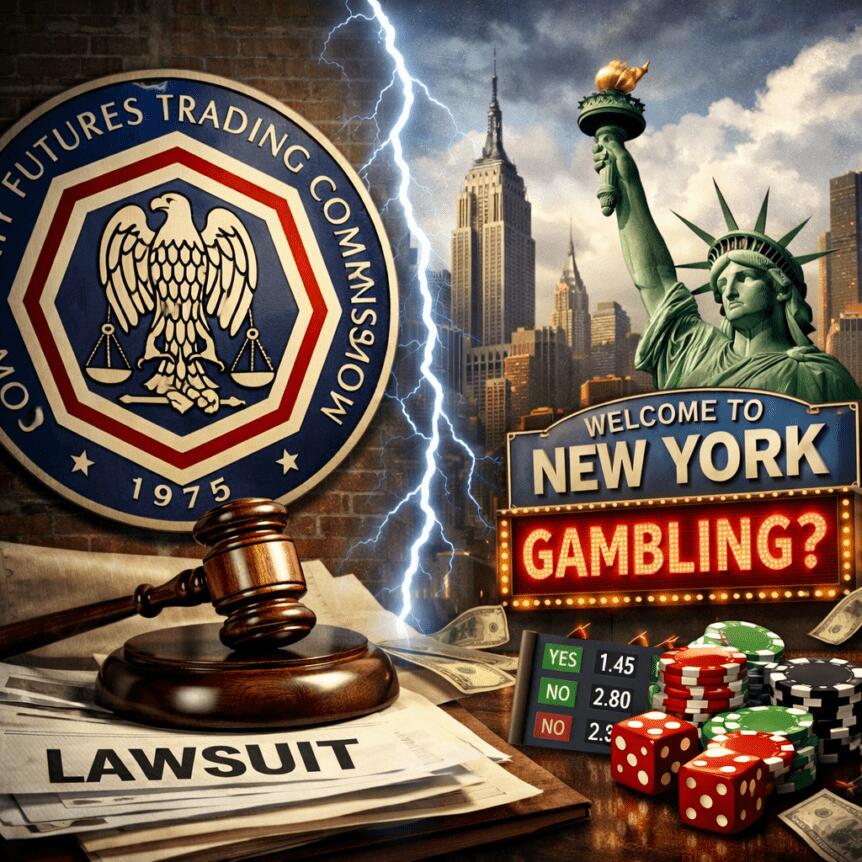
The regulatory fight over prediction markets moved to the federal courts this week as the Commodity Futures Trading Commission (CFTC) sued New York state to block its gambling-law actions from applying to federally regulated event-contract platforms. In the Southern District of New York, the CFTC argued that federal law grants it exclusive authority over these markets and asked for a declaratory judgment plus a permanent injunction against New York’s enforcement efforts.
“CFTC-registered exchanges have faced an onslaught of state lawsuits seeking to limit Americans’ access to event contracts and undermine the CFTC’s sole regulatory jurisdiction over prediction markets,” said CFTC Chair Michael Selig. The complaint comes as New York has intensified its own actions against major platforms, including Coinbase and Gemini, with Kalshi having faced prior state-enforcement pressure on its sports-related contracts.
For context, New York’s push against unregistered gambling or gaming activities has been part of a broader state-led wave targeting prediction-market operators. Earlier this week, New York filed suits against Coinbase and Gemini, alleging unlicensed gambling activity. Kalshi, a prominent prediction platform, has also faced regulatory moves in the past. Related coverage has highlighted related enforcement actions in other jurisdictions and ongoing debates about the boundaries between federal financial regulation and state gambling rules.
Key takeaways
- The CFTC asserts exclusive federal jurisdiction over prediction markets and seeks a judicial ruling that New York cannot enforce its gambling rules against federally regulated platforms.
- New York has separately pursued enforcement actions against prominent platforms, illustrating a broader state-led crackdown on prediction-market offerings.
- A coalition of 37 states and Washington, D.C. filed an amicus brief backing Massachusetts in its Kalshi case, arguing federal law does not clearly override state gambling authority.
- Kalshi contends its products are “swaps” regulated under a 2010 financial law, while states argue that the law was not intended to legalize nationwide sports betting or preempt state protections.
- The evolving landscape signals greater regulatory fragmentation for prediction markets, with potential implications for users, developers, and investors.
Federal authority under dispute
The CFTC’s filing in SDNY centers on whether New York’s enforcement actions against prediction-market platforms can stand alongside federal supervision of these markets. The agency asserts that federal law grants it exclusive authority over prediction markets and that state actions risk “undermining the CFTC’s sole regulatory jurisdiction.” The CFTC’s move underscores a broader tension between federal oversight and state gambling regulations as platforms offer event-based contracts tied to real-world outcomes.
In presenting its case, the CFTC highlighted what it sees as a pattern of state-level lawsuits aimed at limiting access to these markets. The agency framed its suit as a necessary step to preserve a uniform federal framework for prediction markets and to prevent a patchwork of state rules that could complicate compliance for federally registered exchanges.
The developing legal dispute sits at the intersection of financial regulation and gambling policy, inviting questions about how federal authority should apply to products that blend financial mechanics with event-betting features. Observers will be watching not only the SDNY proceedings but also how state courts interpret the reach of federal financial statutes in relation to traditional gambling authority.
Massachusetts case and the 37-state amicus brief
In a parallel but closely related thread, a coalition of 37 states and Washington, D.C. filed an amicus brief supporting Massachusetts in its challenge to Kalshi’s sports-betting stance. The filing urges Massachusetts’ highest court to reject Kalshi’s argument that federal law permits nationwide sports betting without adhering to state rules. The amicus brief is available from the Massachusetts attorney general’s office: 37-state backing Massachusetts in Kalshi matter.
Kalshi maintains that its betting products are swaps regulated under a 2010 financial law, a position it frames as federal coverage for certain exchange-traded event contracts. States counter that the law in question was never intended to authorize the expansion of sports betting nationwide or to supersede established state gambling regimes. The states contend that preserving state oversight remains essential for protections such as licensing, age restrictions, fraud prevention, and gambling-addiction safeguards—areas not addressed by federal financial regulation.
Previous coverage has noted that the Kalshi case sits at a critical juncture for the broader debate over federal preemption in financial markets and the role of states in policing everyday gambling-related services. The amicus brief signals a broad, organized effort by state attorneys general to shape how federal law interacts with state gambling controls in the context of prediction markets.
State crackdowns intensify across jurisdictions
The past several months have seen a sharpened stance from states against prediction-market operators. Arizona, Connecticut, and Illinois have pursued efforts to enforce gambling laws against platforms offering prediction contracts. In some cases, regulators have issued cease-and-desist orders or pursued court action to curb unregistered offerings. This trend reflects a growing belief among state authorities that prediction markets straddle long-standing lines between gambling regulation and financial product oversight.
Earlier this month, a Nevada judge extended a prohibition on Kalshi’s event-based contracts within the state, siding with regulators who argued that the products function as unlicensed gambling. The Nevada ruling adds to a string of state-level actions that complicate the operating environment for prediction-market platforms and their users.
These developments come amid broader conversations about how to balance consumer protections with innovative financial instruments. While some observers see potential benefits in prediction markets for information discovery and hedging, others warn of regulatory and compliance risks that could constrain adoption and scale.
As coverage from Cointelegraph and other outlets has noted, the tension between federal preemption and state gambling authority is not new, but the current convergence of high-profile suits, amicus briefs, and court decisions raises the stakes for Kalshi, Polymarket, and similar platforms that tether financial mechanics to live events. The evolving legal framework will likely shape how next-generation prediction services design compliance programs and engage with regulators going forward.
What happens next will hinge on courtroom decisions in the SDNY action and in state courts handling Kalshi’s case. Investors, operators, and users should monitor regulatory filings and rulings closely, as outcomes could redefine the permissible scope of prediction markets in the United States and influence how these platforms structure products, licensing, and risk controls going forward.
https://www.cryptobreaking.com/cftc-sues-new-york-over/?utm_source=blogger%20&utm_medium=social_auto&utm_campaign=CFTC%20Sues%20New%20York%20Over%20Plan%20to%20Treat%20Prediction%20Markets%20as%20Gambling%20
Comments
Post a Comment