
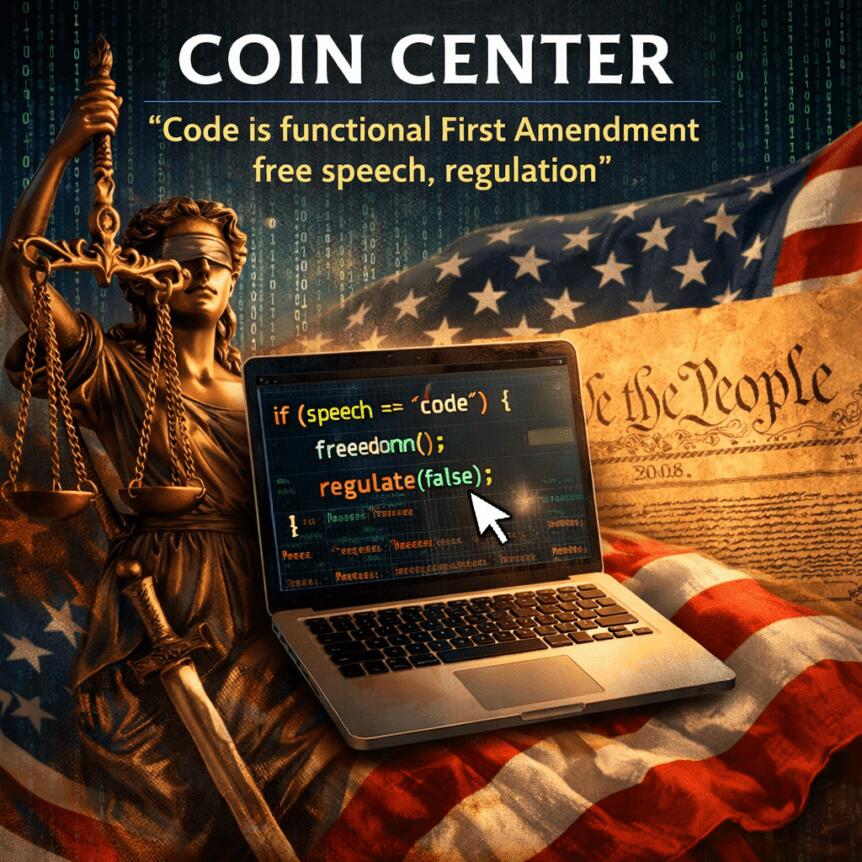
In a policy briefing published this week, the crypto policy group Coin Center argues that software code used to design, publish, and maintain crypto systems constitutes protected speech under the First Amendment, and should not be readily conscripted into regulatory oversight as if it were a traditional financial intermediary. The authors—Executive Director Peter Van Valkenburgh and Director of Research Lizandro Pieper—frame code publication as an act of expression, akin to publishing a book or a culinary recipe, rather than as the actions of a financial services provider.
According to Coin Center, extending pre-registration or licensing requirements to speech activity would undermine constitutional protections and distort the historical rationale for financial oversight. They emphasize that developers are speakers and inventors, not fiduciaries or middlemen, and that treating code as regulated conduct risks a prior restraint that is almost always unconstitutional. The briefing seeks to provide a framework for courts and regulators to distinguish between protected software publication and a developer’s professional conduct in the ecosystem.
They also note that there have been high-profile convictions of crypto developers based on how software is used, including cases tied to Tornado Cash, which underscore the legal tensions around liability for code and its uses. The discussion situates these prosecutions within a broader quest to separate speech from regulated activity in a rapidly evolving technology space.
Key takeaways
- Publication and maintenance of crypto software is argued to be First Amendment–protected speech, not inherently a regulated financial service.
- Regulatory oversight should target conduct only when developers actively control user assets, execute transactions for users, or make decisions on users’ behalf.
- There is ongoing doctrinal tension among courts regarding whether software constitutes speech or conduct; a clear framework is needed to preserve free-speech protections in software publication.
- Precedents such as Lowe v. SEC are cited to support the notion that publishers who do not hold assets or act on behalf of clients may be shielded from regulation as speech, highlighting risks of overreach in enforcement against developers.
- Policy implications span enforcement tactics, licensing regimes, cross-border divergences, and the balance between innovation and consumer protection in crypto markets.
Legal framing: software as speech and the conduct boundary
The authors contend that the First Amendment shields those who publish and maintain code, framing software as a medium of expression rather than a support service that facilitates financial transactions. They argue that treating software publication as regulated conduct would undermine a long-standing constitutional logic that protects speech, regardless of the potential real-world effects of the code when used by others. The briefing emphasizes that the “speakers and inventors” behind crypto software are distinct from intermediaries who custody assets or execute user-directed actions, and that extending licensing requirements to routine publication would amount to an unwarranted prior restraint on speech.
Central to the paper is a call to resist a “functional code theory” that some courts have used to blur the line between speech and conduct. By referencing established jurisprudence, the authors seek to remind courts that the mere execution of code—particularly when published with no asset custody or user-directed action—should not automatically be treated as regulated activity. The framework aims to clarify when regulatory oversight is appropriate and when constitutional protections apply, thereby reducing legal ambiguity for developers and their ecosystems.
Enforcement considerations for developers and institutions
From a regulatory perspective, the briefing highlights a practical concern: if regulators compel pre-registration or licensing for all software publications, the gatekeeping effect could chill innovation and hamper developer collaboration. For institutions such as exchanges, banks, and other market participants, the delineation between speech and conduct has direct compliance implications. The authors argue that the correct approach is to focus on concrete, user-facing conduct—such as asset custody, automated asset transfers, or decisions made or controlled by developers on behalf of users—rather than on the act of writing, publishing, and maintaining software itself.
The discussion also touches on enforcement realities in the United States, where some prosecutions have leveraged traditional money-services or money-transmitter statutes to address crypto software usage. In this context, the paper argues that liability should hinge on connections to asset custody and transactional control, not on the mere availability of code. This distinction matters for developers seeking to avoid mischaracterization as financial intermediaries and for compliance teams that must assess risk without stifling legitimate software innovation.
Coin Center points to the broader regulatory environment as a backdrop for these arguments. The push for tailored frameworks that reflect constitutional protections, rather than broad, asset-centric licensing, has implications for how agencies coordinate cross-border oversight and how industry participants structure KYC and AML programs. The aim is to preserve the ability to publish and steward open-source software while maintaining accountable pathways for consumer and market protection where appropriate.
Case landscape and precedent shaping risk
The briefing places its analysis within a real-world backdrop of recent prosecutions that have involved developers whose work enabled or facilitated certain financial activities. Notably, high-profile cases connected to Tornado Cash have spurred ongoing legal debates about intent, liability, and the role of developers in the use of their code. In related developments, authorities have pursued cases against individuals associated with other privacy-focused or non-custodial projects on charges related to unregistered money transmission and related offenses. In several instances, defendants and their counsel have argued that their actions constituted speech or publication rather than regulated service provision, invoking established constitutional principles in defense of their work.
In this context, the Coin Center briefing draws an explicit line: while developers should not be immunized from accountability for illegal activity they knowingly facilitate, liability should not be expanded to cover publication of software itself. The 1985 Lowe v. SEC decision is cited as a benchmark, in which the Supreme Court suggested that a publisher who does not hold assets on behalf of a client and does not act in the client's stead is protected by free speech. The implication for current enforcement is clear: doctrines that would treat code publication as professional or administrative conduct warrant careful scrutiny to avoid overreach into speech protection.
The broader policy takeaway is that software developers cannot reasonably be treated as scapegoats for illicit activity, nor should their work be criminalized for outcomes driven by user behavior. The briefing argues that the legal framework should reflect the reality that crypto software often operates as an expression of ideas and as a tool for decentralized coordination, rather than as a regulated service in itself. This stance has meaningful implications for licensing debates, regulatory oversight, and the development of compliance programs across the industry.
Regulatory precedent and notable cases shaping risk
Looking ahead, observers should watch how courts apply the conduct-vs-speech distinction in crypto-related litigation, particularly where developers publish code that enables asset transfers or transaction scripting. The current discourse emphasizes that the constitutional protections surrounding speech should guide how regulators approach code publication, while ensuring that enforcement targets genuine custodial or transactional intermediaries. The evolving case law and regulatory discourse will influence policy design across jurisdictions, including any interactions with comprehensive regulatory regimes like MiCA in the European Union and analogous frameworks in the United States and beyond.
As enforcement and policy evolve, the central question remains: how can regulators protect consumers and markets without diminishing the freedoms that underpin open, collaborative software development? The Coin Center analysis suggests that a principled application of First Amendment doctrine—grounded in the distinction between speech and conduct—offers a path to reconcile innovation with public-interest safeguards.
What to watch next: ongoing court decisions, forthcoming regulatory guidance, and cross-border policy developments that define the permissible contours of crypto software publication versus regulated financial activity. The balance struck in these debates will shape both the legal risk environment for developers and the compliance posture of institutions engaging with decentralized technologies.
https://www.cryptobreaking.com/coin-center-code-is-functional/?utm_source=blogger%20&utm_medium=social_auto&utm_campaign=Coin%20Center:%20Code%20is%20functional%20First%20Amendment%20free%20speech,%20regulation%20
Comments
Post a Comment