
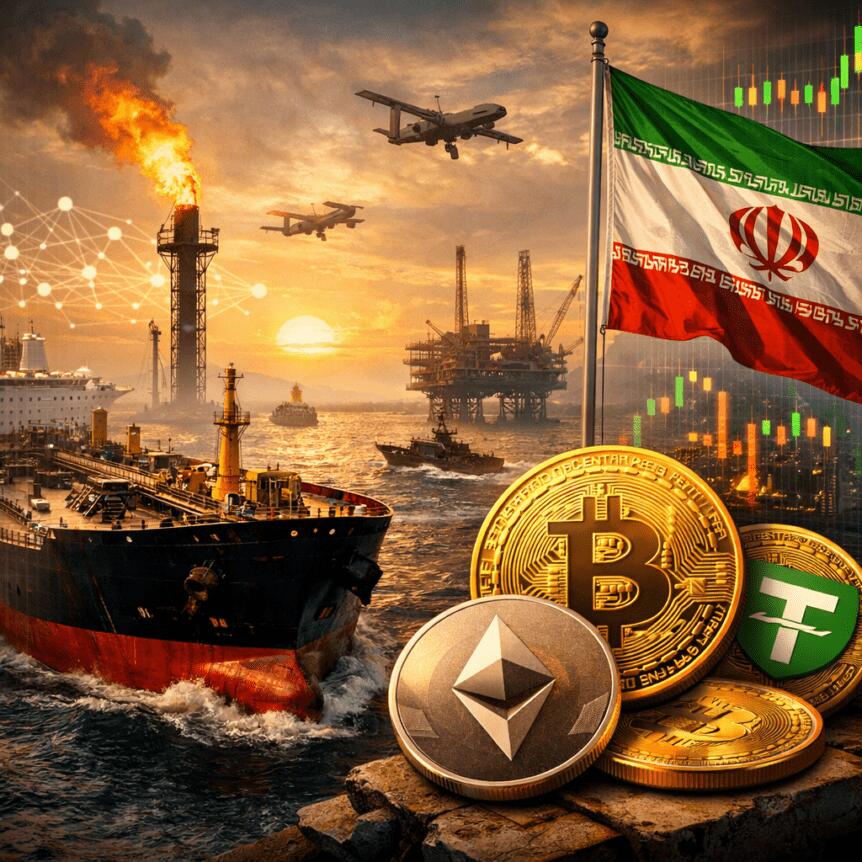
The debate over how Iran might collect tolls from oil tankers crossing the Strait of Hormuz has intensified within the Bitcoin community. The chokepoint through which roughly 20% of global oil supply passes is now being discussed as a potential testing ground for Bitcoin as a cross-border settlement tool, following a Financial Times report that Iran was exploring BTC payments for tolls to dodge sanctions.
Since the FT piece, competing accounts have circulated about what form tolls could take. One line of speculation centers on BTC payments, while other reports point to stablecoins or even Chinese yuan as plausible settlement options. Analysts and advocates alike have stressed the issue is far from settled, but the core question remains: could Iran rely on Bitcoin to bypass traditional financial channels in a manner that would be visible at the corridor’s narrow, high-pressure lanes?
“If this development were to materialize, it would spotlight Bitcoin’s role as a neutral settlement layer for international trade,” according to proponents. Yet the discussion isn’t purely theoretical. The same debate touches on technical feasibility, sanctions risk, and the practical realities of on-chain settlement at oceanic scale.
The Financial Times report cited a spokesperson from Iran’s Oil, Gas and Petrochemical Products Exporters’ Union, who described toll payments as needing to be completed in seconds. That framing has led observers to consider the Lightning Network, a layer-2 solution built on Bitcoin designed for rapid, off-chain transactions, as a potential mechanism for toll settlement. The FT coverage suggested that ships could pay via a quick QR code scan or a Bitcoin address provided after ship clearance. If such a system were deployed, payments would be processed with minimal delay, sidestepping the slower on-chain confirmation times that typically accompany BTC transactions.
Nevertheless, the most widely discussed numbers in this narrative come from analysts who cautioned that any toll scheme would need to handle substantial value per voyage. Alex Thorn, head of firmwide research at Galaxy, floated the possibility of tolls ranging from several hundred thousand dollars to a few million dollars per tanker, depending on the vessel’s size and the crossing’s risk profile. Thorn also noted that, in practice, the largest publicly known Lightning Network transaction is around $1 million, underscoring the operational questions that would need to be resolved for high-volume, time-critical payments at sea. He emphasized that if Iran advances a toll collection framework, it would likely rely on a BTC payment point that ships can access upon approval to pass through Hormuz.
Key takeaways
- Iran’s potential acceptance of BTC for Hormuz tolls would mark a high-profile test of Bitcoin as a cross-border settlement layer amid sanctions pressures.
- Conflicting reporting suggests tolls could be payable in BTC as originally reported, or alternatively settled in stablecoins or yuan, highlighting uncertainty about the exact mechanism.
- Technical feasibility hinges on rapid settlement; while the Lightning Network enables near-instant transfers, the scale of toll payments per voyage could challenge current capacity, given historical LN transaction sizes.
- Advocates point to Bitcoin’s lack of a central issuer or blacklist, contrasting with regulated stablecoins that can be frozen, a factor some see as relevant to Iran’s strategic aim.
- If real, the development would have implications for the perception of Bitcoin as a neutral, global settlement layer and could influence regulatory discourse around cross-border crypto usage.
How the toll concept could unfold in practice
The Financial Times described a scenario in which Iranian authorities would require an extremely quick BTC payment as a ship enters Hormuz. In practical terms, this could involve generating a QR code or a Bitcoin address that the ship’s crew or their payment system would interact with upon receiving clearance. If adopted, this approach would lean on layer-2 solutions like the Lightning Network to keep settlement times short enough to match the navigational and regulatory checkpoints faced by vessels transiting the strait.
However, observers caution that the logistics are nontrivial. The strait’s traffic is heavy, and oil toll calculations can be complex, potentially varying with vessel type, cargo, and passage window. While the Lightning Network offers rapid settlement, its capacity and liquidity at scale for frequent, large-value payments remain an area for close monitoring. As Thorn noted, the largest documented Lightning transaction to date sits around the $1 million mark, which calls into question how a toll scheme would scale for multiple simultaneous crossings or exceptionally large tankers. The alternative—the use of QR codes or alphanumeric addresses—would still require robust onshore or on-chain settlement checkpoints to ensure compliance, routing, and reconciliation with oil-trade records.
Implications for Bitcoin, sanctions policy, and the broader market
Supporters argue that a successful BTC toll system at Hormuz would underscore Bitcoin’s potential as a decentralized, censorship-resistant settlement layer capable of operating in highly sanctioned environments. This line of thinking aligns with broader commentary about Bitcoin as an alternative settlement primitive for international trade, a view that has been echoed in various industry circles. Still, critics point to practical friction, including liquidity management on the Lightning Network, counterparty risk in a sanctioned domain, and the challenge of auditing cross-border flows when on-chain data may be partitioned or obfuscated by policy constraints and compliance regimes.
More broadly, the discussion touches on the evolving regulatory and technical landscape. Some analysts argue that, even if toll payments were settled in BTC, policymakers could still apply controls at different points in the transaction chain, including the gateways and exchanges used to bridge between crypto and fiat. Others highlight recent developments in stablecoin regulation as a reason why a BTC-centered toll arrangement would stand out as a unique case study in crypto-enabled sanctions evasion. As one commentator paraphrased, unlike stablecoins with built-in compliance layers, Bitcoin’s native architecture lacks a centralized issuer that can freeze or sanction tokens, a factor that some see as increasing Iran’s incentive to consider BTC payments in high-risk corridors.
Within the crypto industry, the discussion reflects a longer-running debate about Bitcoin’s credibility as a settlement medium for large-scale, real-world value transfers. Some proponents link this potential use case to arguments that Bitcoin could serve as a neutral, global settlement layer for complex financial transactions. Others urge caution, noting that even if such a toll system emerges, it would operate within a tightly controlled, geopolitically sensitive context that could limit its scalability and adoption outside the immediate environment.
What to watch next
Readers should monitor additional reporting from established outlets for confirmation about whether Iran will proceed with BTC tolls, stablecoins, or yuan settlements. The coming weeks could reveal more concrete details about the mechanics, governance, and interoperability of any toll-collection framework. If actual pilot payments materialize, investors and builders will want to assess the implications for Bitcoin’s transactional use in real-world, sanctioned corridors, as well as the potential regulatory responses that such a development might provoke.
In the meantime, developments at Hormuz will continue to test how crypto-native settlement concepts interface with one of the world’s most consequential energy chokepoints, offering a glimpse into how policymakers, banks, and blockchain networks might navigate the next era of cross-border trade.
Source notes: The Financial Times reported on Iran’s consideration of BTC payments for Hormuz tolls this week, with subsequent commentary from Galaxy’s Alex Thorn outlining alternative possibilities and scale considerations. See the FT coverage for details, and additional commentary linked to industry discussions on Bitcoin’s use as a settlement layer.
https://www.cryptobreaking.com/crypto-community-weighs-irans-alleged/?utm_source=blogger%20&utm_medium=social_auto&utm_campaign=Crypto%20community%20weighs%20Iran's%20alleged%20crypto%20toll%20on%20oil%20shipments%20
Comments
Post a Comment