
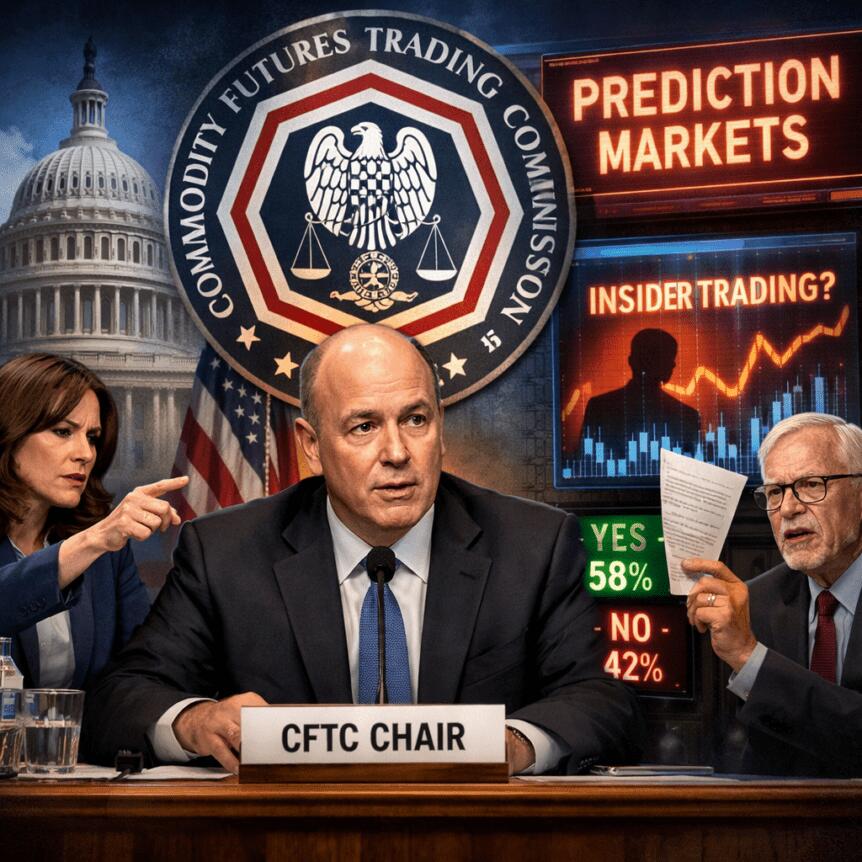
A bipartisan group of seven House members has formally pressed the Commodity Futures Trading Commission (CFTC) to account for its approach to insider trading in prediction markets and event contracts tied to geopolitical events. In a letter to CFTC Chair Michael Selig, the lawmakers argued that the agency wields clear authority under the Commodities Exchange Act to prevent evasion of the act’s underlying swap provisions, signaling support for Selig’s view that the CFTC has jurisdiction over prediction markets.
The letter also raises questions about how the CFTC polices contracts deemed “morally obscene,” including wagers on U.S. military actions in Iran and Venezuela. The lawmakers pointed to instances of suspicious trades related to the timing and outcomes of such actions, calling for swift and decisive oversight to prevent exploitation of these markets. They warned that allowing these contracts to persist could undermine confidence in a federal regulatory framework intended to ensure fair, transparent markets.
Key takeaways
- Lawmakers request a formal response from the CFTC by April 15 on six questions related to insider trading and the regulation of prediction markets.
- The seven-member letter reinforces the CFTC’s claimed jurisdiction over prediction markets by tying them to the agency’s swap provisions under the Commodities Exchange Act.
- Concerns over “morally obscene” event contracts—such as bets tied to U.S. military actions—highlight ongoing scrutiny of market content and potential misuse.
- Regulatory battles unfold at federal and state levels, including lawsuits by state gaming authorities against Kalshi and Polymarket, with questions of preemption and enforcement increasingly central.
- CFTC enforcement chief David Miller signaled a pragmatic stance on insider trading—prosecuting only cases involving tipping or misappropriated information, not pursuing every minor violation.
Regulatory scope and the arc of enforcement
The exchange between lawmakers and the CFTC underscores a broader debate about how federal commodities rules should apply to prediction markets and event contracts. The letter cites the Commodities Exchange Act as granting the CFTC the authority to apply rules designed to prevent evasion of swaps provisions, reinforcing the agency’s position that prediction markets fall within federal regulation rather than purely state purview. This stance sits against a backdrop of legal challenges to market operators ranging from Kalshi to Polymarket, with state authorities pursuing enforcement actions that argue unlicensed gambling or sports betting violations.
The legal landscape is drafting itself in real time as courts weigh the reach of federal preemption against state gaming statutes. For example, the Third Circuit recently affirmed a lower court ruling blocking New Jersey gaming authorities from pursuing enforcement actions against Kalshi, with two of three judges indicating Kalshi had a reasonable chance of success in arguing that federal commodities laws preempted state actions. The outcome of these jurisdictional questions could shape how prediction markets operate across multiple states and whether state regulators can curb activities they deem unlawful without clashing with federal authority.
Beyond court battles, industry players continue to navigate a patchwork of state laws and regulatory expectations. Kalshi and Polymarket have faced separate suits and inquiries as states seek to police unlicensed gambling while federal regulators frame certain event contracts as swaps. The evolving regulatory posture matters for investors and builders who rely on predictable rules for creating, listing, or trading contracts tied to real-world events.
Insider trading enforcement: a measured approach
As lawmakers pressed for more aggressive oversight, CFTC enforcement chief David Miller weighed in on how insider trading in prediction markets would be pursued. Miller indicated that the agency would prosecute cases involving tipping or trading on misappropriated information but would not allocate resources to “trivial” instances that do not rise to a material manipulation of market integrity. The distinction—between serious, information-based misconduct and routine or minor mispricings—speaks to a broader enforcement philosophy that weighs market impact against prosecutorial effort.
For market participants, the comment signals that while insider trading remains a crucial concern, the CFTC’s approach may prioritize cases with clear, material harm to market fairness. This stance could influence how platforms design surveillance, disclosure, and antifraud controls to deter misuse without hampering legitimate price discovery and hedging activity.
What to watch next: implications for platforms and investors
The administration of prediction markets sits at the intersection of financial regulation, consumer protection, and national security considerations. The current letter and the broader regulatory dialogue suggest several trajectories to monitor:
- Regulatory clarity could emerge on whether prediction markets are categorically swaps under federal law or if alternative regulatory frameworks apply in specific contexts. The outcome will affect platform licensing, product design, and cross-state operations.
- State actions against prediction-market operators may continue to test the balance between state gaming authority and federal preemption, with potential implications for market access and compliance costs.
- Enforcement priorities could tilt toward high-impact, information-based misconduct, prompting platforms to strengthen anti-insider trading controls, surveillance analytics, and governance standards to deter misconduct.
- Investors and developers should watch how sensitive event contracts—especially those tied to geopolitical or military actions—are treated in terms of content guidelines, listing approvals, and risk disclosures.
The exchange between lawmakers and regulators arrives amid broader conversations about how to harmonize innovation in on-chain or off-chain prediction markets with robust oversight. As platforms adapt to the regulatory rhythm, participants should weigh the potential for policy shifts that could either broaden permissible activities under uniform federal standards or tighten restrictions at state levels. The next formal response from the CFTC by mid-April will be a telling signal of how aggressively the agency plans to police insider trading and whether it will pursue a more centralized, comprehensive framework for prediction-market regulation.
For readers following the evolution of prediction markets, the unfolding dynamic between federal regulators, state enforcers, and market operators like Kalshi and Polymarket will shape both the viability of these platforms and the risk landscape for traders who rely on event-based contracts to hedge or speculate. The coming weeks will reveal whether lawmakers’ questions translate into tangible regulatory clarity or simply intensify the ongoing debate over the proper scope of the CFTC’s powers in this evolving arena.
Readers should stay attentive to any formal CFTC responses, upcoming court decisions affecting jurisdiction, and platform-level governance changes that may arise as a result of increased scrutiny into insider trading and the content of event contracts.
https://www.cryptobreaking.com/dems-question-cftc-chair-on/?utm_source=blogger%20&utm_medium=social_auto&utm_campaign=Dems%20Question%20CFTC%20Chair%20on%20Insider%20Trading%20in%20Prediction%20Markets%20
Comments
Post a Comment