
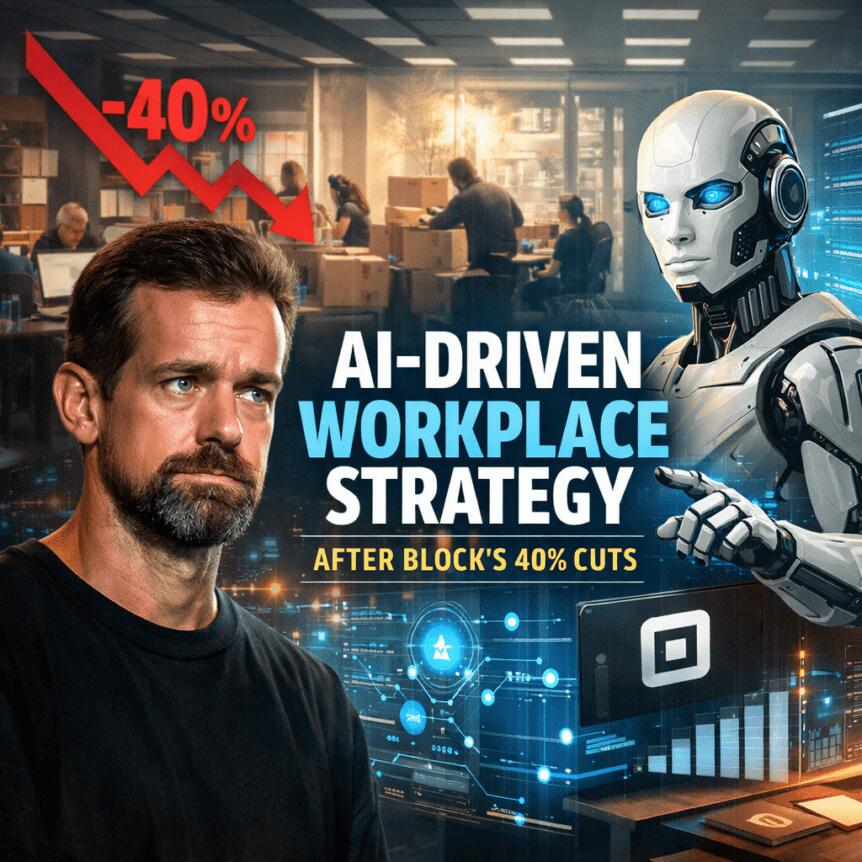
Block co-founder Jack Dorsey and the company’s lead independent director, Roelof Botha, have laid out a forward-looking vision in which artificial intelligence could fundamentally change how work is coordinated. In a blog post published this week, they describe a model where AI would take on the tasks typically handled by middle managers—tracking projects, flagging issues, assigning work, and sharing critical information faster than human processes allow.
The post comes on the heels of Block’s previously reported workforce restructuring, part of a broader wave of AI-driven cost-cutting across the tech sector. Block disclosed that it cut roughly 4,000 jobs in February, an action Dorsey attributed to the rapid pace of AI adoption and the need to stay competitive. In March, some of the employees who had been laid off were quietly rehired, illustrating a cautionary approach to the current wave of optimization. The blog authors emphasize that AI’s role in the new model is evolving, not yet fully realized, and that Block remains in the “early stages” of testing how an intelligence-centric structure could function in practice.
“We’re questioning the underlying assumption: that organizations have to be hierarchically organized with humans as the coordination mechanism. Instead, we intend to replace what the hierarchy does. Most companies using AI today are giving everyone a copilot, which makes the existing structure work slightly better without changing it. We’re after something different: a company built as an intelligence, or mini-AGI.”
Key takeaways
- Block’s leadership proposes replacing traditional hierarchical management with an intelligence-driven framework that leverages AI to coordinate work and decision-making.
- The envisioned structure redefines roles around three pillars: individual contributors, directly responsible individuals, and player-coaches who mentor while continuing to contribute technically.
- AI would enable real-time visibility into what’s being built, what’s blocked, resource allocation, and overall product performance, potentially speeding up information flow beyond conventional managerial channels.
- Despite the AI emphasis, human involvement remains central to strategic and ethical decisions, signaling a blended governance approach rather than a pure automation model.
From hierarchy to intelligence: Block’s strategic shift
The core idea articulated by Dorsey and Botha is a pivot away from the familiar pyramid where instructions travel up and down through layers of management. In a remote-first, machine-readable environment, AI would continuously build and maintain a live picture of organizational activity: what’s in development, what’s blocked, where resources are needed, and what outcomes are proving effective or failing. The authors describe the aim as moving beyond “copilot” enhancements to a more transformative design—an organization that operates as an intelligence rather than a traditional hierarchy.
They emphasize that the pattern could reshape corporate operation across sectors, not just within Block. The argument rests on a simple premise: information flow drives speed and adaptability. If AI can handle the coordination overhead more efficiently than humans, the bottlenecks created by layers of management could recede, enabling faster iteration and more responsive leadership decisions.
To illustrate the proposed shift, Block outlines a three-tier talent model. Individual contributors would be responsible for building and maintaining the operating systems that power the company’s workflows. Directly responsible individuals would tackle specific problems and be empowered to marshal any resources necessary to resolve them. Between these layers, player-coaches would assume manager-like duties—mentoring and supporting others—while continuing to contribute code and substantive work themselves. In this arrangement, the traditional gatekeeping function of middle management would be distributed and augmented by AI-enabled visibility and automation.
People still in the driver’s seat
Even as AI takes on coordination tasks, Dorsey and Botha stress that human judgment remains indispensable. They acknowledge that AI can process information at a scale and speed far beyond human capability, but key business and ethical decisions will continue to require human insight. The blog notes that while AI can present a continuously updated view of operations, it cannot substitute for the values, prudence, and accountability that guide corporate governance.
This stance sits at an important crossroads for investors and workers alike. The acceleration of AI-driven restructuring has historically raised questions about job security, morale, and the long-term viability of new organizational paradigms. Block’s own experience—balancing a major layoff with later rehiring of some affected employees—illustrates a cautious, iterative approach rather than a speculative leap into a fully automated future. The authors’ framing suggests a model where AI acts as a force multiplier for human capabilities, rather than replacing people wholesale.
Why it matters for crypto-adjacent ventures
The broader crypto and fintech sectors have watched Block (the company behind the Cash App and a notable crypto-friendly stance) as a bellwether for technology-enabled financial services. If an AI-first, intelligence-driven corporate structure gains traction, it could influence how other blockchain and payments firms think about product development cycles, regulatory compliance, and governance practices. The potential impact extends to how quickly teams can respond to security risks, how product roadmaps are validated in real time, and how cross-functional collaboration is organized in a hybrid or fully remote environment.
From an investor perspective, the shift raises questions about how governance, risk controls, and performance metrics would be managed in an AI-augmented organization. Real-time visibility into development pipelines and resource allocation could improve transparency, but it also heightens sensitivity to data quality, AI oversight, and ethical considerations in automated decision-making. As with any large-scale adoption of AI in corporate governance, the outcomes will hinge on guardrails, accountability, and the ongoing calibration of human-in-the-loop processes.
Block’s announcement aligns with a wider industry conversation about whether AI can augment, or even replace, certain managerial functions. While the blog presents a staged, experimental path toward an intelligent enterprise, observers will be watching to see whether early pilots yield tangible improvements in productivity, risk management, and employee engagement. The balance between speed and governance will be particularly telling in sectors where regulatory scrutiny and customer trust are paramount.
What to watch next
The immediate questions center on execution and governance. How quickly will Block move from a conceptual framework to concrete organizational changes? What criteria will the company use to assess the success of its AI-driven coordination model? And how will Block address potential pitfalls, such as algorithmic bias, data silos, or accountability for automated decisions?
As AI continues to redefine work patterns across the technology landscape, Block’s approach could foreshadow a broader shift in corporate design. If the model proves adaptable and beneficial, it may prompt other firms to experiment with similar intelligence-driven structures, especially in environments that prize rapid iteration and remote collaboration.
Readers should monitor Block’s forthcoming updates and pilot implementations to gauge whether the vision moves from theory to practice and how those developments influence investor confidence, employee experience, and the broader discourse around AI-enabled governance.
https://www.cryptobreaking.com/dorsey-unveils-ai-driven-workplace/?utm_source=blogger%20&utm_medium=social_auto&utm_campaign=Dorsey%20unveils%20AI-driven%20workplace%20strategy%20after%20Block's%2040%%20cuts%20
Comments
Post a Comment