
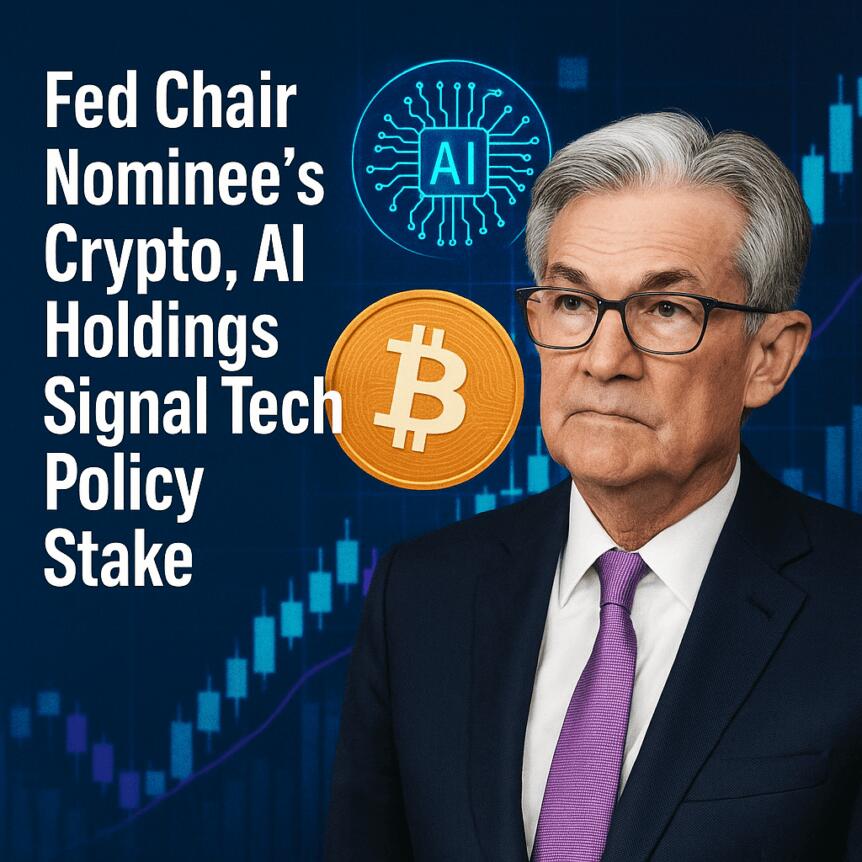
Kevin Warsh, the former Federal Reserve governor tapped by President Donald Trump to lead the central bank, has filed asset disclosures that reveal a broad portfolio with notable crypto and artificial intelligence exposure. The Office of Government Ethics (OGE) filing shows Warsh owning or having stakes in crypto- and AI-oriented investments alongside a portfolio that pushes the total value well into nine figures. The document lists investments in funds and ventures such as Compound, Dapper Labs, and Kinetic, as well as AI-focused names including Delphi, Conversion, Factory, and Glue, among others. The disclosures accompany the nomination process ahead of a Senate confirmation hearing.
Reuters reported that the crypto and AI components of Warsh’s portfolio were not assigned explicit value ranges in the filing. Ethics rules do not require reporting for assets under $1,000, which leaves some detail about the crypto and AI investments opaque in terms of dollar amounts. The filing does, however, flag substantial holdings elsewhere, including more than $50 million in the Juggernaut Fund and more than $10 million in income from consulting fees tied to the Duquesne Family Office, the investment firm of Stanley Druckenmiller.
Trump announced Warsh as his Fed nominee in January, and the nomination moved to the Senate in March after earlier signals of dissent from within the administration. If confirmed, Warsh would succeed Fed Chair Jerome Powell, whose second four-year term ends on May 15. As of now, it remains unclear when the Senate Banking Committee will hold a hearing, though reports suggested votes could come as soon as next week.
Beyond Warsh himself, the timing underscores broader questions about leadership at the two agencies central to crypto oversight. The Securities and Exchange Commission (SEC) and the Commodity Futures Trading Commission (CFTC) are operating with vacancies that have intensified tensions around digital-asset regulation. The SEC currently has three commissioners, all Republicans, while the CFTC has just one commissioner with four seats unfilled. Lawmakers have been debating a crypto market structure bill that has stalled in the Senate since mid-2025, casting a shadow over how quickly a unified regulatory framework might emerge.
Key takeaways
- The asset disclosure places crypto- and AI-focused holdings in Warsh’s portfolio, though valuation specifics for those investments were not disclosed in the ethics filing according to Reuters.
- Ethics rules do not require reporting for assets under $1,000, a threshold that leaves some crypto and AI exposure without explicit dollar values in the public filing.
- Among the largest disclosed holdings are more than $50 million in the Juggernaut Fund and more than $10 million in consulting income from the Duquesne Family Office, the investment vehicle of Stanley Druckenmiller.
- The nomination process for Warsh coalesces with a broader regulatory backdrop, where the SEC and CFTC face leadershipVacancies amid stalled crypto legislation that could shape how digital assets are supervised.
- As central bankers with potential influence over monetary policy, Warsh’s confirmed stance could affect market conditions that interact with crypto markets, even as detailed crypto policy remains under the purview of agencies and Congress.
What Warsh’s disclosures imply for crypto policy and the Fed landscape
Warsh’s disclosure of crypto- and AI-related holdings arrives at a moment of heightened focus on how federal policy could affect digital assets. The Fed’s primary mandate—price stability and maximum employment—intersects with crypto markets insofar as monetary policy influences risk sentiment, liquidity, and capital flows that can impact the prices and adoption of digital assets. While the direct line from a central banker’s personal investments to policy decisions is complex and deliberately constrained by ethics rules, the optics of a policymaker with exposure to crypto and AI can shape investor and market interpretations of how seriously the Fed may treat these sectors in a broad financial-stability framework.
Separately, the regulatory environment for crypto remains unsettled. The Senate has been wrestling with a crypto market structure bill that has languished since July 2025, with anticipation that new leadership at financial agencies could alter its trajectory. The SEC, which remains short-handed with three commissioners, and the CFTC, operating with a single commissioner amid four vacancies, would be pivotal in implementing any new structure or guidelines for digital assets. In this climate, the choice of a Fed chair could influence the pace and emphasis of cross-agency coordination on crypto oversight, even if the immediate policy tools of the central bank are not crypto-specific.
Industry observers point out that the central bank’s influence on financial conditions—through rate signals, liquidity operations, and financial-stability considerations—will reverberate through crypto markets. Yet the exact impact depends on a matrix of regulatory actions, congressional decisions, and industry adaptation. The fact that Warsh’s filing includes crypto holdings underscores a broader market reality: the overlap between mainstream financial leadership and digital-asset ecosystems is increasingly a matter of public record and reader interest, rather than a covert footnote.
Context around Warsh’s nomination has been drawn by multiple outlets. Coverage notes that Warsh was named in January and that the Senate could act soon, following debates about the Fed’s direction and potential leadership changes in the wake of Powell’s term. The political timing matters for how quickly the administration and Congress move on not only the Fed chair but also other critical financial regulators that will shape how crypto markets operate within the U.S. financial system. For readers tracking crypto policy developments, this is a reminder that the governance layer surrounding digital assets remains a political and regulatory frontier as much as a technical one.
What to watch next for investors and builders
Key upcoming milestones include the Senate Banking Committee’s schedule for Warsh’s confirmation hearing and the broader regulatory timetable for crypto legislation. If Warsh is confirmed, market participants will be listening for signals about the Fed’s willingness to address financial stability concerns in a fast-evolving digital-asset landscape, and for any shifts in how cross-border payment rails, stablecoins, and market infrastructure might be treated under a comprehensive regulatory framework. The absence of a clear, immediate path to a crypto market structure bill keeps expectations tempered, while the congressional and regulatory cadence remains the primary driver of near-term uncertainty for the sector.
Regulators and market participants will also be watching how the Fed chair interacts with the agency leadership vacuums at the SEC and CFTC. The interplay between central bank policy signals and securities-compliance or futures-regulation regimes could shape how crypto markets respond to macro shifts, even before concrete policy changes are enacted. In practical terms, traders and builders should monitor confirmation developments, any early policy remarks from Warsh that touch on financial stability or broad market integrity, and the evolving stance of the Biden and Trump-administration-adjacent regulatory teams on digital assets.
As with any confirmation that sits at the crossroads of monetary policy and financial regulation, the path forward is likely to feature a mix of cautious optimism and cautious doubt. The market will hedge around timing, signals, and the potential for a more concrete regulatory framework that could unlock or constrain crypto adoption depending on the exact contours of the policy approach. The next weeks will reveal not only whether Warsh will chair the Fed but how his broader portfolio history, including crypto and AI exposure, will be interpreted in the context of U.S. financial governance.
For readers seeking deeper context, ongoing coverage from Reuters and Politico highlights the timing and procedural steps of the nomination process, while Cointelegraph’s broader reporting has tracked the evolving crypto-regulatory landscape as it interacts with policy and political currents.
Source notes: Reuters reported on Warsh’s disclosures and context around the nomination process; Politico provided live updates on hearing timing; Cointelegraph has covered related developments in the crypto-regulatory space. See Reuters: Warsh-files-financial-disclosure-step-towards-confirmation; Politico live updates on the nomination hearing timeline.
https://www.cryptobreaking.com/fed-chair-nominees-crypto-ai/?utm_source=blogger%20&utm_medium=social_auto&utm_campaign=Fed%20chair%20nominee's%20crypto,%20AI%20holdings%20signal%20tech%20policy%20stake%20
Comments
Post a Comment