
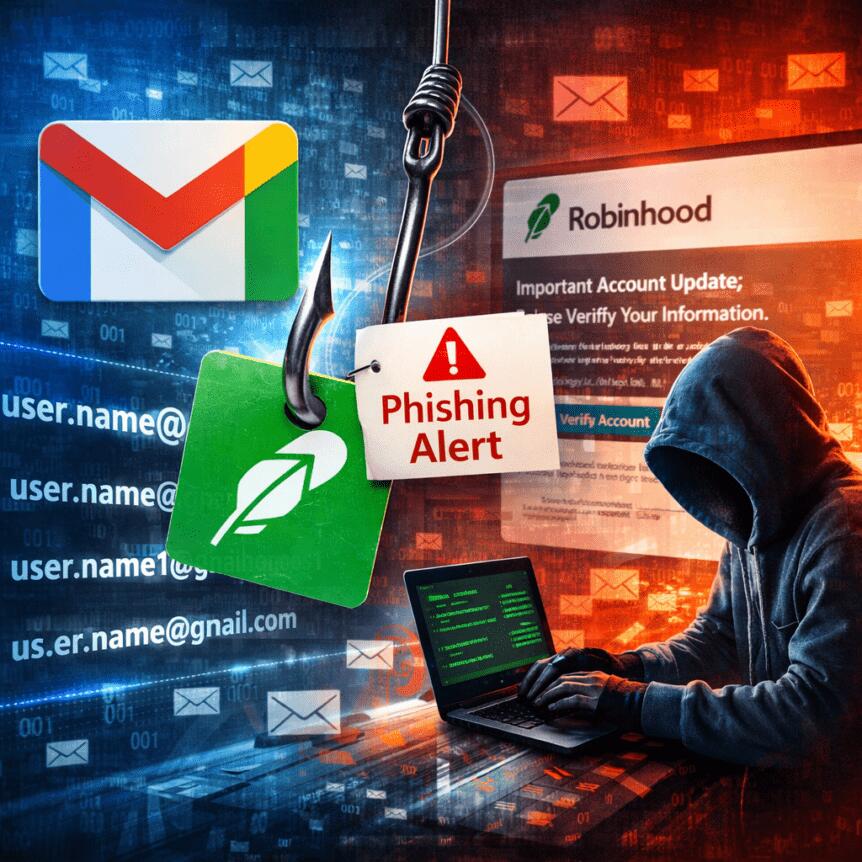
Robinhood users are confronting a new phishing campaign that rides on Gmail’s native dot alias feature and weaknesses in the platform’s account-creation flow. The emails, which appear to originate from Robinhood’s mail server, warn of an unrecognized device login and direct recipients to malicious sites via a deceptive call-to-action button.
Early reports on social media show users receiving messages that look like legitimate Robinhood alerts. The attackers exploit Gmail’s dot-insensitivity to register nearly identical-looking accounts, then leverage a flaw in Robinhood’s onboarding flow to inject forged content into the automated emails. The result is an email that can slip past common defenses and prompt a user to click through to a phishing page.
Key takeaways
- The attack leverages Gmail’s dot alias behavior to route phishing emails to a target’s inbox by creating Robinhood-style accounts that differ only by a dot in the address.
- Fraudsters embed HTML instructions in the optional “device name” field during Robinhood’s account creation, which Gmail treats as formatting, enabling a seemingly legitimate email with a malicious phishing link.
- The forged message can pass standard email authentication (SPF, DKIM, DMARC), making the email appear trustworthy and increasing the likelihood of a click on the phishing button.
- Victims are at risk mainly if they enter credentials on the fake site; the mere visit does not grant access, but credential input can lead to account compromise.
- Robinhood confirmed that the incident involved abuse of the account creation flow, not a breach of its systems or customer accounts, and no personal data or funds were reported as impacted.
The exploitation mechanics
Experts describe a two-pronged method that underpins the campaign. First, scammers create Robinhood accounts using email addresses that differ only by the presence or absence of a dot in Gmail’s address handling, such as “jane.smith@gmail.com” versus “janesmith@gmail.com.” In the eyes of Robinhood, these are distinct accounts, but Gmail routes mail to the same inbox, enabling fraudsters to seed legitimate-looking communications under a target’s actual address.
Second, attackers exploit the account-creation flow by injecting HTML into the optional “device name” field. Gmail interprets field content as formatting, allowing a phony email to contain a credible header and a convincing call to action. The crafted email can pass SPF, DKIM, and DMARC checks, making it appear as though it truly originates from noreply@robinhood.com. When a recipient clicks the phishing button, they are taken to a counterfeit login page designed to harvest credentials.
Robinhood's response and user guidance
Robinhood’s official stance was communicated through its support account on X, which acknowledged that some users received a falsified email from “noreply@robinhood.com” with the subject line “Your recent login to Robinhood.” The company attributed the issue to an abuse of the account-creation flow and stressed that there was no breach of Robinhood’s systems or customer accounts, and that personal information and funds were not impacted.
“This phishing attempt was made possible by an abuse of the account creation flow. It was not a breach of our systems or customer accounts, and personal information and funds were not impacted. If you received this email, please delete it and do not click any suspicious links. If you have clicked a suspicious link or have any questions about your account, please contact us directly within the Robinhood app or website.”
Security researchers emphasize prudence: users should avoid clicking unfamiliar links, delete suspicious messages, and contact official Robinhood channels for account questions. The episode also underscores the need for vigilance around onboarding flows and the resilience of email authentication measures, which attackers now appear capable of circumventing in targeted contexts.
Industry context and what’s next
The phishing wave hitting Robinhood arrives amid a broader trend in crypto-security risk. Hacken, a blockchain security firm, reported earlier this month that phishing and social engineering dominated crypto attacks in the first quarter of 2026, accounting for about $306 million in losses. The finding highlights a persistent vulnerability vector in the crypto ecosystem, where attackers increasingly blend social manipulation with technical exploits to bypass conventional safeguards.
For investors, traders, and builders, the episode reinforces several practical considerations. Platforms must tighten onboarding checks to prevent impersonation through dot aliases or other address-equivalence tricks, while improving email authentication and leveraging behavioral signals to distinguish genuine messages from forged ones. Users should practice heightened skepticism with any alert that requests action within a financial app, especially when a message prompts credential input or redirects to a login page. Enabling two-factor authentication, staying within official apps or websites for sign-in, and cross-checking any unusual activity with direct support channels become critical defensive habits in this environment.
Looking ahead, observers will be watching how Robinhood and other platforms shore up their onboarding processes and email security controls. Investigators will also assess whether additional victims were targeted and whether similar dot-alias techniques are leveraged in other services. For now, the incident serves as a pointed reminder that even well-known fintech apps remain vulnerable to technically simple yet highly effective social engineering plays when combined with misconfigurations in onboarding flows.
Readers should watch for updates from Robinhood on account-flow protections and for guidance from security researchers on mitigations that can be deployed both by platforms and by users to reduce exposure to this evolving tactic.
https://www.cryptobreaking.com/gmail-dot-trick-underpins-robinhood/?utm_source=blogger%20&utm_medium=social_auto&utm_campaign=Gmail%20Dot%20Trick%20Underpins%20Robinhood%20Phishing,%20Sending%20Real-Looking%20Emails%20
Comments
Post a Comment