
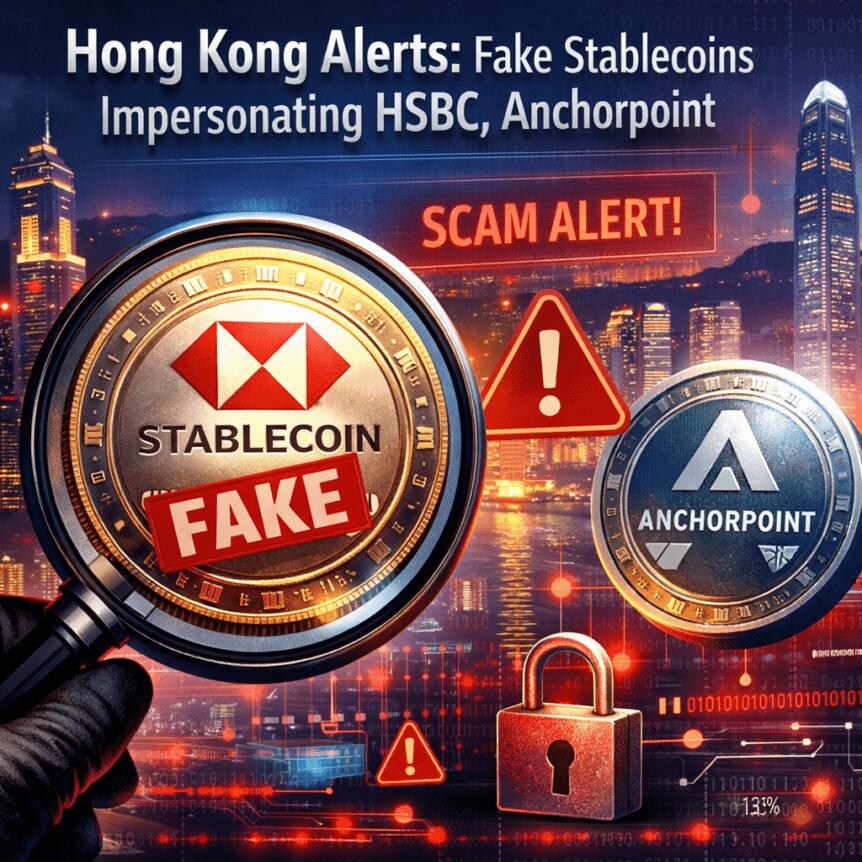
Hong Kong’s nascent stablecoin regime faced a fresh test as scammers impersonated the two newly licensed issuers ahead of their official product launches. Warnings issued by the Hong Kong Monetary Authority (HKMA), HSBC, and Anchorpoint Financial stated that tokens bearing the tickers HKDAP and HSBC have appeared on the market but are not connected to the licensed issuers.
Hong Kong began its stablecoin licensing regime in August 2025. Last month, the HKMA granted its first stablecoin issuer licenses, approving Anchorpoint Financial and HSBC under the new framework. The episode underscores the growing pains that accompany a regulated rollout of fiat-backed digital currencies in a major financial hub.
The HKMA emphasized that, at present, neither licensed issuer has published any regulated stablecoins. The authority’s warning was echoed by HSBC and Anchorpoint, who stressed that no stablecoins have been issued by either institution under the HKMA framework.
HSBC said in a statement that it “has not yet issued any stablecoins in Hong Kong,” adding that its planned Hong Kong dollar stablecoin will be available only through PayMe and the HSBC HK Mobile App when it launches in the second half of 2026. Anchorpoint likewise clarified that since receiving its license from the HKMA on April 10, it has not issued any tokens or products under the HKDAP name, and urged the public to verify information through official channels and to use regulated avenues when acquiring or using stablecoins.
The guidelines governing fiat-backed stablecoins in Hong Kong require issuers to obtain an HKMA license and adhere to rules around reserve backing, redemption rights, governance, and anti-money-laundering controls. The HKMA maintains enforcement powers that include fines, suspensions, and license revocations to ensure compliance with the regime.
The episode arrives as banks and other traditional financial players increasingly pivot toward stablecoins. In a notable move last week, Morgan Stanley’s investment management arm launched a “Stablecoin Reserves Portfolio,” allowing stablecoin issuers to park reserve funds in one of the bank’s money market funds and earn interest. Separately, Western Union has signaled a May rollout for its USD-backed stablecoin, USDPT, which will be built on Solana and issued by Anchorage Digital Bank. These developments illustrate growing institutional interest in reserve management and settlement rails for fiat-backed digital currencies.
Key takeaways
- Fake tokens with tickers HKDAP and HSBC appeared in the market, but neither is issued by the HKMA-licensed stablecoin issuers Anchorpoint Financial or HSBC.
- The HKMA, HSBC, and Anchorpoint Financial confirm that no regulated stablecoins have been issued to date; real launches are expected later, including HSBC’s HKD stablecoin planned for H2 2026.
- Hong Kong’s licensing regime requires reserve backing, redemption rights, governance, and AML controls, with the HKMA empowered to fine, suspend, or revoke licenses for non-compliance.
- Traditional banks are increasingly engaging with stablecoins, exemplified by Morgan Stanley’s reserve portfolio product and Western Union’s USDPT rollout plans with Anchorage Digital Bank.
Regulatory framework and the road ahead
The HKMA’s stance reflects a balancing act between fostering innovation and maintaining stringent oversight. The newly licensed issuers must meet a set of governance and reserve standards designed to ensure that each stablecoin is fully backed and redeemable under orderly conditions. The enforcement toolkit—ranging from fines to license revocation—signals that regulators intend to act decisively against misrepresentation or mismanagement in the stablecoin space.
For market participants, the latest warnings serve as a reminder to rely on official channels for information and to verify any claims about regulated products. Investors and users should monitor both issuers’ adherence to the HKMA framework and the public rollouts of the actual stablecoins when they become available via licensed channels.
Beyond Hong Kong, the momentum around stablecoins continues to attract traditional finance players. Morgan Stanley’s new reserve portfolio approach provides a pathway for issuers to optimize cash management, while Western Union’s USDPT project points to a broader trend of fiat-backed digital currencies integrating with existing payment rails. As the regulatory regime matures and real products begin to surface, observers will watch how reserve strategies, custody arrangements, and redemption mechanics evolve in practice.
Readers should stay tuned for updates on when the HKD stablecoin will actually launch in Hong Kong, how the public markets will verify legitimacy, and what additional licensing actions the HKMA may take as the regime scales.
Note: This reporting reflects information available from official statements and linked industry reports. Readers are encouraged to consult the cited sources for the most current developments.
Related coverage and sources: Hong Kong’s first stablecoin licenses issued, HSBC warns against fraudulent stablecoins, Anchorpoint alert on HKDAP, Morgan Stanley launches money-market fund for stablecoin issuers, Western Union targets May for USDPT rollout.
https://www.cryptobreaking.com/hong-kong-alerts-fake-stablecoins/?utm_source=blogger%20&utm_medium=social_auto&utm_campaign=Hong%20Kong%20Alerts:%20Fake%20Stablecoins%20Impersonating%20HSBC,%20Anchorpoint%20
Comments
Post a Comment