
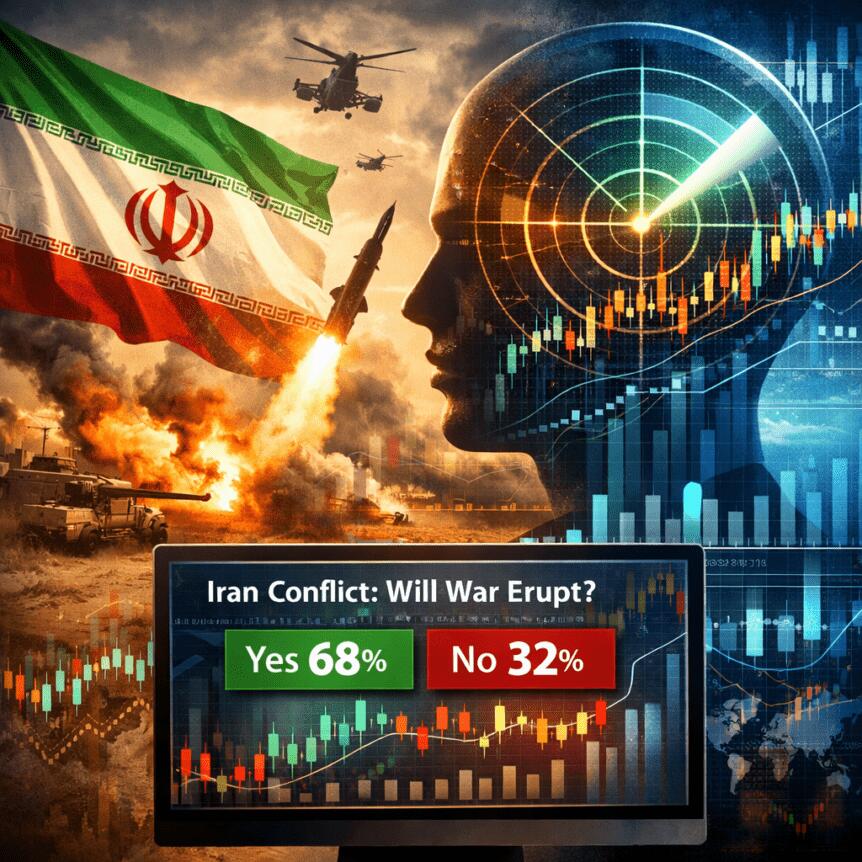
Prediction markets rapidly repriced the odds of a U.S. escalation in the Iran crisis, offering a real-time read on geopolitical risk for traders. Platforms such as Polymarket and Kalshi adjusted odds in tandem with shifting signals from Washington, while Bitcoin moved higher, climbing about 3.5% on the day.
Industry practitioners say these markets are increasingly embedded in professional portfolios. Fabian Dori, chief investment officer at Sygnum Bank, described prediction markets as providing priced outcomes with real capital behind them. “Prediction markets price discrete, named outcomes with real capital behind them. For crypto in particular, where price action is often driven by binary events, regulatory decisions, geopolitical developments and protocol upgrades, that is a categorically different signal,” Dori told Cointelegraph.
Throughout the Iran crisis, odds on de-escalation appeared to shift ahead of broad-media coverage, with a visible correlation to Bitcoin price action, according to Dori.
Key takeaways
- Prediction markets are increasingly used as macro risk monitors on professional desks, not just as niche tools.
- Institutional money is flowing in: March data showed about 191 million prediction-market transactions, up 2,838% year-on-year, with notional volume around $23.9 billion.
- Traditional market infrastructure is embracing prediction markets, highlighted by ICE’s $600 million investment in Polymarket in late March.
- While growing in adoption, the sector faces fairness and integrity questions, including insider-trading concerns and market removals after controversy.
- ARK Invest has integrated Kalshi’s data into its investment process, signaling a move toward mainstream corporate usage of event-based odds data.
Prediction markets migrate into macro playbooks
On increasingly active professional desks, prediction markets are being employed as a real-time event monitor amid fast-moving geopolitical developments. They run alongside traditional risk tools such as funding-rate data, options surfaces and flows to help quantify the probability of outcomes like war, sanctions or ceasefires. In this context, markets that continuously update a capital-weighted probability of major geopolitical events are a natural fit for structured risk assessment.
Kalshi’s data and activity have become part of institutional workflows, with ARK Invest noted for incorporating Kalshi data into its decision-making process. This signals a broader trend: event odds are migrating from niche platforms to mainstream investment processes, shaping how teams frame risk scenarios rather than simply reacting to headlines.
As prediction markets grow, they are increasingly used to form a contextual layer for decision-making. The aim is to anticipate, rather than chase, outcomes before they occur, leveraging markets that reflect evolving probabilities around war, sanctions or engagement dynamics.
Institutional money and growing scrutiny
The scale of activity in prediction markets has begun to move traditional conversations about liquidity and reliability. In March, the number of prediction-market transactions reached about 191 million, up 2,838% year-on-year, with monthly notional volume around $23.9 billion. The flows have drawn attention from mainstream finance operators who see potential value in event-driven risk analytics.
Concretely, Intercontinental Exchange (ICE), the parent company of the New York Stock Exchange, completed a new $600 million investment in Polymarket on March 27, deepening its conviction in the space. This milestone underscores a growing appetite among traditional market participants to engage with prediction markets as part of macro risk assessment and portfolio construction.
Industry practitioners caution that the core question for investors is now about how to incorporate these signals into analysis in a way that adds genuine analytical value rather than introducing noise. “This is no longer a niche product,” Dori said, emphasizing that prediction markets are entering mainstream risk workflows. The challenge remains to balance insight with due diligence, especially as the ecosystem confronts questions about market fairness and integrity.
Not all developments have been positive. Polymarket faced controversy over insider trading when six traders netted around $1 million betting on the timing of U.S. strikes on Iran in late February. The platform also removed a market related to a missing U.S. pilot after backlash, highlighting concerns about the social and political consequences of betting markets tied to real-world events.
Regulatory frames, integrity and what to watch
As prediction markets gain prominence, regulators and market operators are navigating questions around fairness, information asymmetries and the proper boundaries of event-based wagering. The industry has already been exploring its legal limits in different jurisdictions, including strict Asian markets where regulatory testing has taken place. The ongoing dialogue around governance and integrity will shape how widely and deeply these markets are adopted by institutions in the coming months.
What to watch next is how mainstream players integrate these tools without compromising risk discipline. Readers should monitor: whether more asset managers formalize the use of event-odds in risk models, how regulators respond to elevated liquidity and possible manipulation concerns, and whether new interfaces or data feeds emerge to standardize the integration of prediction-market signals into traditional research workflows.
As geopolitics and policy continue to move at machine speed, the market’s appetite for probabilistic signals tied to real outcomes will likely intensify. The coming weeks could reveal how far prediction markets can travel from niche experimentation toward a core element of macro risk assessment.
https://www.cryptobreaking.com/iran-war-bets-make-prediction/?utm_source=blogger%20&utm_medium=social_auto&utm_campaign=Iran%20War%20Bets%20Make%20Prediction%20Markets%20Real-Time%20Macro%20Radar,%20Sygnum%20
Comments
Post a Comment