
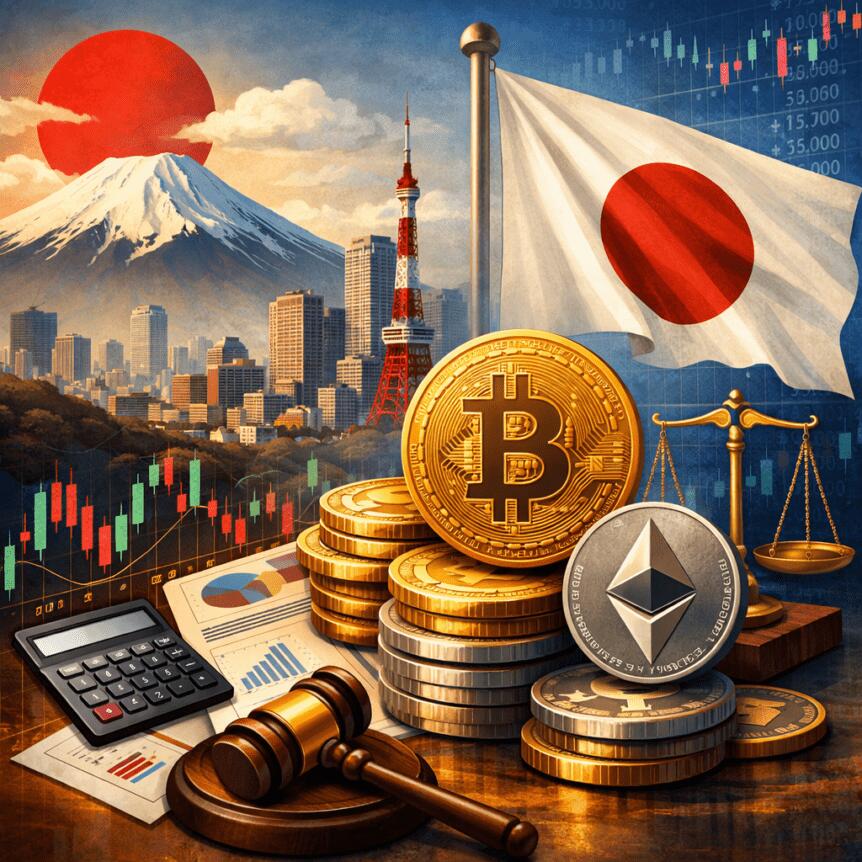
The Japanese government has amended the Financial Instruments and Exchange Act to classify crypto assets as financial instruments, a move that expands regulatory oversight and tightens the rules governing issuers, exchanges, and market conduct. According to Nikkei, the changes also ban insider trading and other trading practices based on undisclosed information. The amendment will require cryptocurrency issuers to disclose information on an annual basis, enhancing transparency across the sector.
Previously scoped under the Payment and Settlement Act, crypto assets were regulated by Japan’s Financial Services Agency (FSA) as potential payment instruments. The new framework repositions digital assets within the same regulatory orbit as traditional securities and financial instruments, a shift that aligns with rising institutional participation and the sector’s growing capital inflows. By reclassifying crypto as a financial instrument rather than solely a payment method, Japan signals a move away from experimental payments toward a market structure more closely linked to its stock market ecosystem.
Key takeaways
- Crypto assets are reclassified as financial instruments, broadening regulatory oversight and introducing annual disclosure requirements for issuers.
- Insider trading and other information-based market manipulation are explicitly banned, with tighter enforcement for unregistered exchanges.
- The reforms aim to strengthen fairness, transparency, and investor protection as crypto market activity becomes more institutionalized.
- Japan plans to legalize crypto exchange-traded funds (ETFs) by 2028, with major players such as Nomura Holdings and SBI Holdings expected to develop crypto-linked ETPs.
- Crypto profits will be taxed under a flat 20% rate, reflecting broader tax reform efforts to equalize treatment with other asset classes.
Regulatory shift: Crypto moves under the Financial Instruments umbrella
The amendment marks a deliberate move to treat digital assets as part of the formal financial infrastructure rather than niche payment tools. By placing crypto assets under the Financial Instruments and Exchange Act, Tokyo signals that crypto markets will face the same disclosure, governance, and market integrity standards that govern equities and other financial products. The annual disclosure requirement for issuers is designed to shore up transparency and reduce information gaps for investors, a priority as institutional investors increasingly eye digital assets.
Japan’s Financial Services Agency has repeatedly underscored the importance of integrating crypto markets with mainstream finance. The shift follows a broader government push to ensure that market infrastructure can safely support growing participation from institutions and professional investors, while preserving clear rules for participants and clear expectations for disclosures.
Enforcement and market integrity: stronger rules for exchanges and insiders
Alongside the reclassification, the amendment tightens enforcement against fraud and non-compliance. Notably, the reform expands penalties for unregistered crypto exchanges, with higher fines and stiffer sentences intended to deter unauthorized operations. Nikkei reported that the measure also criminalizes insider trading and other activities that rely on undisclosed information, aligning crypto market conduct with established securities laws and enforcement norms.
In framing the broader policy direction, Finance Minister Satsuki Katayama emphasized the government’s commitment to expanding growth capital while ensuring market fairness and investor protection. In remarks following the Cabinet meeting, she stressed that a robust market infrastructure and transparent exchange operations would be essential to ensure citizens benefit from digital and blockchain-based assets.
These developments come in the context of earlier signals from Tokyo that crypto should sit under the same umbrella as traditional finance. In January, Katayama indicated that exchanges and market infrastructure would be central to enabling citizens to benefit from digital assets, a sentiment that has now translated into concrete regulatory steps.
From experiments to mainstream finance: ETFs on the horizon
Japan is also pursuing a more ambitious path for crypto adoption by targeting the legalization of crypto exchange-traded funds (ETFs) by 2028. A January report outlined plans to usher crypto ETFs into the mainstream, with major financial groups taking the lead. Nomura Holdings and SBI Holdings are among the early contenders expected to develop crypto-linked exchange-traded products, signaling a transition from speculative trading to diversified investment vehicles that could broaden access to digital assets for retail and institutional investors alike.
The push toward ETFs sits alongside broader policy aims to simplify the tax treatment of crypto profits. In December, Tokyo signaled support for a flat tax rate on crypto profits—set at 20%—a move designed to streamline compliance and reduce the tax drag on profitable trading strategies. While tax policy does not directly dictate market structure, it shapes incentives for trading, reporting, and the overall attractiveness of crypto-related investment products for both individuals and institutions.
Implications for investors, issuers, and the market
For investors, the government’s reclassification and disclosure obligations could unlock greater confidence in crypto assets as investable instruments. Annual disclosures may improve visibility into project fundamentals, governance, and risk, helping investors price assets more accurately and compare crypto offerings with traditional securities. The expected rise in enforcement against unregistered exchanges could also push players toward registered venues, potentially reducing counterparty risk during periods of volatility.
For issuers and platform operators, the shift imposes new compliance and governance expectations. Issuers will need robust disclosure practices and ongoing transparency about project status, financial health, and governance structures. Exchanges and trading venues will need to align with stricter regulatory standards to maintain registration and avoid penalties, a change that could raise compliance costs but improve market quality in the long run.
From a market structure perspective, the ETF pathway could be a catalyst for broader adoption of crypto products. If the plan to authorize crypto ETFs by 2028 comes to fruition, traditional asset managers and brokerages may expand their crypto productラインups, potentially driving higher net inflows and more predictable demand. The 20% flat tax on crypto profits could further streamline investment decisions, reducing tax-related complexity and contributing to a more straightforward investment thesis for crypto assets within retirement and taxable accounts.
However, several uncertainties remain. The precise list of assets captured by the new framework, the exact format and frequency of issuer disclosures, and the regulatory steps required to launch crypto ETFs all require further clarifications from authorities. Market participants will be watching for detailed guidance on definitions, compliance timelines, and the practical implications of the annual reporting regime as the reforms take effect.
Overall, Japan’s regulatory recalibration signals a notable shift in how the world’s third-largest economy treats crypto. By integrating digital assets into the same regulatory ecosystem that governs securities and market infrastructure, Tokyo aims to reduce information asymmetries, curb illicit activity, and foster a more robust channel for capital formation in digital assets. The coming months are likely to reveal how quickly and concretely these changes will unfold in practice, and which firms move fastest to adapt to the new regime.
Readers should monitor updates on the disclosure requirements for issuers, the final list of assets encompassed by the act, and the regulatory timetable for ETF approvals. As Japan tests the waters of mainstream crypto finance, the balance between investor protection and innovation will shape the trajectory of crypto adoption in one of Asia’s most influential markets.
https://www.cryptobreaking.com/japan-to-classify-crypto-as/?utm_source=blogger%20&utm_medium=social_auto&utm_campaign=Japan%20to%20classify%20crypto%20as%20financial%20instruments,%20shaping%20policy%20
Comments
Post a Comment