
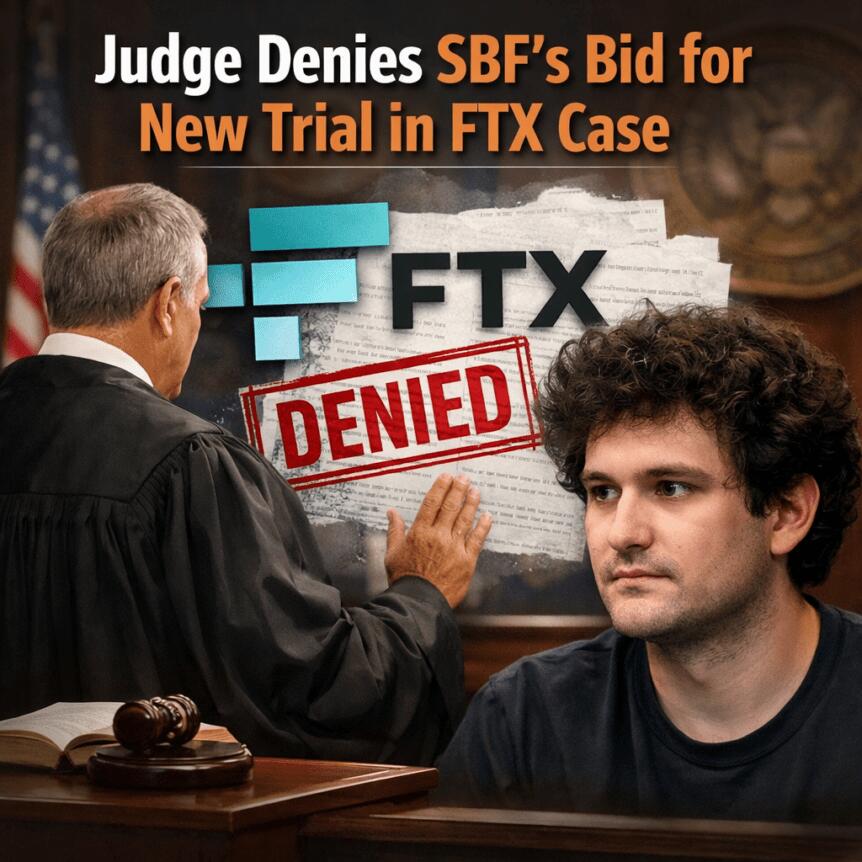
A Manhattan federal judge has denied Sam Bankman-Fried’s bid for a new trial, saying there was no new evidence or witnesses to warrant reopening his fraud-and-money-laundering case. U.S. District Judge Lewis Kaplan, who presided over the 2023 trial and later sentenced Bankman-Fried to 25 years in prison, rejected the defense’s claims in an order issued this week.
Bankman-Fried had sought a new trial in February to be overseen by a different judge—a rare maneuver filed without his attorneys’ input while an appeals court was weighing the conviction and sentence. Kaplan’s ruling makes clear that he viewed the motion as lacking merit and as part of an effort to rehabilitate Bankman-Fried’s public image after FTX’s collapse.
“This motion appears to be one part of a plan to rescue his reputation that Bankman-Fried hatched and even committed to writing after FTX declared bankruptcy but before he was indicted.”
In the order, Kaplan specifically rejected the assertion that three former FTX executives could counter the government’s position that FTX was insolvent. He described the claim as “baseless on multiple independently sufficient levels.”
Bankman-Fried had argued that two former FTX executives who did not testify—Ryan Salame, the former CEO of FTX’s Bahamian arm, and Daniel Chapsky, FTX’s former head of data science—could have provided testimony countering the government’s insolvency narrative. Salame has since pleaded guilty to campaign-finance violations and operating an illegal money-transmitting business and was sentenced to seven and a half years in prison in May 2024. Chapsky, who also faced charges, did not testify at trial. A third figure, Nishad Singh, FTX’s former engineering lead who cut a plea deal with prosecutors to avoid jail and testified against Bankman-Fried, was alleged to have changed his testimony “following threats from the government.”
Kaplan noted that Bankman-Fried could have attempted to compel testimony from these individuals but did not, and that the claim of government pressure driving their decisions was “wildly conspiratorial and entirely contradicted by the record.” The judge also emphasized that Bankman-Fried’s conviction followed seven criminal charges related to fraud and money laundering, centered on the transfer of billions of dollars of customer funds from FTX to Alameda Research for high-risk trades that contributed to the exchange’s collapse. Bankman-Fried is currently held at a federal prison in Lompoc, California.
Key takeaways
- What was denied: A bid for a new trial based on alleged “new evidence,” with Kaplan ruling the claim baseless and the witnesses not newly discovered.
- Who was at the center of the request: Three former FTX executives—Ryan Salame, Daniel Chapsky, and Nishad Singh—who the defense said could counter government assertions about insolvency.
- Notable context on the witnesses: Salame pleaded guilty to campaign-finance violations and operating an unlawful money-transmitting business; Singh testified against Bankman-Fried after striking a plea deal; Chapsky did not testify at trial.
- Procedural nuance: The motion was filed in February to be heard by a different judge and was pursued without Bankman-Fried’s lawyers, while an appeals court reviewed his conviction and sentence.
- What this means for the case: Kaplan casts doubt on the viability of reopening the trial, signaling a high evidentiary bar for similar motions moving forward.
What the ruling clarifies about the insolvency narrative
The heart of Bankman-Fried’s defense rested on whether new testimony from Salame, Chapsky, or Singh could alter the government’s portrayal of FTX’s finances. Kaplan’s assessment makes explicit that simply proposing familiar names as potential witnesses does not constitute “new” evidence, especially when the individuals were known to Bankman-Fried long before the trial and had been considered for testimony previously. The court’s language underscores a careful standard for post-trial relief: new evidence must genuinely change the factual landscape of the case, not simply repackage existing information or reframe arguments after a conviction.
Context within the broader FTX saga
The Bankman-Fried case sits within the larger FTX collapse and the ensuing prosecutions of several executives tied to the exchange’s downfall. The seven charges he faced at trial encompassed fraud and money laundering allegations tied to the alleged improper transfer of customer funds to Alameda Research to execute risky trades. Kaplan’s ruling reaffirms the trajectory of the case—the government’s portrayal of insolvency and the misuse of customer funds stands central to the narrative that secured Bankman-Fried’s conviction and lengthy prison sentence. The status of the various co-defendants, their cooperation agreements, and any subsequent testimony will continue to influence related proceedings and potential appeals.
What’s next for the legal process?
With the new-trial bid rejected, the focus shifts to the appellate process and any further motions that might arise as Bankman-Fried and his defense team navigate potential avenues for relief. While the current ruling narrows the grounds for reopening the trial, appellate considerations often hinge on technical aspects of trial procedure and evidentiary standards, rather than re-litigating the facts. Investors, traders, and industry observers will want to monitor whether the defense pursues subsequent avenues or leverages related cases as part of a broader strategy around the FTX collapse and its regulatory implications.
Readers should watch for updates on the appeals timeline and any additional disclosures from the parties as they position themselves for the next phase of this high-profile financial-crypto crackdown case.
https://www.cryptobreaking.com/judge-denies-sbfs-bid-for/?utm_source=blogger%20&utm_medium=social_auto&utm_campaign=Judge%20Denies%20SBF's%20Bid%20for%20New%20Trial%20in%20FTX%20Case%20
Comments
Post a Comment