
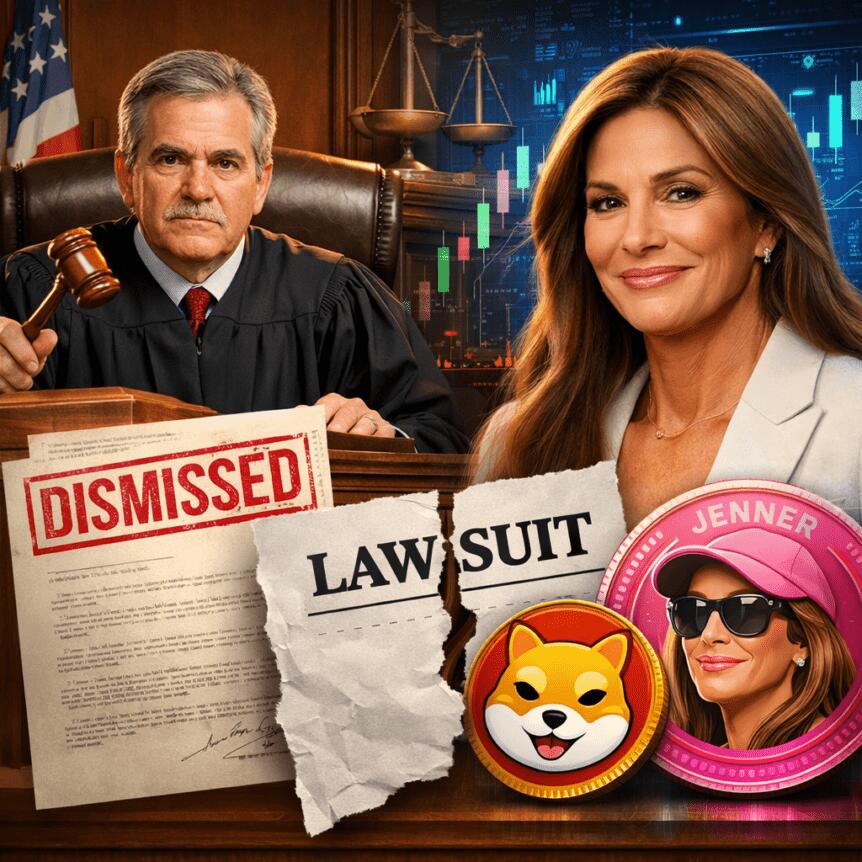
A California federal judge has cleared Caitlyn Jenner of a class-action push stemming from her JENNER memecoin, ruling that the token does not meet the basic securities requirements under U.S. law. In a Thursday order, U.S. District Judge Stanley Blumenfeld Jr. said the plaintiffs failed to plausibly plead that JENNER tokens were investment contracts because the venture did not pool investor money or use funds to develop a related product or technology.
Defendants stated that “the $JENNER token is a memecoin on the Ethereum blockchain intended solely for entertainment purposes,” and that its value would increase because Jenner would use her fame and influence to promote it, increasing demand. Promotion alone, however, does not establish a common enterprise absent pooling or a structure linking investor fortunes.
The case traces back to November 2024, when a group of JENNER memecoin buyers filed suit against Jenner and her late manager, Sophia Hutchins, alleging an unregistered securities offering and that investors lost thousands as the token’s price collapsed. The plaintiffs claimed that Jenner’s campaign-promised activities and fee mechanics would drive a return for investors. In May 2025, Blumenfeld had already tossed the suit for failure to state a claim, and an amended complaint was filed later that month, led by Lee Greenfield, a UK citizen who said he had invested more than $40,000.
In the amended filing, plaintiffs argued that investors pooled their assets as Jenner promised that once the token reached a market value of $50 million, a 3% transaction fee would fund token buybacks, marketing, donations to a political campaign, and a separate token representing ownership in Jenner’s Olympic gold medal. Blumenfeld pointed out that the amended complaint heavily focused on donations to Donald Trump’s campaign but did not clearly explain how such donations would deliver a financial return to investors. He also noted that the plan to distribute fractional ownership in the gold medal was announced after most purchases and was never executed.
The judge declined to give the class another chance to amend the complaint and indicated that claims tied to contracts and common-law fraud under California law would be more appropriate in state court. The decision leaves the securities-related claims resolved in federal court, while signaling that related state-law claims may proceed separately on different grounds.
JENNER first surfaced on the Solana blockchain via the memecoin creatorPump.fun in May 2024. The project quickly found itself embroiled in controversy after Jenner and other celebrities behind memecoin launches claimed they were allegedly scammed by Sahil Arora, a figure linked to the project’s early promotion efforts. Jenner subsequently relaunched JENNER on Ethereum, a move that investors said diluted the value of the original Solana token, which had peaked at nearly $7.5 million in June 2024 before retreating sharply.
The court’s ruling highlights a central challenge in memecoin litigation: promotional activity alone does not automatically create a securities partnership or an investment contract unless funds are pooled and a plausible path to investor returns can be demonstrated. The decision does not provide a broad endorsement of memecoins as safe investments, but it narrows the legal route for investors who relied primarily on celebrity promotion to claim securities violations.
For investors and builders in the memecoin ecosystem, the ruling reinforces the importance of transparent token mechanics and verifiable fundraising structures. It also underscores that, even in high-profile celebrity launches, the line between entertainment-focused tokens and regulated securities remains a contested frontier—one that regulators continue to scrutinize, particularly as new token categories emerge and promotional campaigns accelerate.
Key takeaways
- The court dismissed the federal securities claims against Caitlyn Jenner in the JENNER memecoin case, ruling the token did not plausibly constitute an investment contract because funds were not pooled and no related product or technology was developed with investor money.
- The decision preserves the possibility that related California-law claims could proceed in state court, though the federal securities case is resolved on the merits for now.
- The amended complaint failed to convincingly connect promised uses of a 3% fee and public donations to tangible financial returns for investors, according to the judge’s order.
- JENNER originated on Solana in May 2024, later migrated to Ethereum after controversies and claims of misrepresentation, with the token peaking at about $7.5 million in mid-2024 before collapsing.
- The ruling underscores that promotional activity alone is insufficient to show a common enterprise or an investment contract; structure and fund flows matter significantly in securities analyses of memecoins.
Context and implications for the memecoin landscape
The ruling arrives at a time of heightened regulatory attention toward memecoins and celebrity-led token launches. While it narrows the scope for investors to pursue federal securities claims in similar cases, it does not absolve promoters from potential liability on other legal grounds. The case illustrates that courts will closely examine whether investor money was actually pooled and whether a credible pathway exists for investors to obtain a financial return, beyond hype and promotional activity.
Looking ahead, observers will watch whether California state courts continue to pursue related contract or fraud theories and how parties might frame future campaigns to balance promotional potential with clear, investor-centric tokenomics. As the ecosystem evolves, the balance between creative branding and legally compliant fundraising remains a central concern for issuers, platforms, and legal counsel navigating a rapidly shifting regulatory environment.
Readers should monitor developments around memecoin regulation, enforcement actions, and any new guidance from U.S. authorities as they analyze cases where celebrity-led launches intersect with traditional securities law principles. The outcome in this case serves as a notable data point in the broader discourse on what constitutes a security in the fast-moving world of blockchain-enabled hype tokens.
https://www.cryptobreaking.com/judge-rules-jenners-memecoin-not/?utm_source=blogger%20&utm_medium=social_auto&utm_campaign=Judge%20Rules%20Jenner's%20Memecoin%20Not%20a%20Security;%20Lawsuit%20Dismissed%20
Comments
Post a Comment