
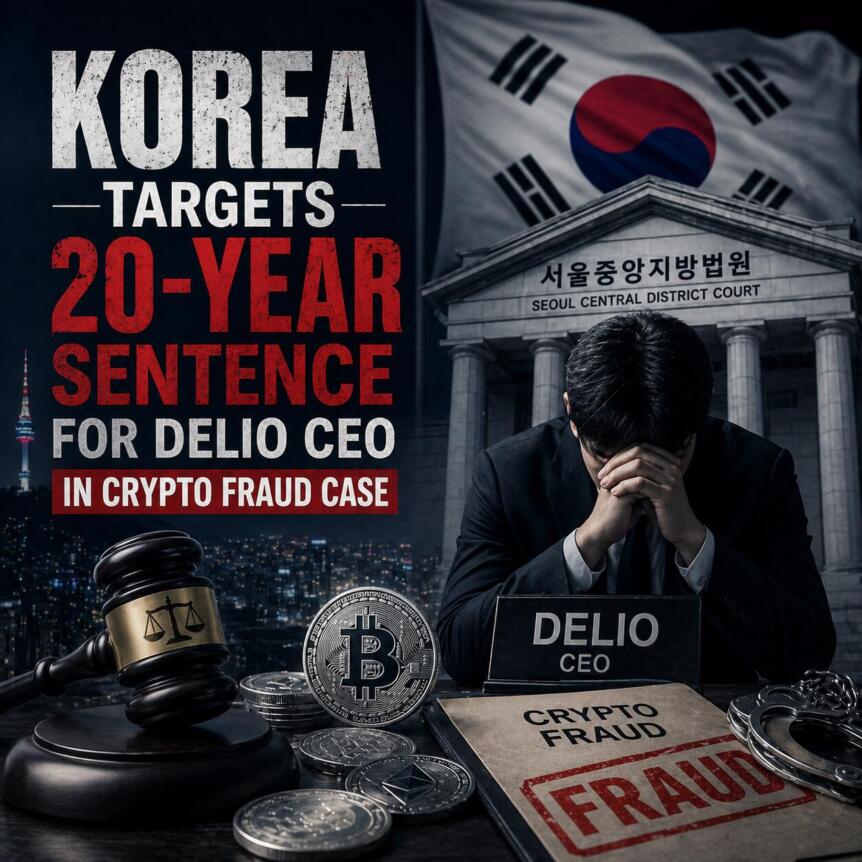
South Korean prosecutors are seeking a 20-year prison term for Delio’s chief executive, Jeong Sang-ho, in a case prosecutors describe as a large-scale breach that harmed thousands of investors. Closing arguments at the Seoul Southern District Court framed the allegations as deliberate deception and false promotion tied to the crypto deposit platform’s operations, as reported by Yonhap.
The prosecutors emphasized the alleged misconduct, saying that the defendant’s actions created broad and lasting damage to investors while he allegedly avoided accountability and maintained an uncooperative stance. Delio suspended withdrawals on June 14, 2023, freezing customer assets valued at 250 billion won (about $169 million), and the company was declared bankrupt in November 2024. Jeong was later indicted in April 2025 on charges of embezzling roughly $169 million in crypto assets from victims over a two-year period.
Key takeaways
- Prosecution seeks a 20-year term for Delio CEO Jeong Sang-ho under South Korea’s Act on Aggravated Punishment of Specific Economic Crimes, reflecting the scale and alleged deception in the case.
- Massive investor impact prosecutors describe the scheme as affecting nearly 2,800 victims, with funds locked when withdrawals were halted in June 2023.
- Criminal charges detail embezzlement Jeong faces allegations of diverting about $169 million in crypto assets from victims between August 2021 and June 2023.
- Regulatory tightening in Korea the case unfolds as Seoul strengthens oversight of crypto exchanges, levying AML-related penalties on firms such as Coinone and Bithumb in recent months.
- Enforcement and investor protection the Delio proceedings highlight ongoing regulatory focus on licensing, AML/KYC compliance, and enforcement risk for platform operators in Korea.
Prosecution case and charges
During closing arguments, prosecutors urged the court to impose a two-decade sentence on Jeong Sang-ho, invoking the Act on Aggravated Punishment of Specific Economic Crimes to address what they termed deliberate deception and false promotion. They asserted that the alleged scheme inflicted harm on thousands of investors and that the defendant showed little willingness to accept responsibility or cooperate with investigators. The court is weighing the facts as it prepares to render a first-instance verdict on July 16.
According to Yonhap, the prosecutors highlighted the scale of the damage, describing it as “massive” and note that the defendant’s alleged actions exposed a large number of victims to financial harm. The case centers on claims that Delio offered high returns on deposits of cryptocurrencies and then abruptly suspended withdrawals, effectively freezing investor funds.
In the charging timeline, Jeong was indicted in April 2025 on accusations of embezzling about $169 million in crypto assets from customers over roughly two years, spanning August 2021 to June 2023. The prosecutors’ framing during closing arguments underscores the court’s consideration of both the alleged deception and the financial magnitude of the losses when determining an appropriate penalty.
Delio’s collapse and investor impact
Delio operated a deposit service promising elevated yields on cryptocurrencies deposited for fixed terms. The platform’s June 2023 withdrawal suspension marked a turning point, with 250 billion won ($169 million) in customer assets effectively locked. A Seoul court subsequently declared Delio bankrupt in November 2024, signaling a full collapse of the platform and a difficult path for creditors and investors seeking recovery.
Jeong’s defense acknowledged the harm caused to investors. An attorney for Jeong stated that the defense “is aware of the victims’ suffering and feels a deep sense of responsibility,” and that the defendant would explore avenues to compensate victims if acquitted. The legal process remains ongoing, with the first-instance verdict scheduled for mid-July.
Regulatory crackdown and industry implications in South Korea
The Delio case coincides with a broader, intensifying regulatory crackdown on crypto exchanges in South Korea. Earlier this month, Coinone—the country’s third-largest exchange—faced penalties and a partial business suspension over Anti-Money Laundering failures. In March, Bithumb incurred a $24.5 million fine accompanied by a six-month partial suspension for similar AML shortcomings. The drive for stricter compliance follows a series of high-profile missteps, including instances of operational risk and recent enforcement actions aimed at strengthening customer protections and regulatory oversight.
The intensified enforcement environment underscores the ongoing push to align crypto-asset platforms with robust AML/KYC frameworks and licensing obligations. In a broader policy context, the Korean regime is part of a global movement toward stricter industry standards on exchange conduct, asset handling, and investor safeguards, with regulatory reforms paralleling initiatives in other jurisdictions and ongoing discussions around cross-border compliance and supervision.
Past incidents—such as the episode where Bithumb reportedly transferred a large quantity of Bitcoin by mistake—have amplified public and regulatory scrutiny over exchange governance, risk controls, and customer asset protections. Korea’s actions reflect an emphasis on narrowing compliance gaps and ensuring transparent, verifiable processes across crypto service providers, a stance that is likely to shape licensing regimes and enforcement priorities in the near term.
From a policy perspective, the Delio case reinforces the importance of clear disclosure, accountable leadership, and proven liquidity management for platform operators. Regulatory observers will be watching how the court’s ruling aligns with ongoing AML/KYC enhancements and with any future licensing updates that affect exchange operations, stablecoins, and cross-border activity within the Korean market.
Closing perspective
The ongoing proceedings against Delio’s leadership, set against a backdrop of intensified regulatory scrutiny, illustrate the resilience of investor protection frameworks in Korea’s crypto sector and the continued risk management focus for institutional participants. The coming verdict will signal how aggressively South Korea intends to pursue high-scale misconduct in crypto services and what this portends for exchanges, custodians, and other market infrastructure operators.
https://www.cryptobreaking.com/korea-targets-20-year-sentence/?utm_source=blogger%20&utm_medium=social_auto&utm_campaign=Korea%20Targets%2020-Year%20Sentence%20for%20Delio%20CEO%20in%20Crypto%20Fraud%20Case%20
Comments
Post a Comment