
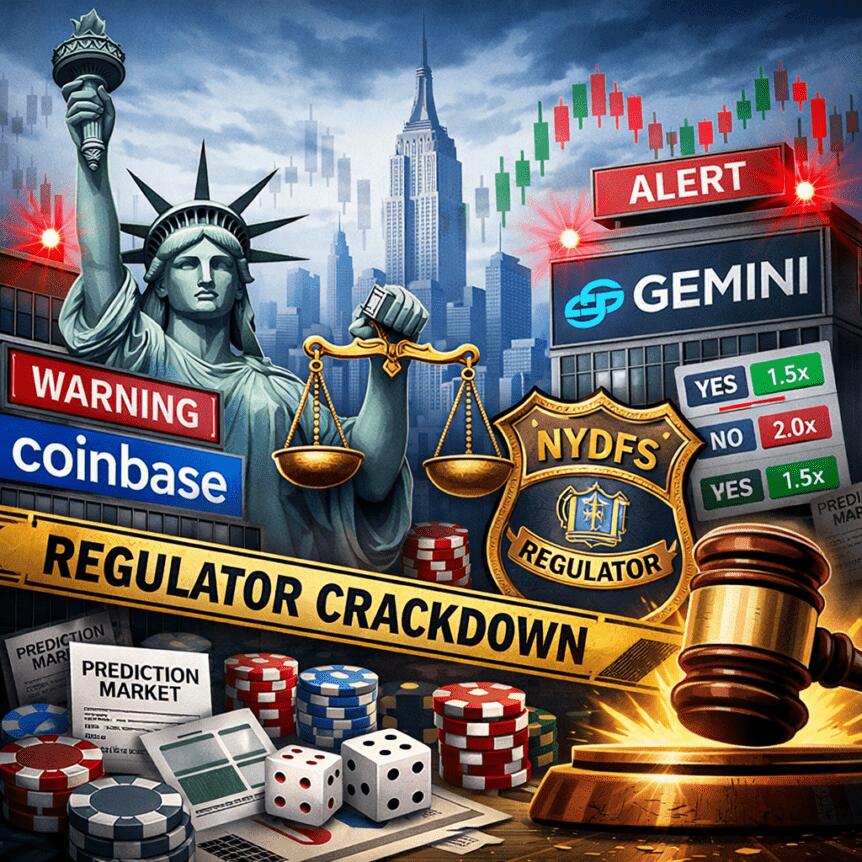
New York’s top legal officer has moved to curb prediction-market style offerings linked to cryptocurrency platforms, filing lawsuits against Coinbase Financial Markets and Gemini Titan for allegedly operating such markets in New York without proper licensing. Reuters reported on the complaints, which contend these platforms violated the state’s gambling laws by offering real-world event bets without approval from the New York State Gaming Commission.
Attorney General Letitia James asserted that “Gambling by another name is still gambling, and it is not exempt from regulation under our state laws and Constitution.” The lawsuits seek disgorgement of allegedly illegal profits, restitution for affected customers, and a prohibition on offering these products to individuals under 21 years of age.
These actions reflect a broader, state-level push to regulate prediction markets, a fast-growing niche in crypto commerce that allows users to wager on outcomes ranging from political events to other real-world occurrences. Much of the recent scrutiny has focused on platforms such as Polymarket and Kalshi, which have sparked questions about whether their products fall under gambling law or financial regulation. The federal landscape has also been active; the Commodity Futures Trading Commission (CFTC) has asserted it holds exclusive authority over prediction markets in several actions against state attempts to regulate the sector.
For crypto firms operating prediction-like products, the NY filing underscores significant regulatory risk. By targeting so-called prediction markets, regulators are signaling that many of these products may not be exempt from oversight, even if they are framed as information markets or data-heavy forecasting tools. As coverage on related developments notes, Polymarket has pursued legal action in other jurisdictions and broader market participants continue to navigate a complex regulatory mosaic.
Related context: Cointelegraph reported that Polymarket has been involved in a Massachusetts dispute over state authority to regulate prediction markets that the CFTC has approved, illustrating the broader tension between state regulators and platforms that operate near the line between gambling, financial products, and information services.
Key takeaways
- New York’s attorney general alleges Coinbase Financial Markets and Gemini Titan operated unlicensed prediction markets in the state, violating NY gambling laws.
- The complaints seek disgorgement of profits, restitution to affected consumers, and a ban on offerings to users under 21.
- The action is part of a broader state-level crackdown on prediction markets, highlighting regulatory ambiguity around whether these products are gambling, securities, or commodities.
- The case unfolds amid ongoing CFTC assertions of federal authority over prediction markets, signaling potential regulatory tension between state and federal regimes.
- For crypto platforms, the enforcement action reinforces licensing and compliance risks, with cross-border and jurisdictional differences shaping product design and rollout strategies.
Allegations against Coinbase Financial Markets and Gemini Titan
According to Reuters, the complaints contend that Coinbase Financial Markets and Gemini Titan operated prediction-market-like products in New York without licenses from the New York State Gaming Commission. The suits argue that these activities fall under state gambling statutes and are therefore subject to licensing and regulatory oversight.
Attorney General James’s office framed the matter as a regulatory and consumer-protection issue, stressing that the activities implicated “illegal profits” and potential harm to residents who may be under the age of 21. The actions seek monetary remedies as well as measures to restrict access to such offerings for younger users.
In the broader ecosystem, the NY action arrives amid questions about how platforms that blend crypto with real-world event bets should be classified—whether as gambling, securities, or something else entirely. The debate is ongoing, with Polymarket and Kalshi cited in industry and regulatory discussions as examples of platforms navigating (and sometimes testing) existing legal boundaries.
Additionally, the case highlights the risk regulators perceive in prediction-style markets, even as some firms argue for a broader interpretation of permissible offerings within crypto markets. The tension between state enforcement and federal authority continues to shape strategic decisions for operators considering expansion into major markets. As noted in industry coverage, Polymarket has taken its own legal steps in related matters, underscoring a wider pattern of regulatory contest in this space.
Regulatory landscape for prediction markets
The NY filings come against a backdrop of a shifting regulatory mosaic in which state authorities seek to police gambling-like activities within crypto ecosystems, while federal agencies claim jurisdiction over specific product classes. The CFTC has pursued legal actions against several states attempting to regulate prediction markets, asserting that it is the federal body with primary authority in this domain. That tension creates a fragmented environment for platforms that operate across jurisdictions, forcing operators to calibrate product design, licensing approaches, and KYC/AML controls to satisfy multiple regimes.
From a policy perspective, the developments underscore how regulators are re-evaluating the line between gambling and financial-market products in the digital era. The dialogue also intersects with broader regulatory themes, including licensing standards, consumer protection, and cross-border compliance obligations for platforms offering complex financial and forecasting instruments.
Within the international context, observers note that regulatory approaches vary widely—from licensing requirements to outright prohibitions in some jurisdictions—making global rollouts increasingly complex for prediction-market operators and their banking partners. The evolving stance in the United States, paired with ongoing EU and other regional considerations, contributes to significant compliance planning challenges for incumbents and entrants alike.
Implications for compliance, licensing, and institutional risk
For crypto firms, the New York action reinforces the imperative to align product offerings with clear regulatory classifications and licensing pathways. Operators must consider whether their markets resemble gambling, securities, or commodity products, and ensure that appropriate registrations, disclosures, and age-restriction controls are in place.
Financial institutions and payment partners evaluating involvement with prediction-market platforms will also be weighing regulatory risk, customer-protection obligations, and potential sanctions for noncompliance. The NY action amplifies the need for rigorous AML/KYC programs, robust consumer safeguards, and transparent disclosures about product mechanics and eligibility criteria. In this context, cross-border operations must account for divergent regulatory regimes, potentially complicating settlement rails, custody arrangements, and banking relationships.
From a policy standpoint, the case contributes to broader discussions about how to regulate innovative crypto-enabled bets and forecast markets without stifling legitimate innovation. It also highlights the ongoing jurisdictional contest between state regulators seeking direct control and federal authorities asserting overarching authority, a dynamic that will likely influence licensing strategies and litigation risk for market participants in the near term.
As part of the broader ecosystem narrative, observers should monitor whether other states replicate New York’s approach, and whether the CFTC’s asserted authority leads to new federal guidance or enforcement actions that reshape the permissible scope of prediction-market products. The regulatory trajectory could influence business models, risk controls, and capital planning for crypto exchanges and ancillary platforms seeking to offer similar services.
Closing perspective: with enforcement focused on licensing, age restrictions, and regulatory classification, the NY action signals a key inflection point for prediction markets in crypto. Institutions should watch for new guidance, potential licensing reforms, and the possibility of harmonized—or at least clarified—standards across jurisdictions in the months ahead.
https://www.cryptobreaking.com/ny-regulators-crack-down-on/?utm_source=blogger%20&utm_medium=social_auto&utm_campaign=NY%20Regulators%20Crack%20Down%20on%20Prediction%20Markets,%20Target%20Coinbase,%20Gemini%20
Comments
Post a Comment